

6 Digital Twin: Case Study from Merck KGaA Darmstadt,
Germany
6.1 Overall Approach
In order to maintain competitiveness in this “new world,” Merck KGaA, as a vibrant
Science and Technology company, has been significantly investing since several
years in digital technology for manufacturing and supply chain to pursue its vision of
“Self-Driving Supply Chains.”
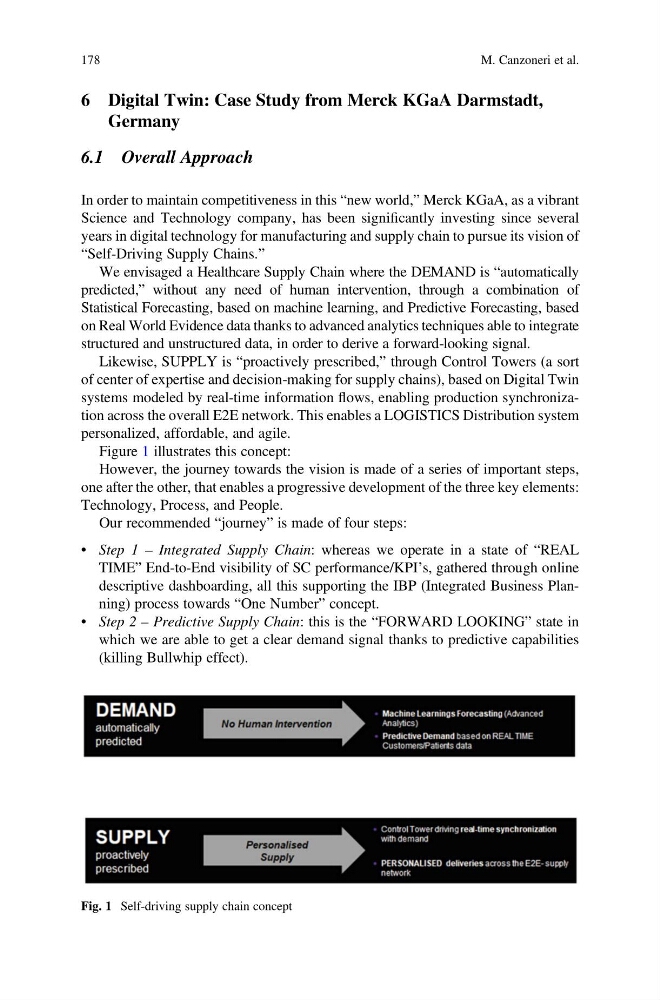
We envisaged a Healthcare Supply Chain where the DEMAND is “automatically
predicted,” without any need of human intervention, through a combination of
Statistical Forecasting, based on machine learning, and Predictive Forecasting, based
on Real World Evidence data thanks to advanced analytics techniques able to integrate
structured and unstructured data, in order to derive a forward-looking signal.
Likewise, SUPPLY is “proactively prescribed,” through Control Towers (a sort
of center of expertise and decision-making for supply chains), based on Digital Twin
systems modeled by real-time information flows, enabling production synchronization across the overall E2E network. This enables a LOGISTICS Distribution system
personalized, affordable, and agile.
Figure 1 illustrates this concept:
However, the journey towards the vision is made of a series of important steps,
one after the other, that enables a progressive development of the three key elements:
Technology, Process, and People.
Our recommended “journey” is made of four steps:
• Step 1 – Integrated Supply Chain: whereas we operate in a state of “REAL
TIME” End-to-End visibility of SC performance/KPI’s, gathered through online
descriptive dashboarding, all this supporting the IBP (Integrated Business Planning) process towards “One Number” concept.
• Step 2 – Predictive Supply Chain: this is the “FORWARD LOOKING” state in
which we are able to get a clear demand signal thanks to predictive capabilities
(killing Bullwhip effect).
Fig. 1 Self-driving supply chain concept
178
M. Canzoneri et al.
Germany
6.1 Overall Approach
In order to maintain competitiveness in this “new world,” Merck KGaA, as a vibrant
Science and Technology company, has been significantly investing since several
years in digital technology for manufacturing and supply chain to pursue its vision of
“Self-Driving Supply Chains.”
We envisaged a Healthcare Supply Chain where the DEMAND is “automatically
predicted,” without any need of human intervention, through a combination of
Statistical Forecasting, based on machine learning, and Predictive Forecasting, based
on Real World Evidence data thanks to advanced analytics techniques able to integrate
structured and unstructured data, in order to derive a forward-looking signal.
Likewise, SUPPLY is “proactively prescribed,” through Control Towers (a sort
of center of expertise and decision-making for supply chains), based on Digital Twin
systems modeled by real-time information flows, enabling production synchronization across the overall E2E network. This enables a LOGISTICS Distribution system
personalized, affordable, and agile.
Figure 1 illustrates this concept:
However, the journey towards the vision is made of a series of important steps,
one after the other, that enables a progressive development of the three key elements:
Technology, Process, and People.
Our recommended “journey” is made of four steps:
• Step 1 – Integrated Supply Chain: whereas we operate in a state of “REAL
TIME” End-to-End visibility of SC performance/KPI’s, gathered through online
descriptive dashboarding, all this supporting the IBP (Integrated Business Planning) process towards “One Number” concept.
• Step 2 – Predictive Supply Chain: this is the “FORWARD LOOKING” state in
which we are able to get a clear demand signal thanks to predictive capabilities
(killing Bullwhip effect).
Fig. 1 Self-driving supply chain concept
178
M. Canzoneri et al.