

Furthermore, the communication structure is critical for extensive networking
within the company, enabling real-time data traffic between the DT and its counterparts (physical assets). A DTMS requires bidirectional communication. This interrelation can be implemented through a wired or wireless network and radio standards
such as 5G. Notably, the 5G standard is widening possibilities in creating local area
data networks to use mobile and rapid information exchange inside plants using
smart mobile devices [13]. A well-established network is essential for the DT to
share real-time data with physical assets such as control modules, sensors, machines,
and human–machine interfaces (HMI).
Data communication must follow common language, universal communication,
and standardized structure. The existing industrial communication protocols commonly used for process monitoring and control can be used for data communication.
In practice, owing to the numerous companies acting worldwide, more than one
format or communication protocol is commonly used in one production plant. Here,
converters may translate the data into a dominating protocol.
HMIs are the link between the human operator and the DT. They integrate human
intelligence and skills to improve efficiency [14]. By defining particular transfer
points in the physical systems, HMIs can be implemented into the DT, which adds
less automated or even offline modules to the system. Every manual input affects the
system’s consistency and should, therefore, be avoided.
The granularity of the DT can be determined within the network structure and
connectivity of the physical assets. A simple DT is limited to a particular physical
asset such as a product, administration task, single machine, or equipment. Increasing the granularity of the DT increases the number of linked physical assets.
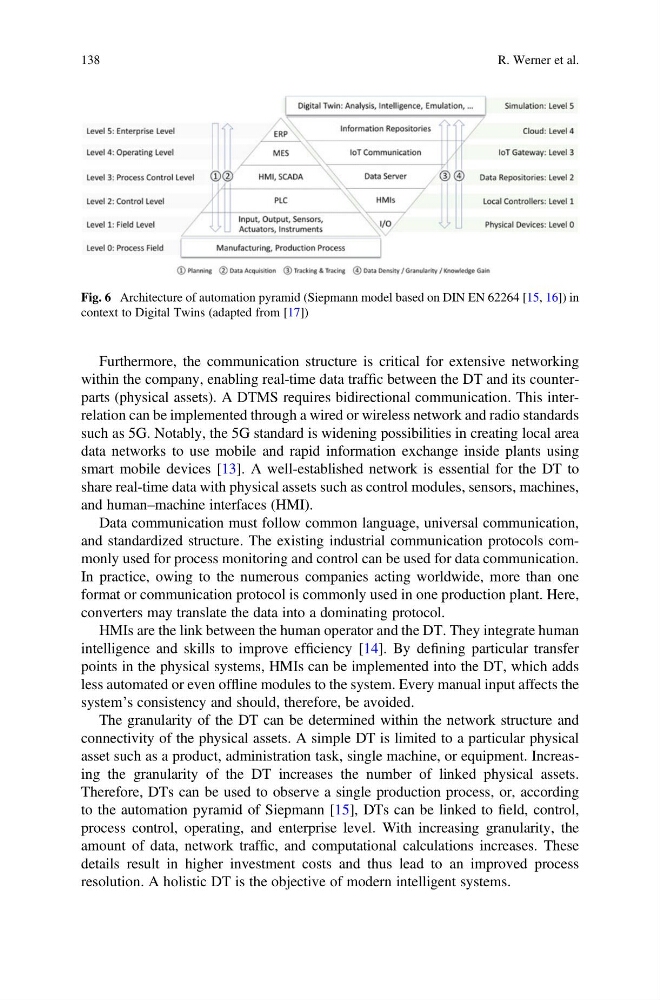
Therefore, DTs can be used to observe a single production process, or, according
to the automation pyramid of Siepmann [15], DTs can be linked to field, control,
process control, operating, and enterprise level. With increasing granularity, the
amount of data, network traffic, and computational calculations increases. These
details result in higher investment costs and thus lead to an improved process
resolution. A holistic DT is the objective of modern intelligent systems.
Fig. 6 Architecture of automation pyramid (Siepmann model based on DIN EN 62264 [15, 16]) in
context to Digital Twins (adapted from [17])
138
R. Werner et al.
within the company, enabling real-time data traffic between the DT and its counterparts (physical assets). A DTMS requires bidirectional communication. This interrelation can be implemented through a wired or wireless network and radio standards
such as 5G. Notably, the 5G standard is widening possibilities in creating local area
data networks to use mobile and rapid information exchange inside plants using
smart mobile devices [13]. A well-established network is essential for the DT to
share real-time data with physical assets such as control modules, sensors, machines,
and human–machine interfaces (HMI).
Data communication must follow common language, universal communication,
and standardized structure. The existing industrial communication protocols commonly used for process monitoring and control can be used for data communication.
In practice, owing to the numerous companies acting worldwide, more than one
format or communication protocol is commonly used in one production plant. Here,
converters may translate the data into a dominating protocol.
HMIs are the link between the human operator and the DT. They integrate human
intelligence and skills to improve efficiency [14]. By defining particular transfer
points in the physical systems, HMIs can be implemented into the DT, which adds
less automated or even offline modules to the system. Every manual input affects the
system’s consistency and should, therefore, be avoided.
The granularity of the DT can be determined within the network structure and
connectivity of the physical assets. A simple DT is limited to a particular physical
asset such as a product, administration task, single machine, or equipment. Increasing the granularity of the DT increases the number of linked physical assets.
Therefore, DTs can be used to observe a single production process, or, according
to the automation pyramid of Siepmann [15], DTs can be linked to field, control,
process control, operating, and enterprise level. With increasing granularity, the
amount of data, network traffic, and computational calculations increases. These
details result in higher investment costs and thus lead to an improved process
resolution. A holistic DT is the objective of modern intelligent systems.
Fig. 6 Architecture of automation pyramid (Siepmann model based on DIN EN 62264 [15, 16]) in
context to Digital Twins (adapted from [17])
138
R. Werner et al.