

In biotechnology, scale-down is eminent to assure the generation of relevant-toprocess knowledge in lab scale. As discussed further below, the variation to the
cellular response caused by the bioreactor stresses cannot be predicted without
extensive experimental information under proper conditions. That is, the experiments at lab scale must create the proper environment, to emulate industrial conditions which are unfortunately difficult to predict beforehand due to the highly
complex interaction between the organism(s) and the bioreactor. Scale-up is the art
of extracting knowledge from experimental data to translate it into an efficient
manufacturing strategy. This process is as challenging as scale-down for the same
reasons: insufficient data on the underlying dynamics of the bioprocess and the lack
of a proper mathematical translation of the information throughout scales. In both
cases (scale-up and scale-down), purely data-driven methods fail to understand the
complex interactions between the organism(s) and the distinct bioreactor environment, generating unrealistic predictions for the next scales and corroborating the
risks of extrapolating black-box models [34, 35]. On the other side, highly complex
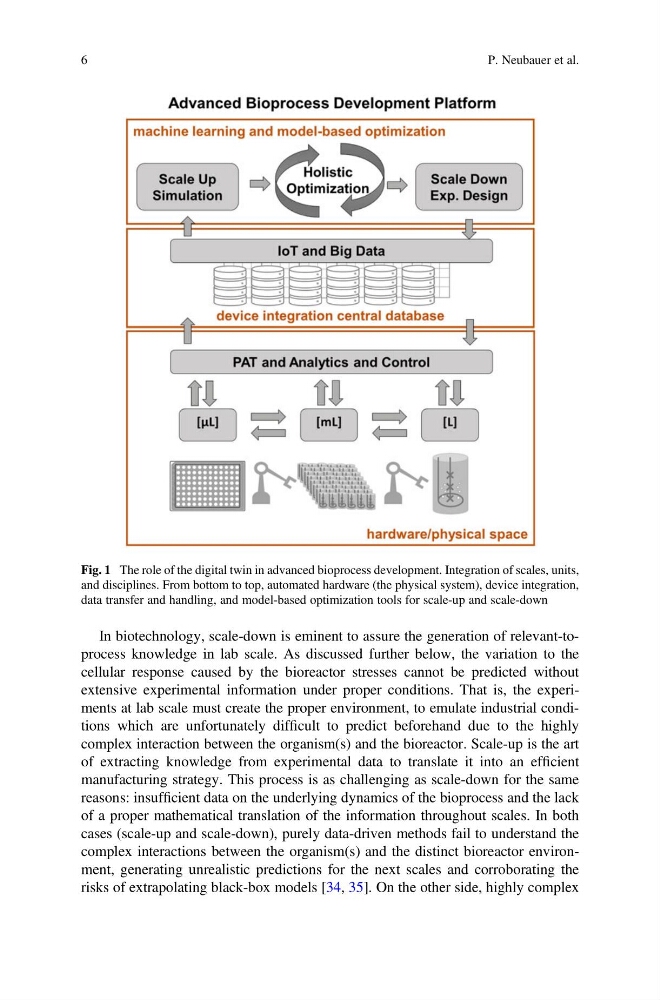
Fig. 1 The role of the digital twin in advanced bioprocess development. Integration of scales, units,
and disciplines. From bottom to top, automated hardware (the physical system), device integration,
data transfer and handling, and model-based optimization tools for scale-up and scale-down
6
P. Neubauer et al.
cellular response caused by the bioreactor stresses cannot be predicted without
extensive experimental information under proper conditions. That is, the experiments at lab scale must create the proper environment, to emulate industrial conditions which are unfortunately difficult to predict beforehand due to the highly
complex interaction between the organism(s) and the bioreactor. Scale-up is the art
of extracting knowledge from experimental data to translate it into an efficient
manufacturing strategy. This process is as challenging as scale-down for the same
reasons: insufficient data on the underlying dynamics of the bioprocess and the lack
of a proper mathematical translation of the information throughout scales. In both
cases (scale-up and scale-down), purely data-driven methods fail to understand the
complex interactions between the organism(s) and the distinct bioreactor environment, generating unrealistic predictions for the next scales and corroborating the
risks of extrapolating black-box models [34, 35]. On the other side, highly complex
Fig. 1 The role of the digital twin in advanced bioprocess development. Integration of scales, units,
and disciplines. From bottom to top, automated hardware (the physical system), device integration,
data transfer and handling, and model-based optimization tools for scale-up and scale-down
6
P. Neubauer et al.