

8 Summary and Outlook . . . . . . . . . . . . . . . . . . . . . . . . . . . . . . . . . . . . . . . . . . . . . . . . . . . . . . . . . . . . . . . . . . . . . . 160
References . . . . . . . . . . . . . . . . . . . . . . . . . . . . . . . . . . . . . . . . . . . . . . . . . . . . . . . . . . . . . . . . . . . . . . . . . . . . . . . . . . . . . . . 162
Abstract The concept of digital twins has become increasingly popular in recent
years. To exploit their full potential, integration of systems and data across entire
value chains is required. Implementing digital twins to newly built plants or production lines is challenging and even more complicated for currently operating
production processes or factories. This chapter reviews and discusses strategies
and tools to successfully implement digital twins into operating value chains in
bioprocess and related industries. Furthermore, the implementation is exemplified
with three recent case studies.
Graphical Abstract
Keywords Digital twin management systems, Ecosystems, Operating value chains,
Standardization
1 Introduction
Industry 4.0 (I4.0), the new industrial revolution, refers to the emerging trends of
digitization concepts for industries such as bioprocesses, food production, and
operation value chains. Initiated by the German government, I4.0 comprises concepts and respective initiatives for digitalization and conception of modern goods
manufacturing [1]. I4.0 includes various approaches to the digitization of new as
well as the existing production processes. One central concept is the Digital Twin,
128
R. Werner et al.
References . . . . . . . . . . . . . . . . . . . . . . . . . . . . . . . . . . . . . . . . . . . . . . . . . . . . . . . . . . . . . . . . . . . . . . . . . . . . . . . . . . . . . . . 162
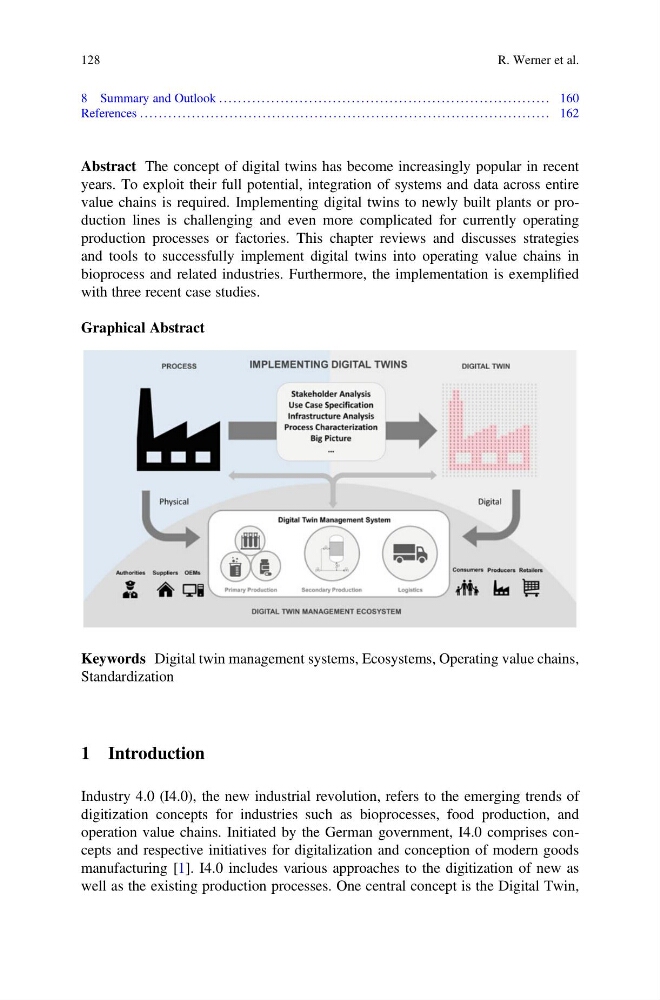
Abstract The concept of digital twins has become increasingly popular in recent
years. To exploit their full potential, integration of systems and data across entire
value chains is required. Implementing digital twins to newly built plants or production lines is challenging and even more complicated for currently operating
production processes or factories. This chapter reviews and discusses strategies
and tools to successfully implement digital twins into operating value chains in
bioprocess and related industries. Furthermore, the implementation is exemplified
with three recent case studies.
Graphical Abstract
Keywords Digital twin management systems, Ecosystems, Operating value chains,
Standardization
1 Introduction
Industry 4.0 (I4.0), the new industrial revolution, refers to the emerging trends of
digitization concepts for industries such as bioprocesses, food production, and
operation value chains. Initiated by the German government, I4.0 comprises concepts and respective initiatives for digitalization and conception of modern goods
manufacturing [1]. I4.0 includes various approaches to the digitization of new as
well as the existing production processes. One central concept is the Digital Twin,
128
R. Werner et al.