

of antibody concentration by combining information coming from kinetic model and
a Raman analyser, in the frame of an extended Kalman filter approach (EKF).
3.5 Measurement Device
An overview of measurement devices that are appropriate for the operation of
bioprocesses is presented by Sonnleitner [61]. More specific details of different
types of sensors and their measurement principles can be found in literature
[62, 63]. The literature presented indicate that in E. coli cultivation, most authors
have employed DO and CO 2 measurements from the exit gas or glucose measurements using flow injection analysis as the measurement in the Kalman filter algorithm. On the other hand, in S. cerevisiae cultivations, besides DO, CO 2 and glucose
measurements, biomass measurements have also been widely applied. For example,
Dewasme et al. [48] applied biomass measurements for their KF during an E. coli
cultivation.
3.6 Process Model
According to the articles presented, the general mass balance equations are the most
common mathematical approach used for describing the process in state observing
algorithms. An overview of typical models applied to bioprocesses is presented by
Chhatre [64]. A wide variety of growth kinetics are developed for modelling of
particular bioprocesses. The Monod growth model [65] is the most applied method
for calculating the growth kinetics of microorganisms; it corresponds to a rational
function in which the specific growth rate μ is only a function of a single limiting
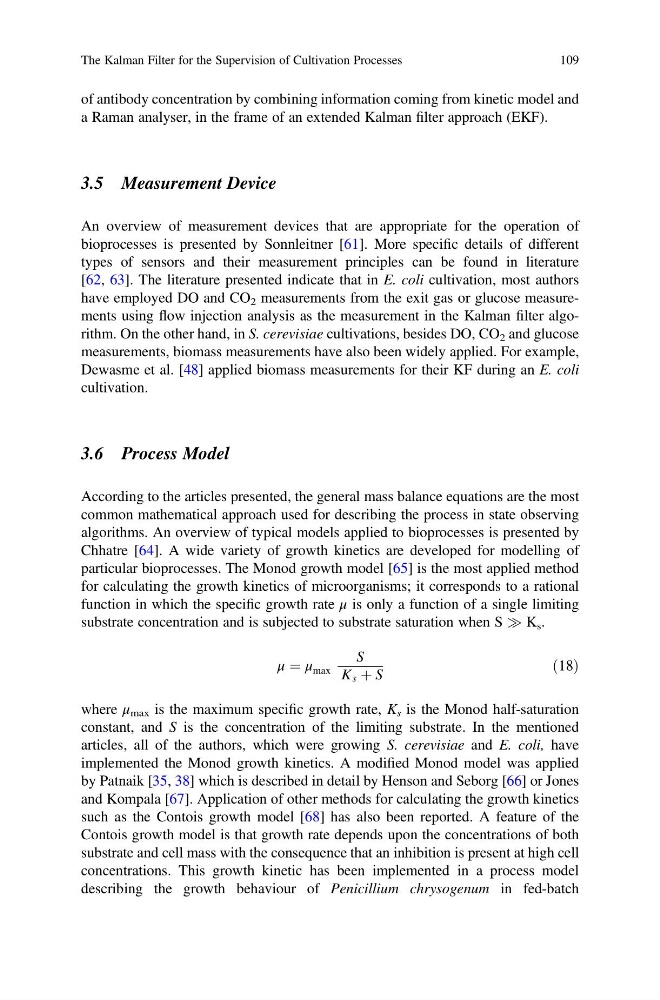
substrate concentration and is subjected to substrate saturation when S ) K s .
μ ¼ μ max
S
K s þ S
ð18Þ
where μ max is the maximum specific growth rate, K s is the Monod half-saturation
constant, and S is the concentration of the limiting substrate. In the mentioned
articles, all of the authors, which were growing S. cerevisiae and E. coli, have
implemented the Monod growth kinetics. A modified Monod model was applied
by Patnaik [35, 38] which is described in detail by Henson and Seborg [66] or Jones
and Kompala [67]. Application of other methods for calculating the growth kinetics
such as the Contois growth model [68] has also been reported. A feature of the
Contois growth model is that growth rate depends upon the concentrations of both
substrate and cell mass with the consequence that an inhibition is present at high cell
concentrations. This growth kinetic has been implemented in a process model
describing the growth behaviour of Penicillium chrysogenum in fed-batch
The Kalman Filter for the Supervision of Cultivation Processes
109
a Raman analyser, in the frame of an extended Kalman filter approach (EKF).
3.5 Measurement Device
An overview of measurement devices that are appropriate for the operation of
bioprocesses is presented by Sonnleitner [61]. More specific details of different
types of sensors and their measurement principles can be found in literature
[62, 63]. The literature presented indicate that in E. coli cultivation, most authors
have employed DO and CO 2 measurements from the exit gas or glucose measurements using flow injection analysis as the measurement in the Kalman filter algorithm. On the other hand, in S. cerevisiae cultivations, besides DO, CO 2 and glucose
measurements, biomass measurements have also been widely applied. For example,
Dewasme et al. [48] applied biomass measurements for their KF during an E. coli
cultivation.
3.6 Process Model
According to the articles presented, the general mass balance equations are the most
common mathematical approach used for describing the process in state observing
algorithms. An overview of typical models applied to bioprocesses is presented by
Chhatre [64]. A wide variety of growth kinetics are developed for modelling of
particular bioprocesses. The Monod growth model [65] is the most applied method
for calculating the growth kinetics of microorganisms; it corresponds to a rational
function in which the specific growth rate μ is only a function of a single limiting
substrate concentration and is subjected to substrate saturation when S ) K s .
μ ¼ μ max
S
K s þ S
ð18Þ
where μ max is the maximum specific growth rate, K s is the Monod half-saturation
constant, and S is the concentration of the limiting substrate. In the mentioned
articles, all of the authors, which were growing S. cerevisiae and E. coli, have
implemented the Monod growth kinetics. A modified Monod model was applied
by Patnaik [35, 38] which is described in detail by Henson and Seborg [66] or Jones
and Kompala [67]. Application of other methods for calculating the growth kinetics
such as the Contois growth model [68] has also been reported. A feature of the
Contois growth model is that growth rate depends upon the concentrations of both
substrate and cell mass with the consequence that an inhibition is present at high cell
concentrations. This growth kinetic has been implemented in a process model
describing the growth behaviour of Penicillium chrysogenum in fed-batch
The Kalman Filter for the Supervision of Cultivation Processes
109