

algorithm are examined. More detailed description of each category for all publications is presented in the following part of this section.
3.1 Type of Kalman Filter
According to the type of Kalman filter algorithm, the literature presented indicates
there exist a considerable number of articles on implementation of EKF for state and
parameter estimation. More than 60% of the applications (28 articles) have
implemented EKF algorithms for their process. This is due to the fact that the
cultivation process of microorganisms is a complex non-linear biochemical process
and the EKF is a well-known state estimation method for non-linear systems. The
linear Kalman filter which is almost exclusively used for state estimation in linear
systems have also been used by some authors (3 articles). Although the EKF shows
good prediction results and is widely used in literature, it presents some disadvantages. It is reliable for systems which are almost linear on the time scale of the update
intervals; it requires the calculation of Jacobians at each time step, which may be
difficult to obtain for higher order systems; it does linear approximations of the
system at a given time instant, which may introduce errors in the estimation, leading
then the state to diverge over time [9, 15]. For instance, in continuous or fed-batch
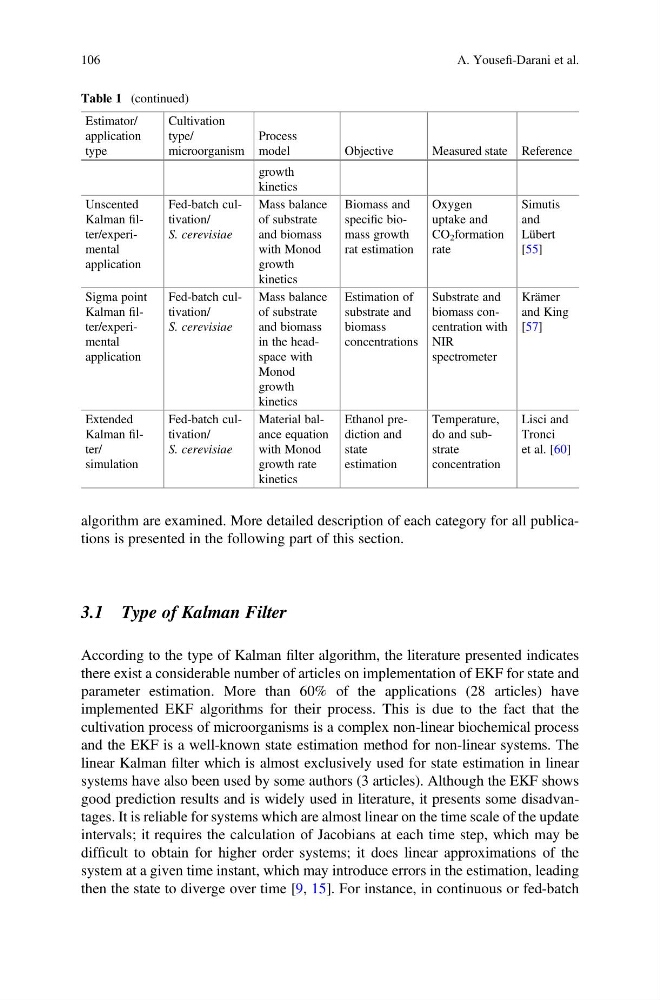
Table 1 (continued)
Estimator/
application
type
Cultivation
type/
microorganism
Process
model
Objective
Measured state Reference
growth
kinetics
Unscented
ter/experimental
application
Fed-batch cultivation/
S. cerevisiae
Mass balance
of substrate
and biomass
with Monod
growth
kinetics
Biomass and
specific biomass growth
rat estimation
Oxygen
uptake and
CO 2 formation
rate
Simutis
and
Lübert
[55]
Sigma point
ter/experimental
application
Fed-batch cultivation/
S. cerevisiae
Mass balance
of substrate
and biomass
in the headspace with
Monod
growth
kinetics
Estimation of
substrate and
biomass
concentrations
Substrate and
biomass concentration with
NIR
spectrometer
Krämer
and King
[57]
Extended
Kalman filter/
simulation
Fed-batch cultivation/
S. cerevisiae
Material balance equation
with Monod
growth rate
kinetics
Ethanol prediction and
state
estimation
Temperature,
do and substrate
concentration
Lisci and
Tronci
et al. [60]
106
A. Yousefi-Darani et al.
3.1 Type of Kalman Filter
According to the type of Kalman filter algorithm, the literature presented indicates
there exist a considerable number of articles on implementation of EKF for state and
parameter estimation. More than 60% of the applications (28 articles) have
implemented EKF algorithms for their process. This is due to the fact that the
cultivation process of microorganisms is a complex non-linear biochemical process
and the EKF is a well-known state estimation method for non-linear systems. The
linear Kalman filter which is almost exclusively used for state estimation in linear
systems have also been used by some authors (3 articles). Although the EKF shows
good prediction results and is widely used in literature, it presents some disadvantages. It is reliable for systems which are almost linear on the time scale of the update
intervals; it requires the calculation of Jacobians at each time step, which may be
difficult to obtain for higher order systems; it does linear approximations of the
system at a given time instant, which may introduce errors in the estimation, leading
then the state to diverge over time [9, 15]. For instance, in continuous or fed-batch
Table 1 (continued)
Estimator/
application
type
Cultivation
type/
microorganism
Process
model
Objective
Measured state Reference
growth
kinetics
Unscented
ter/experimental
application
Fed-batch cultivation/
S. cerevisiae
Mass balance
of substrate
and biomass
with Monod
growth
kinetics
Biomass and
specific biomass growth
rat estimation
Oxygen
uptake and
CO 2 formation
rate
Simutis
and
Lübert
[55]
Sigma point
ter/experimental
application
Fed-batch cultivation/
S. cerevisiae
Mass balance
of substrate
and biomass
in the headspace with
Monod
growth
kinetics
Estimation of
substrate and
biomass
concentrations
Substrate and
biomass concentration with
NIR
spectrometer
Krämer
and King
[57]
Extended
Kalman filter/
simulation
Fed-batch cultivation/
S. cerevisiae
Material balance equation
with Monod
growth rate
kinetics
Ethanol prediction and
state
estimation
Temperature,
do and substrate
concentration
Lisci and
Tronci
et al. [60]
106
A. Yousefi-Darani et al.