

application of dynamic models, in combination with computational fluid dynamics
to quantitatively describe cell behavior. These models allow the description of
possible cellular lifelines which in turn can be used to derive a regime analysis for
scale-down experiments. However, the approaches described so far, which were for
a very few process examples, are very labor- and time-intensive and cannot be
validated easily. In parallel, alternatives have been developed based on the description of the industrial process with hybrid process models, which describe a process
mechanistically as far as possible in order to determine the essential process parameters with their respective variances. On-line analytical methods allow the characterization of population heterogeneity directly in the process. This detailed
information from the industrial process can be used in laboratory screening systems
to select relevant conditions in which the cell and process related parameters reflect
the situation in the industrial scale. In our opinion, these technologies, which are
available in research for modeling biological systems, in combination with process
analytical techniques are so far developed that they can be implemented in industrial
routines for faster development of new processes and optimization of existing ones.
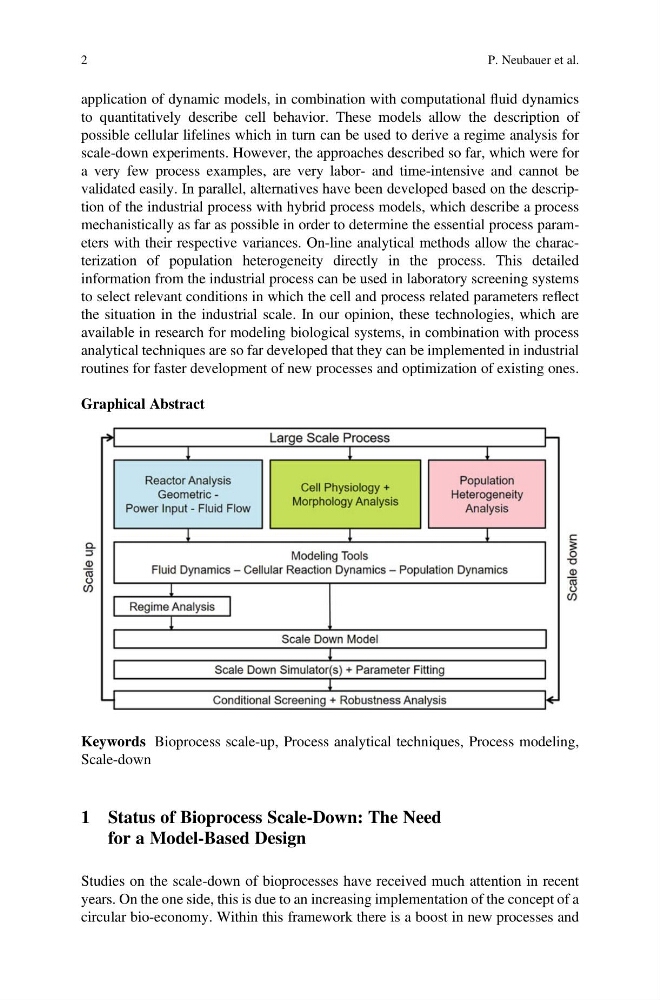
Graphical Abstract
Keywords Bioprocess scale-up, Process analytical techniques, Process modeling,
Scale-down
1 Status of Bioprocess Scale-Down: The Need
for a Model-Based Design
Studies on the scale-down of bioprocesses have received much attention in recent
years. On the one side, this is due to an increasing implementation of the concept of a
circular bio-economy. Within this framework there is a boost in new processes and
2
P. Neubauer et al.
to quantitatively describe cell behavior. These models allow the description of
possible cellular lifelines which in turn can be used to derive a regime analysis for
scale-down experiments. However, the approaches described so far, which were for
a very few process examples, are very labor- and time-intensive and cannot be
validated easily. In parallel, alternatives have been developed based on the description of the industrial process with hybrid process models, which describe a process
mechanistically as far as possible in order to determine the essential process parameters with their respective variances. On-line analytical methods allow the characterization of population heterogeneity directly in the process. This detailed
information from the industrial process can be used in laboratory screening systems
to select relevant conditions in which the cell and process related parameters reflect
the situation in the industrial scale. In our opinion, these technologies, which are
available in research for modeling biological systems, in combination with process
analytical techniques are so far developed that they can be implemented in industrial
routines for faster development of new processes and optimization of existing ones.
Graphical Abstract
Keywords Bioprocess scale-up, Process analytical techniques, Process modeling,
Scale-down
1 Status of Bioprocess Scale-Down: The Need
for a Model-Based Design
Studies on the scale-down of bioprocesses have received much attention in recent
years. On the one side, this is due to an increasing implementation of the concept of a
circular bio-economy. Within this framework there is a boost in new processes and
2
P. Neubauer et al.