

4.4 Gravitational Radiation
85
so that −σ α − i ω α acts as a complex 3-potential for the complex 2-form F. This
example is particularly interesting when extended below to the case of gravitational
waves in the linear approximation.
4.4
Gravitational Radiation
With points of Minkowskian space-time labelled by rectangular Cartesian coordinates x, y, z and time t, the t-lines are the integral curves of the unit time-like vector
field u i = δ i
0 with η ij u i u j = u j u j = +1. These curves are time-like geodesics
with vanishing expansion, twist and shear. In a vacuum space-time chosen to be a
small perturbation of Minkowskian space-time due to the presence of gravitational
radiation, the perturbed t-lines acquire shear, described by the shear tensor σ ij which
is small of first order, but otherwise the perturbed t-lines are geodesic, expansionfree and twist-free. Since σ ij u j = 0 and η ij σ ij = 0 we have σ 0i = 0 and
σ αβ = σ βα = 0 with σ αα = 0. The electric and magnetic parts of the perturbed Weyl
tensor, E ij and H ij respectively, both small of first order, satisfy E 0i = 0 = H 0i
and E αβ = E βα = 0, H αβ = H βα = 0 with E αα = 0 = H αα . The vacuum Ricci
identities and Bianchi identities in first approximation provide us with the partial
differential equations to be satisfied by σ αβ , E αβ and H αβ (see Appendix B):
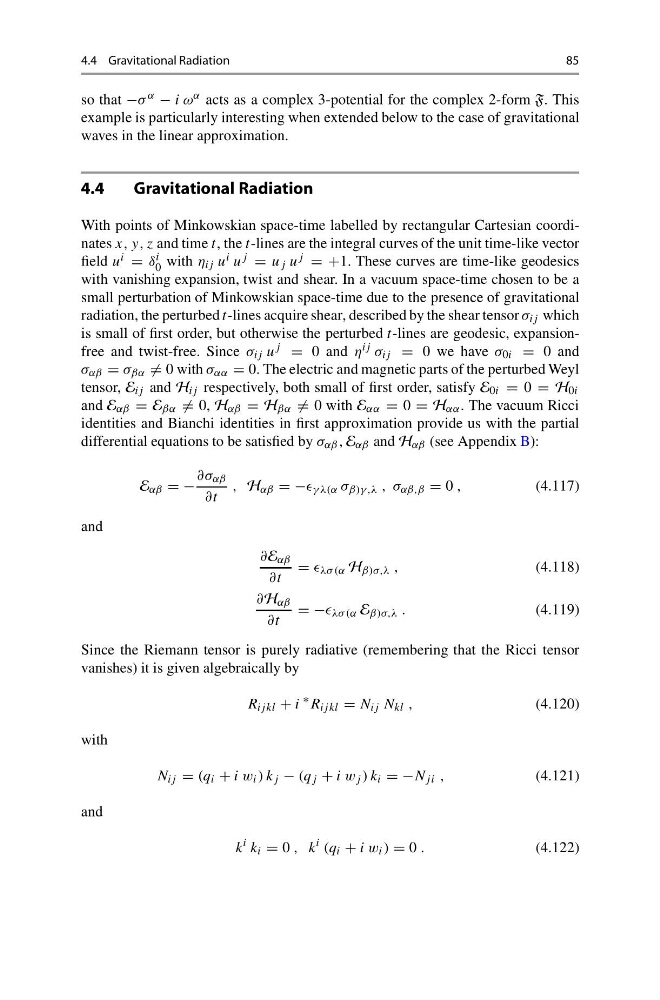
E αβ = −
∂σ αβ
∂t
, H αβ = − γ λ(α σ β)γ ,λ , σ αβ,β = 0 ,
(4.117)
and
∂E αβ
∂t
= λσ (α H β)σ,λ ,
(4.118)
∂H αβ
∂t
= − λσ (α E β)σ,λ .
(4.119)
Since the Riemann tensor is purely radiative (remembering that the Ricci tensor
vanishes) it is given algebraically by
R ij kl + i
∗ R ij kl = N ij N kl ,
(4.120)
with
N ij = (q i + i w i ) k j − (q j + i w j ) k i = −N ji ,
(4.121)
and
k
i k i = 0 , k
i (q i + i w i ) = 0 .
(4.122)
85
so that −σ α − i ω α acts as a complex 3-potential for the complex 2-form F. This
example is particularly interesting when extended below to the case of gravitational
waves in the linear approximation.
4.4
Gravitational Radiation
With points of Minkowskian space-time labelled by rectangular Cartesian coordinates x, y, z and time t, the t-lines are the integral curves of the unit time-like vector
field u i = δ i
0 with η ij u i u j = u j u j = +1. These curves are time-like geodesics
with vanishing expansion, twist and shear. In a vacuum space-time chosen to be a
small perturbation of Minkowskian space-time due to the presence of gravitational
radiation, the perturbed t-lines acquire shear, described by the shear tensor σ ij which
is small of first order, but otherwise the perturbed t-lines are geodesic, expansionfree and twist-free. Since σ ij u j = 0 and η ij σ ij = 0 we have σ 0i = 0 and
σ αβ = σ βα = 0 with σ αα = 0. The electric and magnetic parts of the perturbed Weyl
tensor, E ij and H ij respectively, both small of first order, satisfy E 0i = 0 = H 0i
and E αβ = E βα = 0, H αβ = H βα = 0 with E αα = 0 = H αα . The vacuum Ricci
identities and Bianchi identities in first approximation provide us with the partial
differential equations to be satisfied by σ αβ , E αβ and H αβ (see Appendix B):
E αβ = −
∂σ αβ
∂t
, H αβ = − γ λ(α σ β)γ ,λ , σ αβ,β = 0 ,
(4.117)
and
∂E αβ
∂t
= λσ (α H β)σ,λ ,
(4.118)
∂H αβ
∂t
= − λσ (α E β)σ,λ .
(4.119)
Since the Riemann tensor is purely radiative (remembering that the Ricci tensor
vanishes) it is given algebraically by
R ij kl + i
∗ R ij kl = N ij N kl ,
(4.120)
with
N ij = (q i + i w i ) k j − (q j + i w j ) k i = −N ji ,
(4.121)
and
k
i k i = 0 , k
i (q i + i w i ) = 0 .
(4.122)