

4.3 Some ‘Spherical’ Electromagnetic Waves
83
where A, C are real-valued functions of r − t. In this case the histories of the wave
fronts in Minkowskian space-time are the null cones r − t = constant. These are
the space-time histories of spheres, centred on r = 0, expanding with the speed
of light. It is for this reason that we call these waves spherical waves. However we
shall see that they have a property of having a point on each wave front where the
electromagnetic field is singular and therefore we have referred to the waves in the
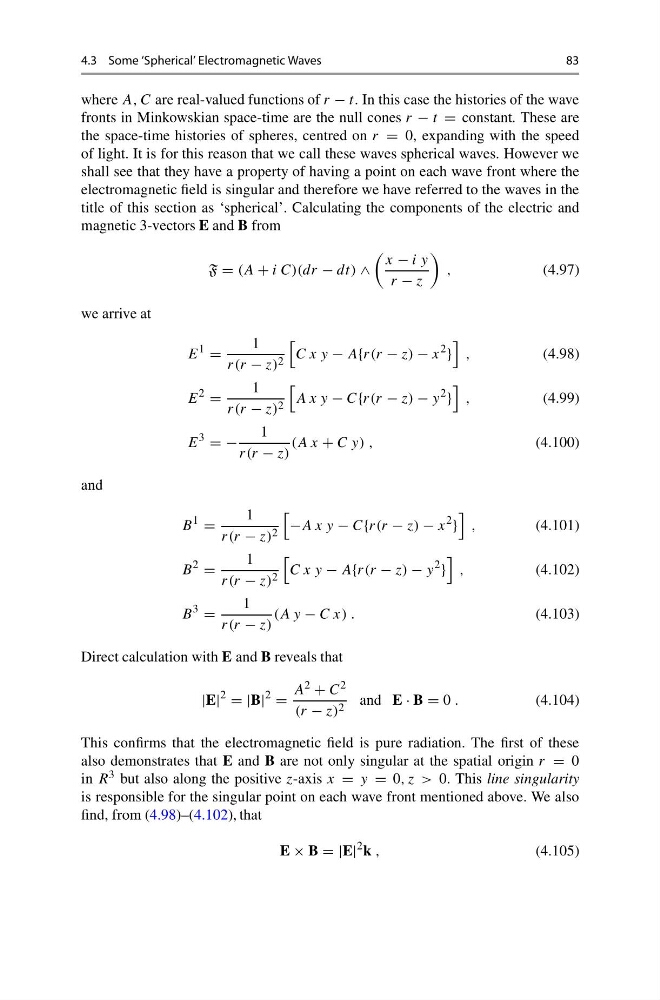
title of this section as ‘spherical’. Calculating the components of the electric and
magnetic 3-vectors E and B from
F = (A + i C)(dr − dt) ∧
x − i y
r − z
,
(4.97)
we arrive at
E
1
=
1
r(r − z) 2
C x y − A{r(r − z) − x
2
}
,
(4.98)
E
2
=
1
r(r − z) 2
A x y − C{r(r − z) − y
2
}
,
(4.99)
E
3
= −
1
r(r − z)
(A x + C y) ,
(4.100)
and
B
1
=
1
r(r − z) 2
−A x y − C{r(r − z) − x
2
}
,
(4.101)
B
2
=
1
r(r − z) 2
C x y − A{r(r − z) − y
2
}
,
(4.102)
B
3
=
1
r(r − z)
(A y − C x) .
(4.103)
Direct calculation with E and B reveals that
|E|
2
= |B|
2
=
A 2 + C 2
(r − z) 2 and E · B = 0 .
(4.104)
This confirms that the electromagnetic field is pure radiation. The first of these
also demonstrates that E and B are not only singular at the spatial origin r = 0
in R 3 but also along the positive z-axis x = y = 0, z > 0. This line singularity
is responsible for the singular point on each wave front mentioned above. We also
find, from (4.98)–(4.102), that
E × B = |E|
2 k ,
(4.105)
83
where A, C are real-valued functions of r − t. In this case the histories of the wave
fronts in Minkowskian space-time are the null cones r − t = constant. These are
the space-time histories of spheres, centred on r = 0, expanding with the speed
of light. It is for this reason that we call these waves spherical waves. However we
shall see that they have a property of having a point on each wave front where the
electromagnetic field is singular and therefore we have referred to the waves in the
title of this section as ‘spherical’. Calculating the components of the electric and
magnetic 3-vectors E and B from
F = (A + i C)(dr − dt) ∧
x − i y
r − z
,
(4.97)
we arrive at
E
1
=
1
r(r − z) 2
C x y − A{r(r − z) − x
2
}
,
(4.98)
E
2
=
1
r(r − z) 2
A x y − C{r(r − z) − y
2
}
,
(4.99)
E
3
= −
1
r(r − z)
(A x + C y) ,
(4.100)
and
B
1
=
1
r(r − z) 2
−A x y − C{r(r − z) − x
2
}
,
(4.101)
B
2
=
1
r(r − z) 2
C x y − A{r(r − z) − y
2
}
,
(4.102)
B
3
=
1
r(r − z)
(A y − C x) .
(4.103)
Direct calculation with E and B reveals that
|E|
2
= |B|
2
=
A 2 + C 2
(r − z) 2 and E · B = 0 .
(4.104)
This confirms that the electromagnetic field is pure radiation. The first of these
also demonstrates that E and B are not only singular at the spatial origin r = 0
in R 3 but also along the positive z-axis x = y = 0, z > 0. This line singularity
is responsible for the singular point on each wave front mentioned above. We also
find, from (4.98)–(4.102), that
E × B = |E|
2 k ,
(4.105)