

66
3 Hypothetical Objects in Electromagnetism and Gravity
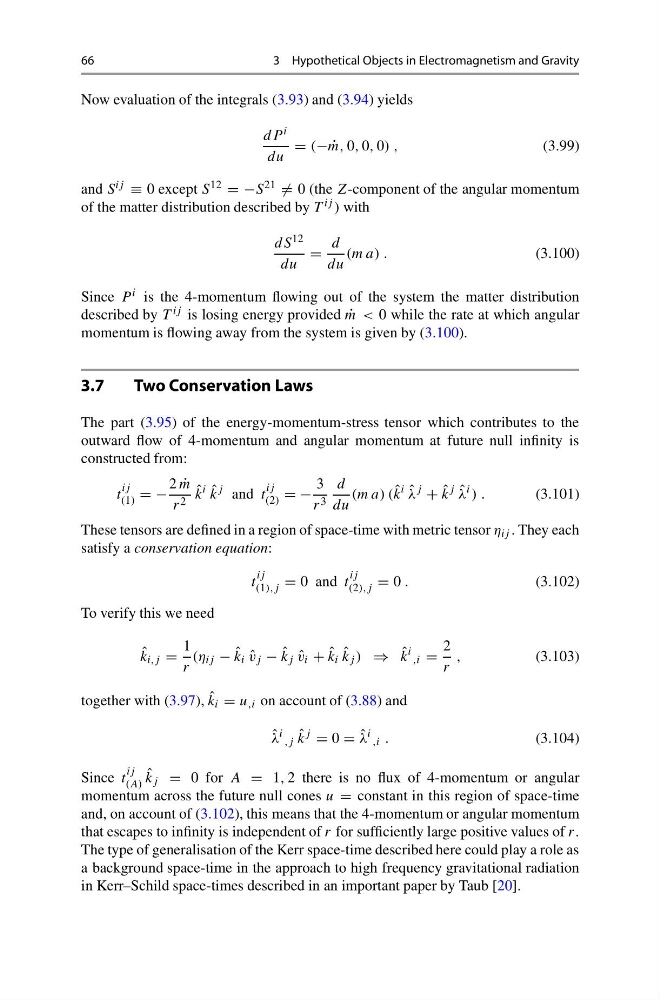
Now evaluation of the integrals (3.93) and (3.94) yields
dP i
du
= (− ˙
m, 0, 0, 0) ,
(3.99)
and S ij ≡ 0 except S 12 = −S 21 = 0 (the Z-component of the angular momentum
of the matter distribution described by T ij ) with
dS 12
du
=
d
du
(m a) .
(3.100)
Since P i is the 4-momentum flowing out of the system the matter distribution
described by T ij is losing energy provided ˙
m < 0 while the rate at which angular
momentum is flowing away from the system is given by (3.100).
3.7
Two Conservation Laws
The part (3.95) of the energy-momentum-stress tensor which contributes to the
outward flow of 4-momentum and angular momentum at future null infinity is
constructed from:
t
ij
(1) = −
2 ˙
m
r 2
ˆ
k
i ˆ
k
j and t
ij
(2) = −
3
r 3
d
du
(m a) ( ˆ
k
i ˆ
λ
j
+ ˆ
k
j ˆ
λ
i ) .
(3.101)
These tensors are defined in a region of space-time with metric tensor η ij . They each
satisfy a conservation equation:
t
ij
(1),j = 0 and t
ij
(2),j = 0 .
(3.102)
To verify this we need
ˆ
k i,j =
1
r
(η ij − ˆ
k i ˆ
v j − ˆ
k j ˆ
v i + ˆ
k i ˆ
k j ) ⇒ ˆ
k
i
,i =
2
r
,
(3.103)
together with (3.97), ˆ
k i = u ,i on account of (3.88) and
ˆ
λ
i
,j ˆ
k
j
= 0 = ˆ
λ
i
,i .
(3.104)
Since t
ij
(A)
ˆ
k j = 0 for A = 1, 2 there is no flux of 4-momentum or angular
momentum across the future null cones u = constant in this region of space-time
and, on account of (3.102), this means that the 4-momentum or angular momentum
that escapes to infinity is independent of r for sufficiently large positive values of r.
The type of generalisation of the Kerr space-time described here could play a role as
a background space-time in the approach to high frequency gravitational radiation
in Kerr–Schild space-times described in an important paper by Taub [20].
3 Hypothetical Objects in Electromagnetism and Gravity
Now evaluation of the integrals (3.93) and (3.94) yields
dP i
du
= (− ˙
m, 0, 0, 0) ,
(3.99)
and S ij ≡ 0 except S 12 = −S 21 = 0 (the Z-component of the angular momentum
of the matter distribution described by T ij ) with
dS 12
du
=
d
du
(m a) .
(3.100)
Since P i is the 4-momentum flowing out of the system the matter distribution
described by T ij is losing energy provided ˙
m < 0 while the rate at which angular
momentum is flowing away from the system is given by (3.100).
3.7
Two Conservation Laws
The part (3.95) of the energy-momentum-stress tensor which contributes to the
outward flow of 4-momentum and angular momentum at future null infinity is
constructed from:
t
ij
(1) = −
2 ˙
m
r 2
ˆ
k
i ˆ
k
j and t
ij
(2) = −
3
r 3
d
du
(m a) ( ˆ
k
i ˆ
λ
j
+ ˆ
k
j ˆ
λ
i ) .
(3.101)
These tensors are defined in a region of space-time with metric tensor η ij . They each
satisfy a conservation equation:
t
ij
(1),j = 0 and t
ij
(2),j = 0 .
(3.102)
To verify this we need
ˆ
k i,j =
1
r
(η ij − ˆ
k i ˆ
v j − ˆ
k j ˆ
v i + ˆ
k i ˆ
k j ) ⇒ ˆ
k
i
,i =
2
r
,
(3.103)
together with (3.97), ˆ
k i = u ,i on account of (3.88) and
ˆ
λ
i
,j ˆ
k
j
= 0 = ˆ
λ
i
,i .
(3.104)
Since t
ij
(A)
ˆ
k j = 0 for A = 1, 2 there is no flux of 4-momentum or angular
momentum across the future null cones u = constant in this region of space-time
and, on account of (3.102), this means that the 4-momentum or angular momentum
that escapes to infinity is independent of r for sufficiently large positive values of r.
The type of generalisation of the Kerr space-time described here could play a role as
a background space-time in the approach to high frequency gravitational radiation
in Kerr–Schild space-times described in an important paper by Taub [20].