

56
3 Hypothetical Objects in Electromagnetism and Gravity
Up to now the parameter u along the world line r = 0 is unspecified. We can
resolve this issue by making the coordinate transformation
¯
ξ = μ ξ , ¯
η = μ η , ¯
r = μ
−1 r , ¯
u = ¯
u(u) ,
(3.32)
with μ = μ(u) given by
μ
−1 dμ
du
=
a 0 − a 3
v 0 − v 3 and
d ¯
u
du
= μ(u) .
(3.33)
It follows from (3.33) that taking
¯
u =
(v
0
− v
3 )du ,
(3.34)
determines ¯
u up to a linear transformation ¯
u → c 1 ¯
u + c 2 with c 1 , c 2 two real
constants. If we let
A
i
= a
i
−
a 0 − a 3
v 0 − v 3
v
i ,
(3.35)
then the cases i = 1 and i = 2 are given in (3.27). If the world line r = 0 is a null
geodesic then, in general, a i = λ(u) v i for some function λ(u) and A i = 0. The
change of parameter u along the world line r = 0 given via (3.33) results in
v
i
= μ ¯
v
i , a
i
= μ
2
¯
a
i
+ μ
a 0 − a 3
v 0 − v 3
¯
v
i ,
(3.36)
where ¯
v i = dw i /d ¯
u and ¯
a i = d ¯
v i /d ¯
u. When this is substituted into (3.35) we
obtain
A
i
= μ
2
¯
a
i ,
(3.37)
and thus we have the result that
a
i
= λ(u) v
i
⇒ ¯
a
i
= 0 .
(3.38)
Hence we see that the parameter ¯
u has the important property that if r = 0 is a
geodesic then ¯
u is an affine parameter along it (cf. [2]).
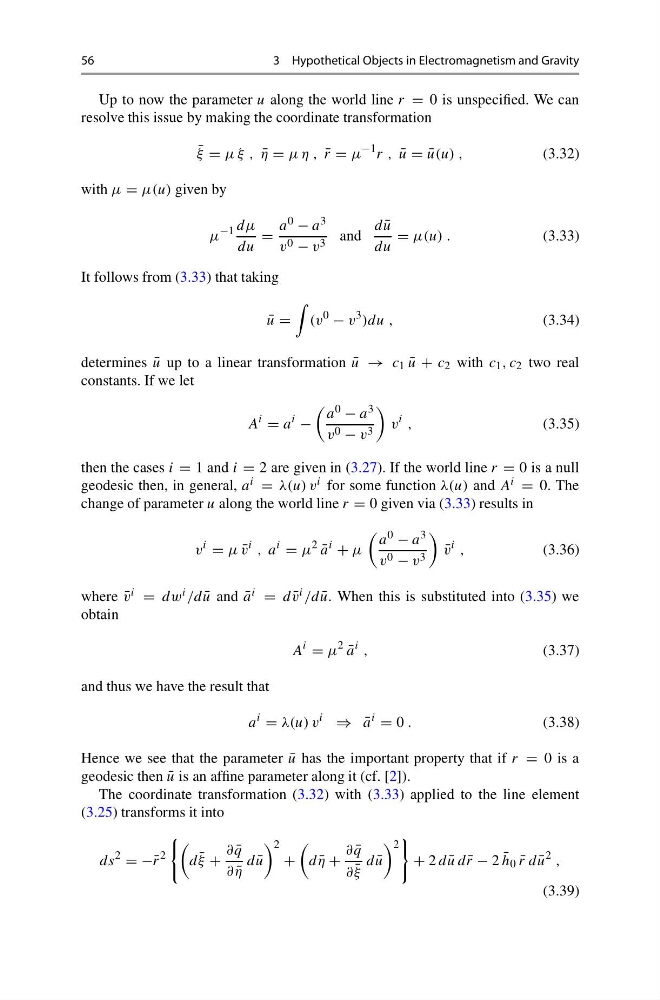
The coordinate transformation (3.32) with (3.33) applied to the line element
(3.25) transforms it into
ds
2
= −¯ r
2
d ¯
ξ +
∂ ¯
q
∂ ¯
η
d ¯
u
2
+
d ¯
η +
∂ ¯
q
∂ ¯
ξ
d ¯
u
2
+ 2 d ¯
u d ¯
r − 2 ¯
h 0 ¯
r d ¯
u
2 ,
(3.39)
3 Hypothetical Objects in Electromagnetism and Gravity
Up to now the parameter u along the world line r = 0 is unspecified. We can
resolve this issue by making the coordinate transformation
¯
ξ = μ ξ , ¯
η = μ η , ¯
r = μ
−1 r , ¯
u = ¯
u(u) ,
(3.32)
with μ = μ(u) given by
μ
−1 dμ
du
=
a 0 − a 3
v 0 − v 3 and
d ¯
u
du
= μ(u) .
(3.33)
It follows from (3.33) that taking
¯
u =
(v
0
− v
3 )du ,
(3.34)
determines ¯
u up to a linear transformation ¯
u → c 1 ¯
u + c 2 with c 1 , c 2 two real
constants. If we let
A
i
= a
i
−
a 0 − a 3
v 0 − v 3
v
i ,
(3.35)
then the cases i = 1 and i = 2 are given in (3.27). If the world line r = 0 is a null
geodesic then, in general, a i = λ(u) v i for some function λ(u) and A i = 0. The
change of parameter u along the world line r = 0 given via (3.33) results in
v
i
= μ ¯
v
i , a
i
= μ
2
¯
a
i
+ μ
a 0 − a 3
v 0 − v 3
¯
v
i ,
(3.36)
where ¯
v i = dw i /d ¯
u and ¯
a i = d ¯
v i /d ¯
u. When this is substituted into (3.35) we
obtain
A
i
= μ
2
¯
a
i ,
(3.37)
and thus we have the result that
a
i
= λ(u) v
i
⇒ ¯
a
i
= 0 .
(3.38)
Hence we see that the parameter ¯
u has the important property that if r = 0 is a
geodesic then ¯
u is an affine parameter along it (cf. [2]).
The coordinate transformation (3.32) with (3.33) applied to the line element
(3.25) transforms it into
ds
2
= −¯ r
2
d ¯
ξ +
∂ ¯
q
∂ ¯
η
d ¯
u
2
+
d ¯
η +
∂ ¯
q
∂ ¯
ξ
d ¯
u
2
+ 2 d ¯
u d ¯
r − 2 ¯
h 0 ¯
r d ¯
u
2 ,
(3.39)