

54
3 Hypothetical Objects in Electromagnetism and Gravity
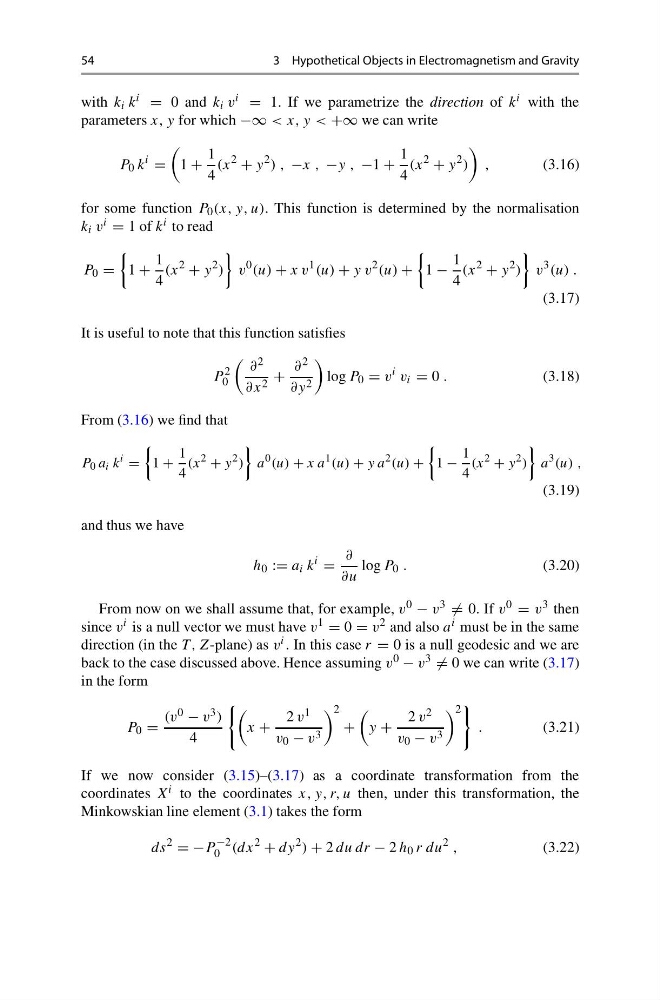
with k i k i = 0 and k i v i = 1. If we parametrize the direction of k i with the
parameters x, y for which −∞ < x, y < +∞ we can write
P 0 k
i
=
1 +
1
4
(x
2
+ y
2 ) , −x , −y , −1 +
1
4
(x
2
+ y
2 )
,
(3.16)
for some function P 0 (x, y, u). This function is determined by the normalisation
k i v i = 1 of k i to read
P 0 =
1 +
1
4
(x
2
+ y
2 )
v
0 (u) + x v
1 (u) + y v
2 (u) +
1 −
1
4
(x
2
+ y
2 )
v
3 (u) .
(3.17)
It is useful to note that this function satisfies
P
2
0
∂ 2
∂x 2 +
∂ 2
∂y 2
log P 0 = v
i v i = 0 .
(3.18)
From (3.16) we find that
P 0 a i k
i
=
1 +
1
4
(x
2
+ y
2 )
a
0 (u) + x a
1 (u) + y a
2 (u) +
1 −
1
4
(x
2
+ y
2 )
a
3 (u) ,
(3.19)
and thus we have
h 0 := a i k
i
=
∂
∂u
log P 0 .
(3.20)
From now on we shall assume that, for example, v 0 − v 3 = 0. If v 0 = v 3 then
since v i is a null vector we must have v 1 = 0 = v 2 and also a i must be in the same
direction (in the T , Z-plane) as v i . In this case r = 0 is a null geodesic and we are
back to the case discussed above. Hence assuming v 0 − v 3 = 0 we can write (3.17)
in the form
P 0 =
(v 0 − v 3 )
4
x +
2 v 1
v 0 − v 3
2
+
y +
2 v 2
v 0 − v 3
2
.
(3.21)
If we now consider (3.15)–(3.17) as a coordinate transformation from the
coordinates X i to the coordinates x, y, r, u then, under this transformation, the
Minkowskian line element (3.1) takes the form
ds
2
= −P
−2
0 (dx
2
+ dy
2 ) + 2 du dr − 2 h 0 r du
2 ,
(3.22)
3 Hypothetical Objects in Electromagnetism and Gravity
with k i k i = 0 and k i v i = 1. If we parametrize the direction of k i with the
parameters x, y for which −∞ < x, y < +∞ we can write
P 0 k
i
=
1 +
1
4
(x
2
+ y
2 ) , −x , −y , −1 +
1
4
(x
2
+ y
2 )
,
(3.16)
for some function P 0 (x, y, u). This function is determined by the normalisation
k i v i = 1 of k i to read
P 0 =
1 +
1
4
(x
2
+ y
2 )
v
0 (u) + x v
1 (u) + y v
2 (u) +
1 −
1
4
(x
2
+ y
2 )
v
3 (u) .
(3.17)
It is useful to note that this function satisfies
P
2
0
∂ 2
∂x 2 +
∂ 2
∂y 2
log P 0 = v
i v i = 0 .
(3.18)
From (3.16) we find that
P 0 a i k
i
=
1 +
1
4
(x
2
+ y
2 )
a
0 (u) + x a
1 (u) + y a
2 (u) +
1 −
1
4
(x
2
+ y
2 )
a
3 (u) ,
(3.19)
and thus we have
h 0 := a i k
i
=
∂
∂u
log P 0 .
(3.20)
From now on we shall assume that, for example, v 0 − v 3 = 0. If v 0 = v 3 then
since v i is a null vector we must have v 1 = 0 = v 2 and also a i must be in the same
direction (in the T , Z-plane) as v i . In this case r = 0 is a null geodesic and we are
back to the case discussed above. Hence assuming v 0 − v 3 = 0 we can write (3.17)
in the form
P 0 =
(v 0 − v 3 )
4
x +
2 v 1
v 0 − v 3
2
+
y +
2 v 2
v 0 − v 3
2
.
(3.21)
If we now consider (3.15)–(3.17) as a coordinate transformation from the
coordinates X i to the coordinates x, y, r, u then, under this transformation, the
Minkowskian line element (3.1) takes the form
ds
2
= −P
−2
0 (dx
2
+ dy
2 ) + 2 du dr − 2 h 0 r du
2 ,
(3.22)