

52
3 Hypothetical Objects in Electromagnetism and Gravity
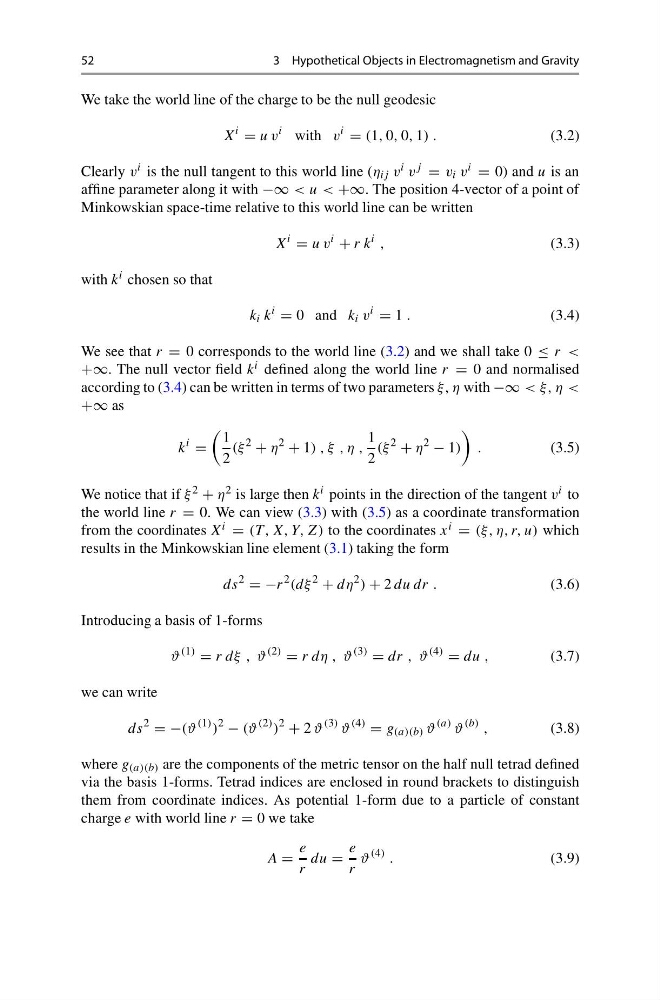
We take the world line of the charge to be the null geodesic
X
i
= u v
i with v
i
= (1, 0, 0, 1) .
(3.2)
Clearly v i is the null tangent to this world line (η ij v i v j = v i v i = 0) and u is an
affine parameter along it with −∞ < u < +∞. The position 4-vector of a point of
Minkowskian space-time relative to this world line can be written
X
i
= u v
i
+ r k
i ,
(3.3)
with k i chosen so that
k i k
i
= 0 and k i v
i
= 1 .
(3.4)
We see that r = 0 corresponds to the world line (3.2) and we shall take 0 ≤ r <
+∞. The null vector field k i defined along the world line r = 0 and normalised
according to (3.4) can be written in terms of two parameters ξ, η with −∞ < ξ, η <
+∞ as
k
i
=
1
2
(ξ
2
+ η
2
+ 1) , ξ , η ,
1
2
(ξ
2
+ η
2
− 1)
.
(3.5)
We notice that if ξ 2 + η 2 is large then k i points in the direction of the tangent v i to
the world line r = 0. We can view (3.3) with (3.5) as a coordinate transformation
from the coordinates X i = (T , X, Y, Z) to the coordinates x i = (ξ, η, r, u) which
results in the Minkowskian line element (3.1) taking the form
ds
2
= −r
2 (dξ
2
+ dη
2 ) + 2 du dr .
(3.6)
Introducing a basis of 1-forms
ϑ
(1)
= r dξ , ϑ
(2)
= r dη , ϑ
(3)
= dr , ϑ
(4)
= du ,
(3.7)
we can write
ds
2
= −(ϑ
(1) )
2
− (ϑ
(2) )
2
+ 2 ϑ
(3) ϑ
(4)
= g (a)(b) ϑ
(a) ϑ
(b) ,
(3.8)
where g (a)(b) are the components of the metric tensor on the half null tetrad defined
via the basis 1-forms. Tetrad indices are enclosed in round brackets to distinguish
them from coordinate indices. As potential 1-form due to a particle of constant
charge e with world line r = 0 we take
A =
e
r
du =
e
r
ϑ
(4) .
(3.9)
3 Hypothetical Objects in Electromagnetism and Gravity
We take the world line of the charge to be the null geodesic
X
i
= u v
i with v
i
= (1, 0, 0, 1) .
(3.2)
Clearly v i is the null tangent to this world line (η ij v i v j = v i v i = 0) and u is an
affine parameter along it with −∞ < u < +∞. The position 4-vector of a point of
Minkowskian space-time relative to this world line can be written
X
i
= u v
i
+ r k
i ,
(3.3)
with k i chosen so that
k i k
i
= 0 and k i v
i
= 1 .
(3.4)
We see that r = 0 corresponds to the world line (3.2) and we shall take 0 ≤ r <
+∞. The null vector field k i defined along the world line r = 0 and normalised
according to (3.4) can be written in terms of two parameters ξ, η with −∞ < ξ, η <
+∞ as
k
i
=
1
2
(ξ
2
+ η
2
+ 1) , ξ , η ,
1
2
(ξ
2
+ η
2
− 1)
.
(3.5)
We notice that if ξ 2 + η 2 is large then k i points in the direction of the tangent v i to
the world line r = 0. We can view (3.3) with (3.5) as a coordinate transformation
from the coordinates X i = (T , X, Y, Z) to the coordinates x i = (ξ, η, r, u) which
results in the Minkowskian line element (3.1) taking the form
ds
2
= −r
2 (dξ
2
+ dη
2 ) + 2 du dr .
(3.6)
Introducing a basis of 1-forms
ϑ
(1)
= r dξ , ϑ
(2)
= r dη , ϑ
(3)
= dr , ϑ
(4)
= du ,
(3.7)
we can write
ds
2
= −(ϑ
(1) )
2
− (ϑ
(2) )
2
+ 2 ϑ
(3) ϑ
(4)
= g (a)(b) ϑ
(a) ϑ
(b) ,
(3.8)
where g (a)(b) are the components of the metric tensor on the half null tetrad defined
via the basis 1-forms. Tetrad indices are enclosed in round brackets to distinguish
them from coordinate indices. As potential 1-form due to a particle of constant
charge e with world line r = 0 we take
A =
e
r
du =
e
r
ϑ
(4) .
(3.9)