

2.5 Passage to Charged Kerr Space-Time
45
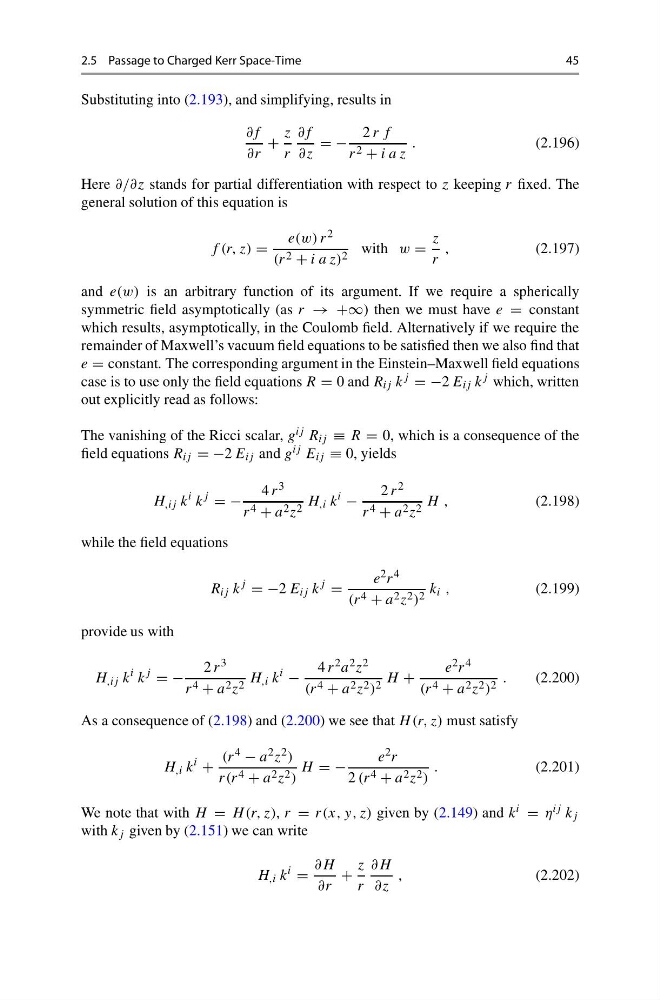
Substituting into (2.193), and simplifying, results in
∂f
∂r
+
z
r
∂f
∂z
= −
2 r f
r 2 + i a z
.
(2.196)
Here ∂/∂z stands for partial differentiation with respect to z keeping r fixed. The
general solution of this equation is
f (r, z) =
e(w) r 2
(r 2 + i a z) 2 with w =
z
r
,
(2.197)
and e(w) is an arbitrary function of its argument. If we require a spherically
symmetric field asymptotically (as r → +∞) then we must have e = constant
which results, asymptotically, in the Coulomb field. Alternatively if we require the
remainder of Maxwell’s vacuum field equations to be satisfied then we also find that
e = constant. The corresponding argument in the Einstein–Maxwell field equations
case is to use only the field equations R = 0 and R ij k j = −2 E ij k j which, written
out explicitly read as follows:
The vanishing of the Ricci scalar, g ij R ij ≡ R = 0, which is a consequence of the
field equations R ij = −2 E ij and g ij E ij ≡ 0, yields
H ,ij k
i k
j
= −
4 r 3
r 4 + a 2 z 2 H ,i k
i
−
2 r 2
r 4 + a 2 z 2 H ,
(2.198)
while the field equations
R ij k
j
= −2 E ij k
j
=
e 2 r 4
(r 4 + a 2 z 2 ) 2 k i ,
(2.199)
provide us with
H ,ij k
i k
j
= −
2 r 3
r 4 + a 2 z 2 H ,i k
i
−
4 r 2 a 2 z 2
(r 4 + a 2 z 2 ) 2 H +
e 2 r 4
(r 4 + a 2 z 2 ) 2 .
(2.200)
As a consequence of (2.198) and (2.200) we see that H (r, z) must satisfy
H ,i k
i
+
(r 4 − a 2 z 2 )
r(r 4 + a 2 z 2 )
H = −
e 2 r
2 (r 4 + a 2 z 2 )
.
(2.201)
We note that with H = H (r, z), r = r(x, y, z) given by (2.149) and k i = η ij k j
with k j given by (2.151) we can write
H ,i k
i
=
∂H
∂r
+
z
r
∂H
∂z
,
(2.202)
45
Substituting into (2.193), and simplifying, results in
∂f
∂r
+
z
r
∂f
∂z
= −
2 r f
r 2 + i a z
.
(2.196)
Here ∂/∂z stands for partial differentiation with respect to z keeping r fixed. The
general solution of this equation is
f (r, z) =
e(w) r 2
(r 2 + i a z) 2 with w =
z
r
,
(2.197)
and e(w) is an arbitrary function of its argument. If we require a spherically
symmetric field asymptotically (as r → +∞) then we must have e = constant
which results, asymptotically, in the Coulomb field. Alternatively if we require the
remainder of Maxwell’s vacuum field equations to be satisfied then we also find that
e = constant. The corresponding argument in the Einstein–Maxwell field equations
case is to use only the field equations R = 0 and R ij k j = −2 E ij k j which, written
out explicitly read as follows:
The vanishing of the Ricci scalar, g ij R ij ≡ R = 0, which is a consequence of the
field equations R ij = −2 E ij and g ij E ij ≡ 0, yields
H ,ij k
i k
j
= −
4 r 3
r 4 + a 2 z 2 H ,i k
i
−
2 r 2
r 4 + a 2 z 2 H ,
(2.198)
while the field equations
R ij k
j
= −2 E ij k
j
=
e 2 r 4
(r 4 + a 2 z 2 ) 2 k i ,
(2.199)
provide us with
H ,ij k
i k
j
= −
2 r 3
r 4 + a 2 z 2 H ,i k
i
−
4 r 2 a 2 z 2
(r 4 + a 2 z 2 ) 2 H +
e 2 r 4
(r 4 + a 2 z 2 ) 2 .
(2.200)
As a consequence of (2.198) and (2.200) we see that H (r, z) must satisfy
H ,i k
i
+
(r 4 − a 2 z 2 )
r(r 4 + a 2 z 2 )
H = −
e 2 r
2 (r 4 + a 2 z 2 )
.
(2.201)
We note that with H = H (r, z), r = r(x, y, z) given by (2.149) and k i = η ij k j
with k j given by (2.151) we can write
H ,i k
i
=
∂H
∂r
+
z
r
∂H
∂z
,
(2.202)