

38
2 Bivector Formalism
and so (2.138) reduces to
2 L
ps L pq
;q
= 0 .
(2.142)
If L ps L pq
;q = 0 then this requires 2 = 0. Putting 2 = 0 in (2.139) and using
(2.141) again simplifies (2.139) to read
3 L
ps L pq
;q
= 0 ,
(2.143)
from which, if L ps L pq
;q = 0, we must have 3 = 0. Now (2.140) with 2 =
3 = 0 becomes
4 L
ps L pq
;q
= 0 .
(2.144)
Hence we see that if L ps L pq
;q = 0 then 2 = 3 = 4 = 0 and the vacuum
space-time is flat. Therefore if R abcd = 0 we must have
L
ps L pq
;q
= 0 ,
(2.145)
and so the degenerate principal null direction k a is geodesic and shear-free as
in (2.64). This result, which is analogous to that of Robinson described in the
previous chapter, leads to the important Goldberg–Sachs [12] theorem for vacuum
algebraically special space-times which has been generalised in a natural way by
Robinson and Schild [13].
2.4
The Kerr Space-Time
As an illustration of the use of the theory of bivectors and gravitational fields we
choose the axially symmetric vacuum space-time describing the gravitational field
of a rotating black hole of mass m and angular momentum per unit mass a about its
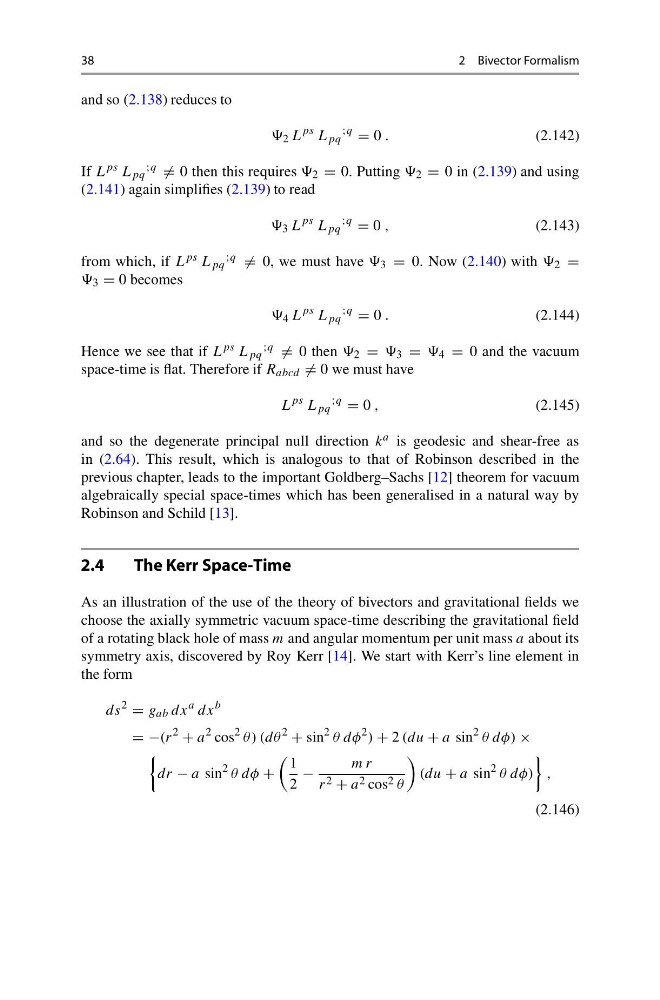
symmetry axis, discovered by Roy Kerr [14]. We start with Kerr’s line element in
the form
ds
2
= g ab dx
a dx
b
= −(r
2
+ a
2 cos
2 θ) (dθ
2
+ sin
2 θ dφ
2 ) + 2 (du + a sin
2 θ dφ) ×
dr − a sin
2 θ dφ +
1
2
−
m r
r 2 + a 2 cos 2 θ
(du + a sin
2 θ dφ)
,
(2.146)
2 Bivector Formalism
and so (2.138) reduces to
2 L
ps L pq
;q
= 0 .
(2.142)
If L ps L pq
;q = 0 then this requires 2 = 0. Putting 2 = 0 in (2.139) and using
(2.141) again simplifies (2.139) to read
3 L
ps L pq
;q
= 0 ,
(2.143)
from which, if L ps L pq
;q = 0, we must have 3 = 0. Now (2.140) with 2 =
3 = 0 becomes
4 L
ps L pq
;q
= 0 .
(2.144)
Hence we see that if L ps L pq
;q = 0 then 2 = 3 = 4 = 0 and the vacuum
space-time is flat. Therefore if R abcd = 0 we must have
L
ps L pq
;q
= 0 ,
(2.145)
and so the degenerate principal null direction k a is geodesic and shear-free as
in (2.64). This result, which is analogous to that of Robinson described in the
previous chapter, leads to the important Goldberg–Sachs [12] theorem for vacuum
algebraically special space-times which has been generalised in a natural way by
Robinson and Schild [13].
2.4
The Kerr Space-Time
As an illustration of the use of the theory of bivectors and gravitational fields we
choose the axially symmetric vacuum space-time describing the gravitational field
of a rotating black hole of mass m and angular momentum per unit mass a about its
symmetry axis, discovered by Roy Kerr [14]. We start with Kerr’s line element in
the form
ds
2
= g ab dx
a dx
b
= −(r
2
+ a
2 cos
2 θ) (dθ
2
+ sin
2 θ dφ
2 ) + 2 (du + a sin
2 θ dφ) ×
dr − a sin
2 θ dφ +
1
2
−
m r
r 2 + a 2 cos 2 θ
(du + a sin
2 θ dφ)
,
(2.146)