

C Gravitational (Clock) Compass
235
In particular we calculate that
K i,j + K j,i = λ η ij + ξ i K j + ξ j K i + O(r) ,
(C.103)
with
λ =
2
r
− h 0 + O(r) ,
(C.104)
and
ξ i =
1
r
(p i − v i ) +
1
2
(a i − h 0 v i ) + O(r) .
(C.105)
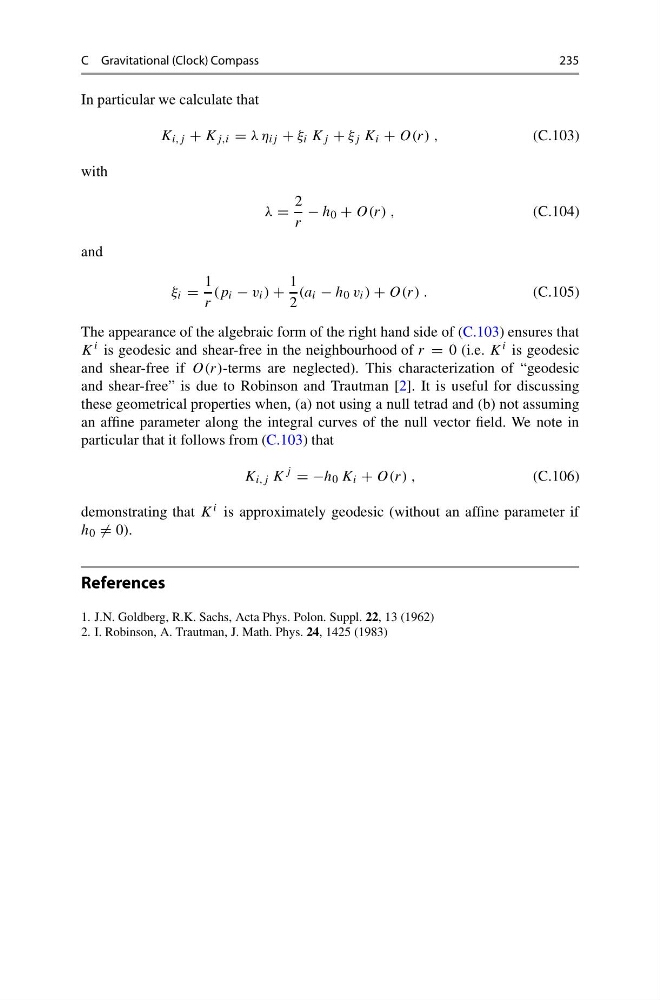
The appearance of the algebraic form of the right hand side of (C.103) ensures that
K i is geodesic and shear-free in the neighbourhood of r = 0 (i.e. K i is geodesic
and shear-free if O(r)-terms are neglected). This characterization of “geodesic
and shear-free” is due to Robinson and Trautman [2]. It is useful for discussing
these geometrical properties when, (a) not using a null tetrad and (b) not assuming
an affine parameter along the integral curves of the null vector field. We note in
particular that it follows from (C.103) that
K i,j K
j
= −h 0 K i + O(r) ,
(C.106)
demonstrating that K i is approximately geodesic (without an affine parameter if
h 0 = 0).
References
1. J.N. Goldberg, R.K. Sachs, Acta Phys. Polon. Suppl. 22, 13 (1962)
2. I. Robinson, A. Trautman, J. Math. Phys. 24, 1425 (1983)
235
In particular we calculate that
K i,j + K j,i = λ η ij + ξ i K j + ξ j K i + O(r) ,
(C.103)
with
λ =
2
r
− h 0 + O(r) ,
(C.104)
and
ξ i =
1
r
(p i − v i ) +
1
2
(a i − h 0 v i ) + O(r) .
(C.105)
The appearance of the algebraic form of the right hand side of (C.103) ensures that
K i is geodesic and shear-free in the neighbourhood of r = 0 (i.e. K i is geodesic
and shear-free if O(r)-terms are neglected). This characterization of “geodesic
and shear-free” is due to Robinson and Trautman [2]. It is useful for discussing
these geometrical properties when, (a) not using a null tetrad and (b) not assuming
an affine parameter along the integral curves of the null vector field. We note in
particular that it follows from (C.103) that
K i,j K
j
= −h 0 K i + O(r) ,
(C.106)
demonstrating that K i is approximately geodesic (without an affine parameter if
h 0 = 0).
References
1. J.N. Goldberg, R.K. Sachs, Acta Phys. Polon. Suppl. 22, 13 (1962)
2. I. Robinson, A. Trautman, J. Math. Phys. 24, 1425 (1983)