

232
C Gravitational (Clock) Compass
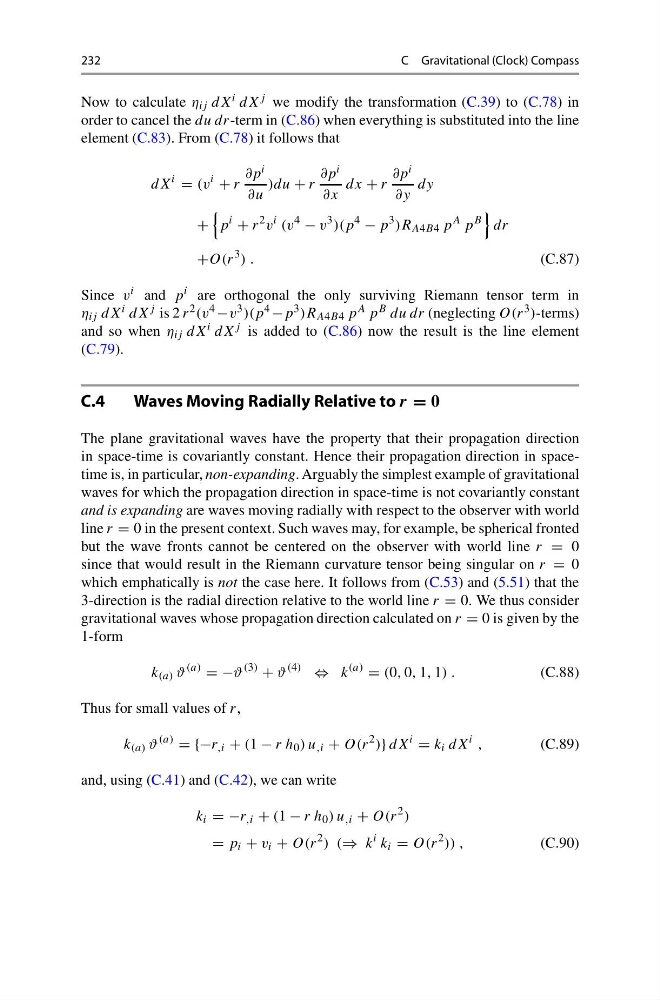
Now to calculate η ij dX i dX j we modify the transformation (C.39) to (C.78) in
order to cancel the du dr-term in (C.86) when everything is substituted into the line
element (C.83). From (C.78) it follows that
dX
i
= (v
i
+ r
∂p i
∂u
)du + r
∂p i
∂x
dx + r
∂p i
∂y
dy
+
p
i
+ r
2 v
i (v
4
− v
3 )(p
4
− p
3 )R A4B4 p
A p
B
dr
+O(r
3 ) .
(C.87)
Since v i and p i are orthogonal the only surviving Riemann tensor term in
η ij dX i dX j is 2 r 2 (v 4 −v 3 )(p 4 −p 3 )R A4B4 p A p B du dr (neglecting O(r 3 )-terms)
and so when η ij dX i dX j is added to (C.86) now the result is the line element
(C.79).
C.4
Waves Moving Radially Relative to r = 0
The plane gravitational waves have the property that their propagation direction
in space-time is covariantly constant. Hence their propagation direction in spacetime is, in particular, non-expanding. Arguably the simplest example of gravitational
waves for which the propagation direction in space-time is not covariantly constant
and is expanding are waves moving radially with respect to the observer with world
line r = 0 in the present context. Such waves may, for example, be spherical fronted
but the wave fronts cannot be centered on the observer with world line r = 0
since that would result in the Riemann curvature tensor being singular on r = 0
which emphatically is not the case here. It follows from (C.53) and (5.51) that the
3-direction is the radial direction relative to the world line r = 0. We thus consider
gravitational waves whose propagation direction calculated on r = 0 is given by the
1-form
k (a) ϑ
(a)
= −ϑ
(3)
+ ϑ
(4)
⇔ k
(a)
= (0, 0, 1, 1) .
(C.88)
Thus for small values of r,
k (a) ϑ
(a)
= {−r ,i + (1 − r h 0 ) u ,i + O(r
2 )} dX
i
= k i dX
i ,
(C.89)
and, using (C.41) and (C.42), we can write
k i = −r ,i + (1 − r h 0 ) u ,i + O(r
2 )
= p i + v i + O(r
2 ) (⇒ k
i k i = O(r
2 )) ,
(C.90)
C Gravitational (Clock) Compass
Now to calculate η ij dX i dX j we modify the transformation (C.39) to (C.78) in
order to cancel the du dr-term in (C.86) when everything is substituted into the line
element (C.83). From (C.78) it follows that
dX
i
= (v
i
+ r
∂p i
∂u
)du + r
∂p i
∂x
dx + r
∂p i
∂y
dy
+
p
i
+ r
2 v
i (v
4
− v
3 )(p
4
− p
3 )R A4B4 p
A p
B
dr
+O(r
3 ) .
(C.87)
Since v i and p i are orthogonal the only surviving Riemann tensor term in
η ij dX i dX j is 2 r 2 (v 4 −v 3 )(p 4 −p 3 )R A4B4 p A p B du dr (neglecting O(r 3 )-terms)
and so when η ij dX i dX j is added to (C.86) now the result is the line element
(C.79).
C.4
Waves Moving Radially Relative to r = 0
The plane gravitational waves have the property that their propagation direction
in space-time is covariantly constant. Hence their propagation direction in spacetime is, in particular, non-expanding. Arguably the simplest example of gravitational
waves for which the propagation direction in space-time is not covariantly constant
and is expanding are waves moving radially with respect to the observer with world
line r = 0 in the present context. Such waves may, for example, be spherical fronted
but the wave fronts cannot be centered on the observer with world line r = 0
since that would result in the Riemann curvature tensor being singular on r = 0
which emphatically is not the case here. It follows from (C.53) and (5.51) that the
3-direction is the radial direction relative to the world line r = 0. We thus consider
gravitational waves whose propagation direction calculated on r = 0 is given by the
1-form
k (a) ϑ
(a)
= −ϑ
(3)
+ ϑ
(4)
⇔ k
(a)
= (0, 0, 1, 1) .
(C.88)
Thus for small values of r,
k (a) ϑ
(a)
= {−r ,i + (1 − r h 0 ) u ,i + O(r
2 )} dX
i
= k i dX
i ,
(C.89)
and, using (C.41) and (C.42), we can write
k i = −r ,i + (1 − r h 0 ) u ,i + O(r
2 )
= p i + v i + O(r
2 ) (⇒ k
i k i = O(r
2 )) ,
(C.90)