

224
C Gravitational (Clock) Compass
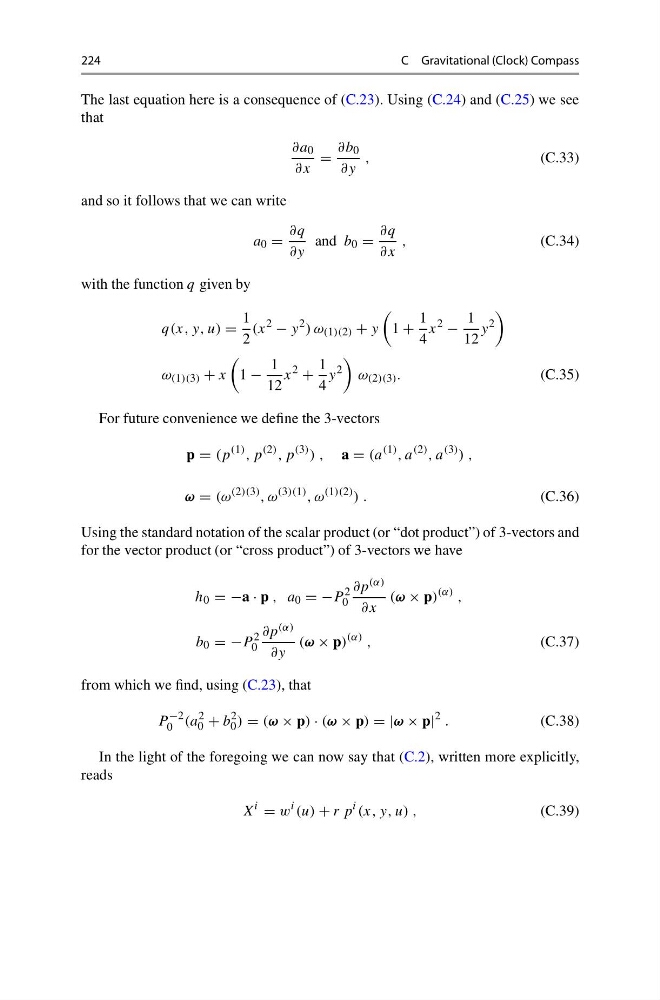
The last equation here is a consequence of (C.23). Using (C.24) and (C.25) we see
that
∂a 0
∂x
=
∂b 0
∂y
,
(C.33)
and so it follows that we can write
a 0 =
∂q
∂y
and b 0 =
∂q
∂x
,
(C.34)
with the function q given by
q(x, y, u) =
1
2
(x
2
− y
2 ) ω (1)(2) + y
1 +
1
4
x
2
−
1
12
y
2
ω (1)(3) + x
1 −
1
12
x
2
+
1
4
y
2
ω (2)(3) .
(C.35)
For future convenience we define the 3-vectors
p = (p
(1) , p
(2) , p
(3) ) , a = (a
(1) , a
(2) , a
(3) ) ,
ω = (ω
(2)(3) , ω
(3)(1) , ω
(1)(2) ) .
(C.36)
Using the standard notation of the scalar product (or “dot product”) of 3-vectors and
for the vector product (or “cross product”) of 3-vectors we have
h 0 = −a · p , a 0 = −P
2
0
∂p (α)
∂x
(ω × p)
(α) ,
b 0 = −P
2
0
∂p (α)
∂y
(ω × p)
(α) ,
(C.37)
from which we find, using (C.23), that
P
−2
0 (a
2
0 + b
2
0 ) = (ω × p) · (ω × p) = |ω × p|
2 .
(C.38)
In the light of the foregoing we can now say that (C.2), written more explicitly,
reads
X
i
= w
i (u) + r p
i (x, y, u) ,
(C.39)
C Gravitational (Clock) Compass
The last equation here is a consequence of (C.23). Using (C.24) and (C.25) we see
that
∂a 0
∂x
=
∂b 0
∂y
,
(C.33)
and so it follows that we can write
a 0 =
∂q
∂y
and b 0 =
∂q
∂x
,
(C.34)
with the function q given by
q(x, y, u) =
1
2
(x
2
− y
2 ) ω (1)(2) + y
1 +
1
4
x
2
−
1
12
y
2
ω (1)(3) + x
1 −
1
12
x
2
+
1
4
y
2
ω (2)(3) .
(C.35)
For future convenience we define the 3-vectors
p = (p
(1) , p
(2) , p
(3) ) , a = (a
(1) , a
(2) , a
(3) ) ,
ω = (ω
(2)(3) , ω
(3)(1) , ω
(1)(2) ) .
(C.36)
Using the standard notation of the scalar product (or “dot product”) of 3-vectors and
for the vector product (or “cross product”) of 3-vectors we have
h 0 = −a · p , a 0 = −P
2
0
∂p (α)
∂x
(ω × p)
(α) ,
b 0 = −P
2
0
∂p (α)
∂y
(ω × p)
(α) ,
(C.37)
from which we find, using (C.23), that
P
−2
0 (a
2
0 + b
2
0 ) = (ω × p) · (ω × p) = |ω × p|
2 .
(C.38)
In the light of the foregoing we can now say that (C.2), written more explicitly,
reads
X
i
= w
i (u) + r p
i (x, y, u) ,
(C.39)