

214
B Bateman Waves
and
k a;b e
a b
b
− k a;b b
a e
b
= e a b
a ;b k
b
− b a e
a ;b k
b ,
(B.23)
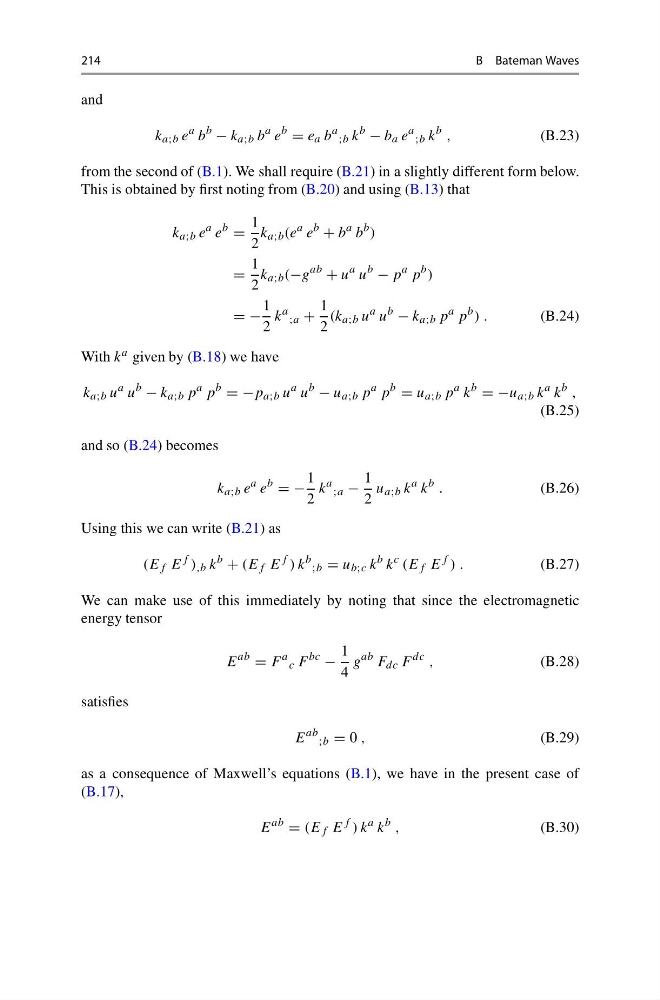
from the second of (B.1). We shall require (B.21) in a slightly different form below.
This is obtained by first noting from (B.20) and using (B.13) that
k a;b e
a e
b
=
1
2
k a;b (e
a e
b
+ b
a b
b )
=
1
2
k a;b (−g
ab
+ u
a u
b
− p
a p
b )
= −
1
2
k
a ;a +
1
2
(k a;b u
a u
b
− k a;b p
a p
b ) .
(B.24)
With k a given by (B.18) we have
k a;b u
a u
b
− k a;b p
a p
b
= −p a;b u
a u
b
− u a;b p
a p
b
= u a;b p
a k
b
= −u a;b k
a k
b ,
(B.25)
and so (B.24) becomes
k a;b e
a e
b
= −
1
2
k
a ;a −
1
2
u a;b k
a k
b .
(B.26)
Using this we can write (B.21) as
(E f E
f ) ,b k
b
+ (E f E
f ) k
b ;b = u b;c k
b k
c (E f E
f ) .
(B.27)
We can make use of this immediately by noting that since the electromagnetic
energy tensor
E
ab
= F
a
c F
bc
−
1
4
g
ab F dc F
dc ,
(B.28)
satisfies
E
ab ;b = 0 ,
(B.29)
as a consequence of Maxwell’s equations (B.1), we have in the present case of
(B.17),
E
ab
= (E f E
f ) k
a k
b ,
(B.30)
B Bateman Waves
and
k a;b e
a b
b
− k a;b b
a e
b
= e a b
a ;b k
b
− b a e
a ;b k
b ,
(B.23)
from the second of (B.1). We shall require (B.21) in a slightly different form below.
This is obtained by first noting from (B.20) and using (B.13) that
k a;b e
a e
b
=
1
2
k a;b (e
a e
b
+ b
a b
b )
=
1
2
k a;b (−g
ab
+ u
a u
b
− p
a p
b )
= −
1
2
k
a ;a +
1
2
(k a;b u
a u
b
− k a;b p
a p
b ) .
(B.24)
With k a given by (B.18) we have
k a;b u
a u
b
− k a;b p
a p
b
= −p a;b u
a u
b
− u a;b p
a p
b
= u a;b p
a k
b
= −u a;b k
a k
b ,
(B.25)
and so (B.24) becomes
k a;b e
a e
b
= −
1
2
k
a ;a −
1
2
u a;b k
a k
b .
(B.26)
Using this we can write (B.21) as
(E f E
f ) ,b k
b
+ (E f E
f ) k
b ;b = u b;c k
b k
c (E f E
f ) .
(B.27)
We can make use of this immediately by noting that since the electromagnetic
energy tensor
E
ab
= F
a
c F
bc
−
1
4
g
ab F dc F
dc ,
(B.28)
satisfies
E
ab ;b = 0 ,
(B.29)
as a consequence of Maxwell’s equations (B.1), we have in the present case of
(B.17),
E
ab
= (E f E
f ) k
a k
b ,
(B.30)