

8.6 Run-Away Magnetic Reissner–Nordström Particle
207
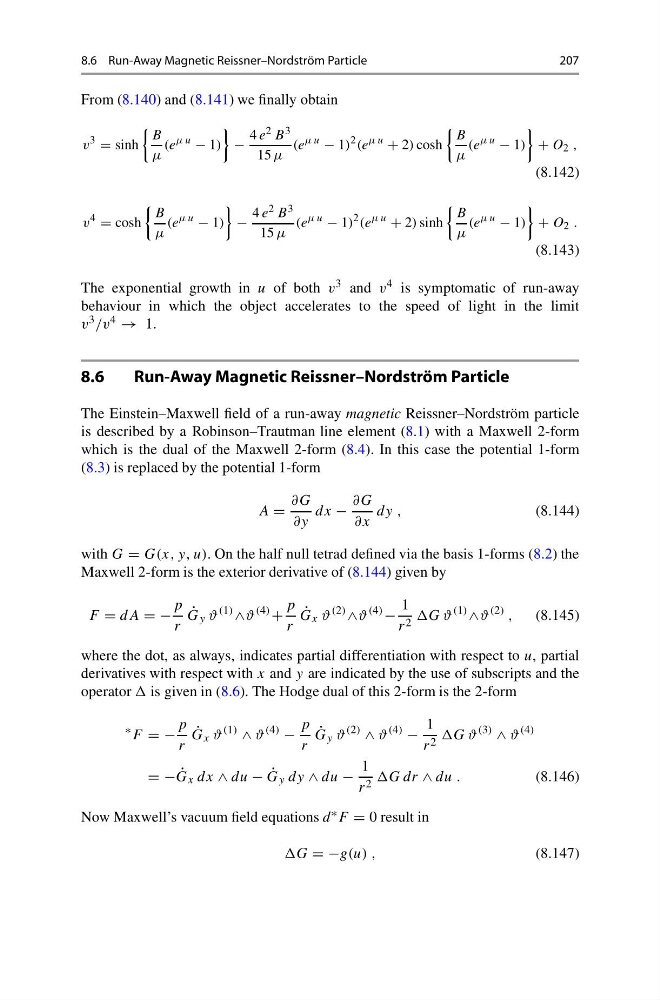
From (8.140) and (8.141) we finally obtain
v
3
= sinh
B
μ
(e
μ u
− 1)
−
4 e 2 B 3
15 μ
(e
μ u
− 1)
2 (e
μ u
+ 2) cosh
B
μ
(e
μ u
− 1)
+ O 2 ,
(8.142)
v
4
= cosh
B
μ
(e
μ u
− 1)
−
4 e 2 B 3
15 μ
(e
μ u
− 1)
2 (e
μ u
+ 2) sinh
B
μ
(e
μ u
− 1)
+ O 2 .
(8.143)
The exponential growth in u of both v 3 and v 4 is symptomatic of run-away
behaviour in which the object accelerates to the speed of light in the limit
v 3 /v 4 → 1.
8.6
Run-Away Magnetic Reissner–Nordström Particle
The Einstein–Maxwell field of a run-away magnetic Reissner–Nordström particle
is described by a Robinson–Trautman line element (8.1) with a Maxwell 2-form
which is the dual of the Maxwell 2-form (8.4). In this case the potential 1-form
(8.3) is replaced by the potential 1-form
A =
∂G
∂y
dx −
∂G
∂x
dy ,
(8.144)
with G = G(x, y, u). On the half null tetrad defined via the basis 1-forms (8.2) the
Maxwell 2-form is the exterior derivative of (8.144) given by
F = dA = −
p
r
˙
G y ϑ
(1)
∧ϑ
(4)
+
p
r
˙
G x ϑ
(2)
∧ϑ
(4)
−
1
r 2 G ϑ
(1)
∧ϑ
(2) ,
(8.145)
where the dot, as always, indicates partial differentiation with respect to u, partial
derivatives with respect with x and y are indicated by the use of subscripts and the
operator is given in (8.6). The Hodge dual of this 2-form is the 2-form
∗ F = −
p
r
˙
G x ϑ
(1)
∧ ϑ
(4)
−
p
r
˙
G y ϑ
(2)
∧ ϑ
(4)
−
1
r 2 G ϑ
(3)
∧ ϑ
(4)
= − ˙
G x dx ∧ du − ˙
G y dy ∧ du −
1
r 2 dr ∧ du .
(8.146)
Now Maxwell’s vacuum field equations d ∗ F = 0 result in
G = −g(u) ,
(8.147)
207
From (8.140) and (8.141) we finally obtain
v
3
= sinh
B
μ
(e
μ u
− 1)
−
4 e 2 B 3
15 μ
(e
μ u
− 1)
2 (e
μ u
+ 2) cosh
B
μ
(e
μ u
− 1)
+ O 2 ,
(8.142)
v
4
= cosh
B
μ
(e
μ u
− 1)
−
4 e 2 B 3
15 μ
(e
μ u
− 1)
2 (e
μ u
+ 2) sinh
B
μ
(e
μ u
− 1)
+ O 2 .
(8.143)
The exponential growth in u of both v 3 and v 4 is symptomatic of run-away
behaviour in which the object accelerates to the speed of light in the limit
v 3 /v 4 → 1.
8.6
Run-Away Magnetic Reissner–Nordström Particle
The Einstein–Maxwell field of a run-away magnetic Reissner–Nordström particle
is described by a Robinson–Trautman line element (8.1) with a Maxwell 2-form
which is the dual of the Maxwell 2-form (8.4). In this case the potential 1-form
(8.3) is replaced by the potential 1-form
A =
∂G
∂y
dx −
∂G
∂x
dy ,
(8.144)
with G = G(x, y, u). On the half null tetrad defined via the basis 1-forms (8.2) the
Maxwell 2-form is the exterior derivative of (8.144) given by
F = dA = −
p
r
˙
G y ϑ
(1)
∧ϑ
(4)
+
p
r
˙
G x ϑ
(2)
∧ϑ
(4)
−
1
r 2 G ϑ
(1)
∧ϑ
(2) ,
(8.145)
where the dot, as always, indicates partial differentiation with respect to u, partial
derivatives with respect with x and y are indicated by the use of subscripts and the
operator is given in (8.6). The Hodge dual of this 2-form is the 2-form
∗ F = −
p
r
˙
G x ϑ
(1)
∧ ϑ
(4)
−
p
r
˙
G y ϑ
(2)
∧ ϑ
(4)
−
1
r 2 G ϑ
(3)
∧ ϑ
(4)
= − ˙
G x dx ∧ du − ˙
G y dy ∧ du −
1
r 2 dr ∧ du .
(8.146)
Now Maxwell’s vacuum field equations d ∗ F = 0 result in
G = −g(u) ,
(8.147)