

188
8 Reissner–Nordström Particle
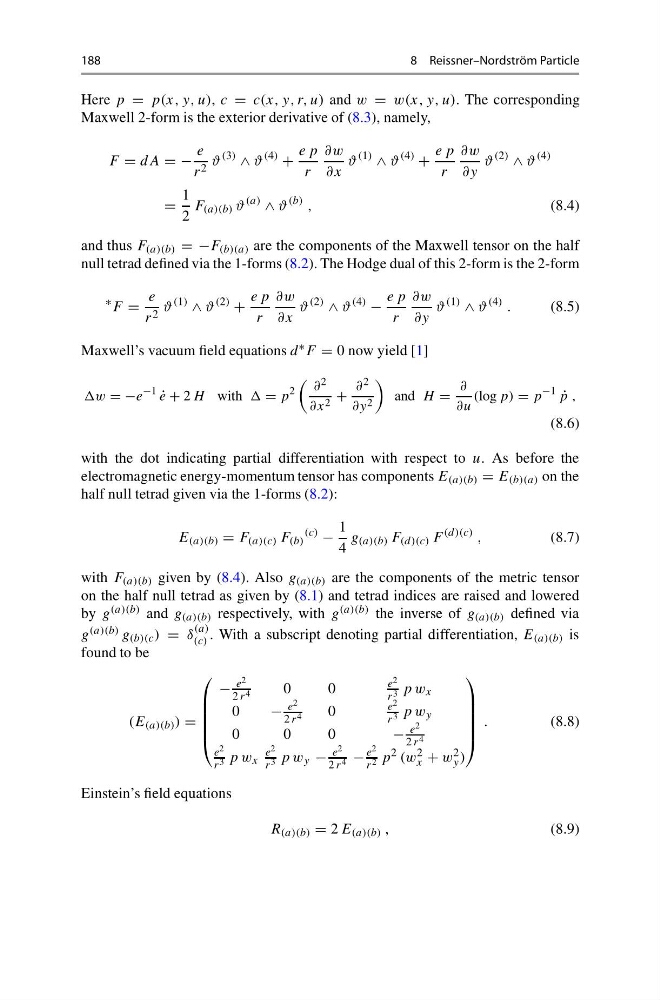
Here p = p(x, y, u), c = c(x, y, r, u) and w = w(x, y, u). The corresponding
Maxwell 2-form is the exterior derivative of (8.3), namely,
F = dA = −
e
r 2 ϑ
(3)
∧ ϑ
(4)
+
e p
r
∂w
∂x
ϑ
(1)
∧ ϑ
(4)
+
e p
r
∂w
∂y
ϑ
(2)
∧ ϑ
(4)
=
1
2
F (a)(b) ϑ
(a)
∧ ϑ
(b) ,
(8.4)
and thus F (a)(b) = −F (b)(a) are the components of the Maxwell tensor on the half
null tetrad defined via the 1-forms (8.2). The Hodge dual of this 2-form is the 2-form
∗ F =
e
r 2 ϑ
(1)
∧ ϑ
(2)
+
e p
r
∂w
∂x
ϑ
(2)
∧ ϑ
(4)
−
e p
r
∂w
∂y
ϑ
(1)
∧ ϑ
(4) .
(8.5)
Maxwell’s vacuum field equations d ∗ F = 0 now yield [1]
w = −e
−1
˙
e + 2 H with = p
2
∂ 2
∂x 2 +
∂ 2
∂y 2
and H =
∂
∂u
(log p) = p
−1
˙
p ,
(8.6)
with the dot indicating partial differentiation with respect to u. As before the
electromagnetic energy-momentum tensor has components E (a)(b) = E (b)(a) on the
half null tetrad given via the 1-forms (8.2):
E (a)(b) = F (a)(c) F (b)
(c)
−
1
4
g (a)(b) F (d)(c) F
(d)(c) ,
(8.7)
with F (a)(b) given by (8.4). Also g (a)(b) are the components of the metric tensor
on the half null tetrad as given by (8.1) and tetrad indices are raised and lowered
by g (a)(b) and g (a)(b) respectively, with g (a)(b) the inverse of g (a)(b) defined via
g (a)(b) g (b)(c ) = δ
(a)
(c) . With a subscript denoting partial differentiation, E (a)(b) is
found to be
(E (a)(b) ) =
⎛
⎜
⎜
⎜
⎜
⎝
−
e 2
2 r 4
0
0
e 2
r 3 p w x
0
−
e 2
2 r 4
0
e 2
r 3 p w y
0
0
0
−
e 2
2 r 4
e 2
r 3 p w x
e 2
r 3 p w y −
e 2
2 r 4 −
e 2
r 2 p 2 (w 2
x + w 2
y )
⎞
⎟
⎟
⎟
⎟
⎠
.
(8.8)
Einstein’s field equations
R (a)(b) = 2 E (a)(b) ,
(8.9)
8 Reissner–Nordström Particle
Here p = p(x, y, u), c = c(x, y, r, u) and w = w(x, y, u). The corresponding
Maxwell 2-form is the exterior derivative of (8.3), namely,
F = dA = −
e
r 2 ϑ
(3)
∧ ϑ
(4)
+
e p
r
∂w
∂x
ϑ
(1)
∧ ϑ
(4)
+
e p
r
∂w
∂y
ϑ
(2)
∧ ϑ
(4)
=
1
2
F (a)(b) ϑ
(a)
∧ ϑ
(b) ,
(8.4)
and thus F (a)(b) = −F (b)(a) are the components of the Maxwell tensor on the half
null tetrad defined via the 1-forms (8.2). The Hodge dual of this 2-form is the 2-form
∗ F =
e
r 2 ϑ
(1)
∧ ϑ
(2)
+
e p
r
∂w
∂x
ϑ
(2)
∧ ϑ
(4)
−
e p
r
∂w
∂y
ϑ
(1)
∧ ϑ
(4) .
(8.5)
Maxwell’s vacuum field equations d ∗ F = 0 now yield [1]
w = −e
−1
˙
e + 2 H with = p
2
∂ 2
∂x 2 +
∂ 2
∂y 2
and H =
∂
∂u
(log p) = p
−1
˙
p ,
(8.6)
with the dot indicating partial differentiation with respect to u. As before the
electromagnetic energy-momentum tensor has components E (a)(b) = E (b)(a) on the
half null tetrad given via the 1-forms (8.2):
E (a)(b) = F (a)(c) F (b)
(c)
−
1
4
g (a)(b) F (d)(c) F
(d)(c) ,
(8.7)
with F (a)(b) given by (8.4). Also g (a)(b) are the components of the metric tensor
on the half null tetrad as given by (8.1) and tetrad indices are raised and lowered
by g (a)(b) and g (a)(b) respectively, with g (a)(b) the inverse of g (a)(b) defined via
g (a)(b) g (b)(c ) = δ
(a)
(c) . With a subscript denoting partial differentiation, E (a)(b) is
found to be
(E (a)(b) ) =
⎛
⎜
⎜
⎜
⎜
⎝
−
e 2
2 r 4
0
0
e 2
r 3 p w x
0
−
e 2
2 r 4
0
e 2
r 3 p w y
0
0
0
−
e 2
2 r 4
e 2
r 3 p w x
e 2
r 3 p w y −
e 2
2 r 4 −
e 2
r 2 p 2 (w 2
x + w 2
y )
⎞
⎟
⎟
⎟
⎟
⎠
.
(8.8)
Einstein’s field equations
R (a)(b) = 2 E (a)(b) ,
(8.9)