

7.6 Review of Approximations
185
R (1)(1) − R (2)(2) + 2 i R (1)(2) = 2 (E (1)(1) − E (2)(2) + 2 i E (1)(2) )
+
1
r 2 × O 3 +
1
r
× O 2 + O 1 + O(r) ,
(7.234)
R (A)(A) − 2 E (A)(A) =
1
r 4 × O 3 +
1
r 2 × O 3 +
1
r
× O 1 + O 1 + O(r) ,
(7.235)
R (3)(4) − 2 E (3)(4) =
1
r 4 × O 4 +
1
r 3 × O 3 +
1
r 2 × O 2 +
1
r
× O 1
+O 1 + O(r) ,
(7.236)
R (A)(4) − 2 E (A)(4) =
1
r 4 × O 3 +
1
r 3 × O 2 +
1
r 2 × O 2 +
1
r
× O 1
+O 1 + O(r) ,
(7.237)
R (4)(4) − 2 E (4)(4) =
1
r 4 × O 4 +
1
r 3 × O 3 +
1
r 2 × O 3 +
1
r
× O 1
+O 1 + O(r) ,
(7.238)
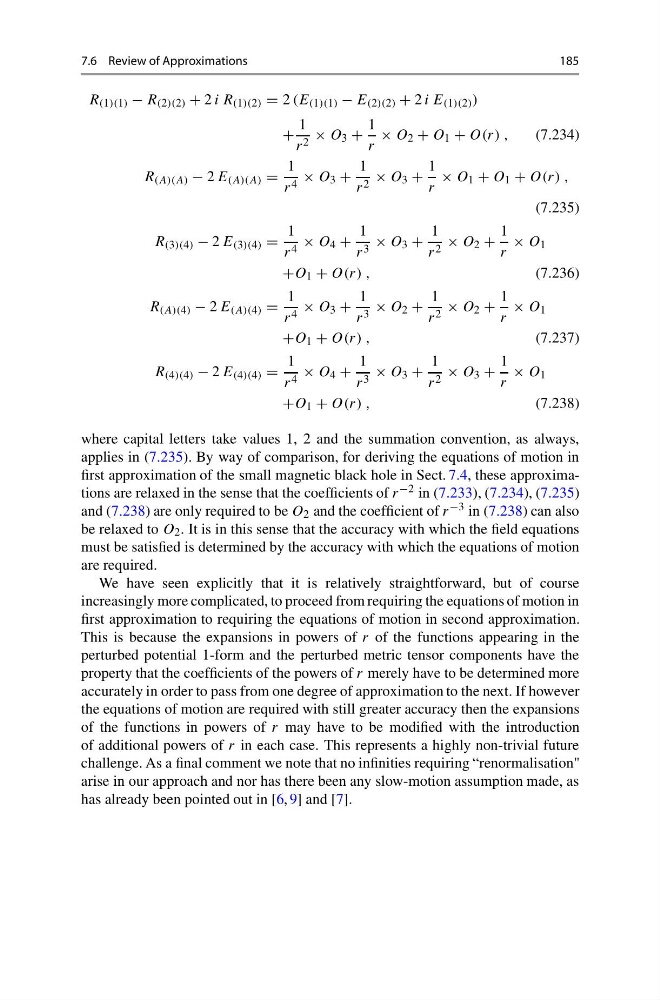
where capital letters take values 1, 2 and the summation convention, as always,
applies in (7.235). By way of comparison, for deriving the equations of motion in
first approximation of the small magnetic black hole in Sect. 7.4, these approximations are relaxed in the sense that the coefficients of r −2 in (7.233), (7.234), (7.235)
and (7.238) are only required to be O 2 and the coefficient of r −3 in (7.238) can also
be relaxed to O 2 . It is in this sense that the accuracy with which the field equations
must be satisfied is determined by the accuracy with which the equations of motion
are required.
We have seen explicitly that it is relatively straightforward, but of course
increasingly more complicated, to proceed from requiring the equations of motion in
first approximation to requiring the equations of motion in second approximation.
This is because the expansions in powers of r of the functions appearing in the
perturbed potential 1-form and the perturbed metric tensor components have the
property that the coefficients of the powers of r merely have to be determined more
accurately in order to pass from one degree of approximation to the next. If however
the equations of motion are required with still greater accuracy then the expansions
of the functions in powers of r may have to be modified with the introduction
of additional powers of r in each case. This represents a highly non-trivial future
challenge. As a final comment we note that no infinities requiring “renormalisation"
arise in our approach and nor has there been any slow-motion assumption made, as
has already been pointed out in [6, 9] and [7].
185
R (1)(1) − R (2)(2) + 2 i R (1)(2) = 2 (E (1)(1) − E (2)(2) + 2 i E (1)(2) )
+
1
r 2 × O 3 +
1
r
× O 2 + O 1 + O(r) ,
(7.234)
R (A)(A) − 2 E (A)(A) =
1
r 4 × O 3 +
1
r 2 × O 3 +
1
r
× O 1 + O 1 + O(r) ,
(7.235)
R (3)(4) − 2 E (3)(4) =
1
r 4 × O 4 +
1
r 3 × O 3 +
1
r 2 × O 2 +
1
r
× O 1
+O 1 + O(r) ,
(7.236)
R (A)(4) − 2 E (A)(4) =
1
r 4 × O 3 +
1
r 3 × O 2 +
1
r 2 × O 2 +
1
r
× O 1
+O 1 + O(r) ,
(7.237)
R (4)(4) − 2 E (4)(4) =
1
r 4 × O 4 +
1
r 3 × O 3 +
1
r 2 × O 3 +
1
r
× O 1
+O 1 + O(r) ,
(7.238)
where capital letters take values 1, 2 and the summation convention, as always,
applies in (7.235). By way of comparison, for deriving the equations of motion in
first approximation of the small magnetic black hole in Sect. 7.4, these approximations are relaxed in the sense that the coefficients of r −2 in (7.233), (7.234), (7.235)
and (7.238) are only required to be O 2 and the coefficient of r −3 in (7.238) can also
be relaxed to O 2 . It is in this sense that the accuracy with which the field equations
must be satisfied is determined by the accuracy with which the equations of motion
are required.
We have seen explicitly that it is relatively straightforward, but of course
increasingly more complicated, to proceed from requiring the equations of motion in
first approximation to requiring the equations of motion in second approximation.
This is because the expansions in powers of r of the functions appearing in the
perturbed potential 1-form and the perturbed metric tensor components have the
property that the coefficients of the powers of r merely have to be determined more
accurately in order to pass from one degree of approximation to the next. If however
the equations of motion are required with still greater accuracy then the expansions
of the functions in powers of r may have to be modified with the introduction
of additional powers of r in each case. This represents a highly non-trivial future
challenge. As a final comment we note that no infinities requiring “renormalisation"
arise in our approach and nor has there been any slow-motion assumption made, as
has already been pointed out in [6, 9] and [7].