

7.5 Equations of Motion in Second Approximation
179
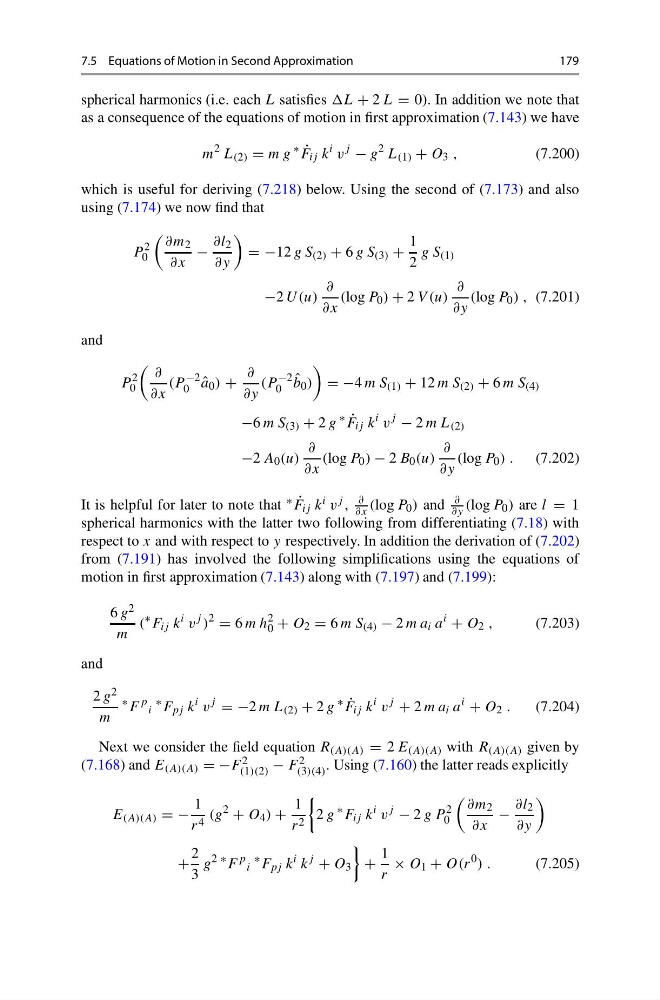
spherical harmonics (i.e. each L satisfies + 2 L = 0). In addition we note that
as a consequence of the equations of motion in first approximation (7.143) we have
m
2 L (2) = m g
∗ ˙
F ij k
i v
j
− g
2 L (1) + O 3 ,
(7.200)
which is useful for deriving (7.218) below. Using the second of (7.173) and also
using (7.174) we now find that
P
2
0
∂m 2
∂x
−
∂l 2
∂y
= −12 g S (2) + 6 g S (3) +
1
2
g S (1)
−2 U(u)
∂
∂x
(log P 0 ) + 2 V (u)
∂
∂y
(log P 0 ) , (7.201)
and
P
2
0
∂
∂x
(P
−2
0 ˆ
a 0 ) +
∂
∂y
(P
−2
0
ˆ
b 0 )
= −4 m S (1) + 12 m S (2) + 6 m S (4)
−6 m S (3) + 2 g
∗ ˙
F ij k
i v
j
− 2 m L (2)
−2 A 0 (u)
∂
∂x
(log P 0 ) − 2 B 0 (u)
∂
∂y
(log P 0 ) . (7.202)
It is helpful for later to note that ∗ ˙
F ij k i v j ,
∂
∂x (log P 0 ) and
∂
∂y (log P 0 ) are l = 1
spherical harmonics with the latter two following from differentiating (7.18) with
respect to x and with respect to y respectively. In addition the derivation of (7.202)
from (7.191) has involved the following simplifications using the equations of
motion in first approximation (7.143) along with (7.197) and (7.199):
6 g 2
m
(
∗ F ij k
i v
j )
2
= 6 m h
2
0 + O 2 = 6 m S (4) − 2 m a i a
i
+ O 2 ,
(7.203)
and
2 g 2
m
∗ F
p
i
∗ F pj k
i v
j
= −2 m L (2) + 2 g
∗ ˙
F ij k
i v
j
+ 2 m a i a
i
+ O 2 .
(7.204)
Next we consider the field equation R (A)(A) = 2 E (A)(A) with R (A)(A) given by
(7.168) and E (A)(A) = −F 2
(1)(2) − F 2
(3)(4) . Using (7.160) the latter reads explicitly
E (A)(A) = −
1
r 4 (g
2
+ O 4 ) +
1
r 2
2 g
∗ F ij k
i v
j
− 2 g P
2
0
∂m 2
∂x
−
∂l 2
∂y
+
2
3
g
2 ∗ F
p
i
∗ F pj k
i k
j
+ O 3
+
1
r
× O 1 + O(r
0 ) .
(7.205)
179
spherical harmonics (i.e. each L satisfies + 2 L = 0). In addition we note that
as a consequence of the equations of motion in first approximation (7.143) we have
m
2 L (2) = m g
∗ ˙
F ij k
i v
j
− g
2 L (1) + O 3 ,
(7.200)
which is useful for deriving (7.218) below. Using the second of (7.173) and also
using (7.174) we now find that
P
2
0
∂m 2
∂x
−
∂l 2
∂y
= −12 g S (2) + 6 g S (3) +
1
2
g S (1)
−2 U(u)
∂
∂x
(log P 0 ) + 2 V (u)
∂
∂y
(log P 0 ) , (7.201)
and
P
2
0
∂
∂x
(P
−2
0 ˆ
a 0 ) +
∂
∂y
(P
−2
0
ˆ
b 0 )
= −4 m S (1) + 12 m S (2) + 6 m S (4)
−6 m S (3) + 2 g
∗ ˙
F ij k
i v
j
− 2 m L (2)
−2 A 0 (u)
∂
∂x
(log P 0 ) − 2 B 0 (u)
∂
∂y
(log P 0 ) . (7.202)
It is helpful for later to note that ∗ ˙
F ij k i v j ,
∂
∂x (log P 0 ) and
∂
∂y (log P 0 ) are l = 1
spherical harmonics with the latter two following from differentiating (7.18) with
respect to x and with respect to y respectively. In addition the derivation of (7.202)
from (7.191) has involved the following simplifications using the equations of
motion in first approximation (7.143) along with (7.197) and (7.199):
6 g 2
m
(
∗ F ij k
i v
j )
2
= 6 m h
2
0 + O 2 = 6 m S (4) − 2 m a i a
i
+ O 2 ,
(7.203)
and
2 g 2
m
∗ F
p
i
∗ F pj k
i v
j
= −2 m L (2) + 2 g
∗ ˙
F ij k
i v
j
+ 2 m a i a
i
+ O 2 .
(7.204)
Next we consider the field equation R (A)(A) = 2 E (A)(A) with R (A)(A) given by
(7.168) and E (A)(A) = −F 2
(1)(2) − F 2
(3)(4) . Using (7.160) the latter reads explicitly
E (A)(A) = −
1
r 4 (g
2
+ O 4 ) +
1
r 2
2 g
∗ F ij k
i v
j
− 2 g P
2
0
∂m 2
∂x
−
∂l 2
∂y
+
2
3
g
2 ∗ F
p
i
∗ F pj k
i k
j
+ O 3
+
1
r
× O 1 + O(r
0 ) .
(7.205)