

164
7 Small Magnetic Black Hole
of the radiation produced by the motion of the magnetic black hole. These null
hypersurfaces are approximately future null cones near r = 0. Hence the wave
fronts can be approximately 2-spheres near the magnetic black hole. Neglecting
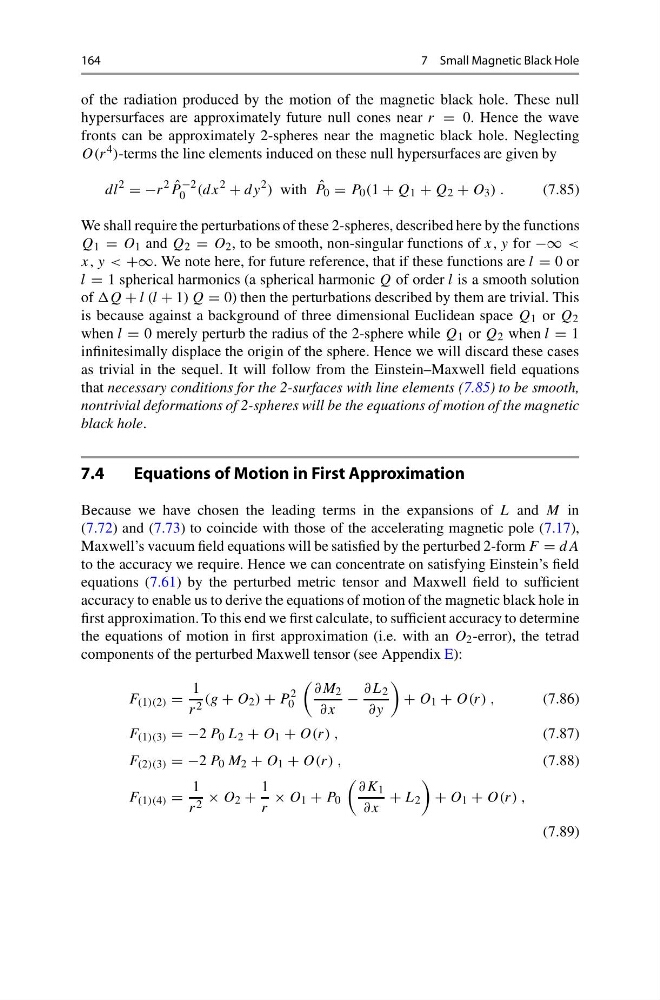
O(r 4 )-terms the line elements induced on these null hypersurfaces are given by
dl
2
= −r
2 ˆ
P
−2
0 (dx
2
+ dy
2 ) with ˆ
P 0 = P 0 (1 + Q 1 + Q 2 + O 3 ) .
(7.85)
We shall require the perturbations of these 2-spheres, described here by the functions
Q 1 = O 1 and Q 2 = O 2 , to be smooth, non-singular functions of x, y for −∞ <
x, y < +∞. We note here, for future reference, that if these functions are l = 0 or
l = 1 spherical harmonics (a spherical harmonic Q of order l is a smooth solution
of + l (l + 1) Q = 0) then the perturbations described by them are trivial. This
is because against a background of three dimensional Euclidean space Q 1 or Q 2
when l = 0 merely perturb the radius of the 2-sphere while Q 1 or Q 2 when l = 1
infinitesimally displace the origin of the sphere. Hence we will discard these cases
as trivial in the sequel. It will follow from the Einstein–Maxwell field equations
that necessary conditions for the 2-surfaces with line elements (7.85) to be smooth,
nontrivial deformations of 2-spheres will be the equations of motion of the magnetic
black hole.
7.4
Equations of Motion in First Approximation
Because we have chosen the leading terms in the expansions of L and M in
(7.72) and (7.73) to coincide with those of the accelerating magnetic pole (7.17),
Maxwell’s vacuum field equations will be satisfied by the perturbed 2-form F = dA
to the accuracy we require. Hence we can concentrate on satisfying Einstein’s field
equations (7.61) by the perturbed metric tensor and Maxwell field to sufficient
accuracy to enable us to derive the equations of motion of the magnetic black hole in
first approximation. To this end we first calculate, to sufficient accuracy to determine
the equations of motion in first approximation (i.e. with an O 2 -error), the tetrad
components of the perturbed Maxwell tensor (see Appendix E):
F (1)(2) =
1
r 2 (g + O 2 ) + P
2
0
∂M 2
∂x
−
∂L 2
∂y
+ O 1 + O(r) ,
(7.86)
F (1)(3) = −2 P 0 L 2 + O 1 + O(r) ,
(7.87)
F (2)(3) = −2 P 0 M 2 + O 1 + O(r) ,
(7.88)
F (1)(4) =
1
r 2 × O 2 +
1
r
× O 1 + P 0
∂K 1
∂x
+ L 2
+ O 1 + O(r) ,
(7.89)
7 Small Magnetic Black Hole
of the radiation produced by the motion of the magnetic black hole. These null
hypersurfaces are approximately future null cones near r = 0. Hence the wave
fronts can be approximately 2-spheres near the magnetic black hole. Neglecting
O(r 4 )-terms the line elements induced on these null hypersurfaces are given by
dl
2
= −r
2 ˆ
P
−2
0 (dx
2
+ dy
2 ) with ˆ
P 0 = P 0 (1 + Q 1 + Q 2 + O 3 ) .
(7.85)
We shall require the perturbations of these 2-spheres, described here by the functions
Q 1 = O 1 and Q 2 = O 2 , to be smooth, non-singular functions of x, y for −∞ <
x, y < +∞. We note here, for future reference, that if these functions are l = 0 or
l = 1 spherical harmonics (a spherical harmonic Q of order l is a smooth solution
of + l (l + 1) Q = 0) then the perturbations described by them are trivial. This
is because against a background of three dimensional Euclidean space Q 1 or Q 2
when l = 0 merely perturb the radius of the 2-sphere while Q 1 or Q 2 when l = 1
infinitesimally displace the origin of the sphere. Hence we will discard these cases
as trivial in the sequel. It will follow from the Einstein–Maxwell field equations
that necessary conditions for the 2-surfaces with line elements (7.85) to be smooth,
nontrivial deformations of 2-spheres will be the equations of motion of the magnetic
black hole.
7.4
Equations of Motion in First Approximation
Because we have chosen the leading terms in the expansions of L and M in
(7.72) and (7.73) to coincide with those of the accelerating magnetic pole (7.17),
Maxwell’s vacuum field equations will be satisfied by the perturbed 2-form F = dA
to the accuracy we require. Hence we can concentrate on satisfying Einstein’s field
equations (7.61) by the perturbed metric tensor and Maxwell field to sufficient
accuracy to enable us to derive the equations of motion of the magnetic black hole in
first approximation. To this end we first calculate, to sufficient accuracy to determine
the equations of motion in first approximation (i.e. with an O 2 -error), the tetrad
components of the perturbed Maxwell tensor (see Appendix E):
F (1)(2) =
1
r 2 (g + O 2 ) + P
2
0
∂M 2
∂x
−
∂L 2
∂y
+ O 1 + O(r) ,
(7.86)
F (1)(3) = −2 P 0 L 2 + O 1 + O(r) ,
(7.87)
F (2)(3) = −2 P 0 M 2 + O 1 + O(r) ,
(7.88)
F (1)(4) =
1
r 2 × O 2 +
1
r
× O 1 + P 0
∂K 1
∂x
+ L 2
+ O 1 + O(r) ,
(7.89)