

162
7 Small Magnetic Black Hole
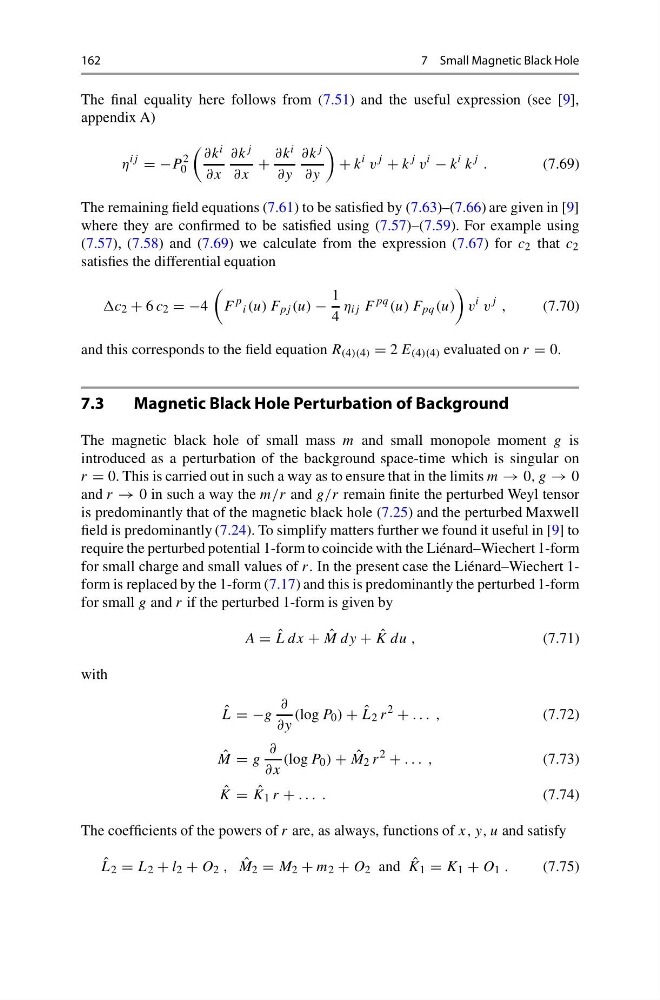
The final equality here follows from (7.51) and the useful expression (see [9],
appendix A)
η
ij
= −P
2
0
∂k i
∂x
∂k j
∂x
+
∂k i
∂y
∂k j
∂y
+ k
i v
j
+ k
j v
i
− k
i k
j .
(7.69)
The remaining field equations (7.61) to be satisfied by (7.63)–(7.66) are given in [9]
where they are confirmed to be satisfied using (7.57)–(7.59). For example using
(7.57), (7.58) and (7.69) we calculate from the expression (7.67) for c 2 that c 2
satisfies the differential equation
2 + 6 c 2 = −4
F
p
i (u) F pj (u) −
1
4
η ij F
pq (u) F pq (u)
v
i v
j ,
(7.70)
and this corresponds to the field equation R (4)(4) = 2 E (4)(4) evaluated on r = 0.
7.3
Magnetic Black Hole Perturbation of Background
The magnetic black hole of small mass m and small monopole moment g is
introduced as a perturbation of the background space-time which is singular on
r = 0. This is carried out in such a way as to ensure that in the limits m → 0, g → 0
and r → 0 in such a way the m/r and g/r remain finite the perturbed Weyl tensor
is predominantly that of the magnetic black hole (7.25) and the perturbed Maxwell
field is predominantly (7.24). To simplify matters further we found it useful in [9] to
require the perturbed potential 1-form to coincide with the Liénard–Wiechert 1-form
for small charge and small values of r. In the present case the Liénard–Wiechert 1form is replaced by the 1-form (7.17) and this is predominantly the perturbed 1-form
for small g and r if the perturbed 1-form is given by
A = ˆ
L dx + ˆ
M dy + ˆ
K du ,
(7.71)
with
ˆ
L = −g
∂
∂y
(log P 0 ) + ˆ
L 2 r
2
+ . . . ,
(7.72)
ˆ
M = g
∂
∂x
(log P 0 ) + ˆ
M 2 r
2
+ . . . ,
(7.73)
ˆ
K = ˆ
K 1 r + . . . .
(7.74)
The coefficients of the powers of r are, as always, functions of x, y, u and satisfy
ˆ
L 2 = L 2 + l 2 + O 2 , ˆ
M 2 = M 2 + m 2 + O 2 and ˆ
K 1 = K 1 + O 1 .
(7.75)
7 Small Magnetic Black Hole
The final equality here follows from (7.51) and the useful expression (see [9],
appendix A)
η
ij
= −P
2
0
∂k i
∂x
∂k j
∂x
+
∂k i
∂y
∂k j
∂y
+ k
i v
j
+ k
j v
i
− k
i k
j .
(7.69)
The remaining field equations (7.61) to be satisfied by (7.63)–(7.66) are given in [9]
where they are confirmed to be satisfied using (7.57)–(7.59). For example using
(7.57), (7.58) and (7.69) we calculate from the expression (7.67) for c 2 that c 2
satisfies the differential equation
2 + 6 c 2 = −4
F
p
i (u) F pj (u) −
1
4
η ij F
pq (u) F pq (u)
v
i v
j ,
(7.70)
and this corresponds to the field equation R (4)(4) = 2 E (4)(4) evaluated on r = 0.
7.3
Magnetic Black Hole Perturbation of Background
The magnetic black hole of small mass m and small monopole moment g is
introduced as a perturbation of the background space-time which is singular on
r = 0. This is carried out in such a way as to ensure that in the limits m → 0, g → 0
and r → 0 in such a way the m/r and g/r remain finite the perturbed Weyl tensor
is predominantly that of the magnetic black hole (7.25) and the perturbed Maxwell
field is predominantly (7.24). To simplify matters further we found it useful in [9] to
require the perturbed potential 1-form to coincide with the Liénard–Wiechert 1-form
for small charge and small values of r. In the present case the Liénard–Wiechert 1form is replaced by the 1-form (7.17) and this is predominantly the perturbed 1-form
for small g and r if the perturbed 1-form is given by
A = ˆ
L dx + ˆ
M dy + ˆ
K du ,
(7.71)
with
ˆ
L = −g
∂
∂y
(log P 0 ) + ˆ
L 2 r
2
+ . . . ,
(7.72)
ˆ
M = g
∂
∂x
(log P 0 ) + ˆ
M 2 r
2
+ . . . ,
(7.73)
ˆ
K = ˆ
K 1 r + . . . .
(7.74)
The coefficients of the powers of r are, as always, functions of x, y, u and satisfy
ˆ
L 2 = L 2 + l 2 + O 2 , ˆ
M 2 = M 2 + m 2 + O 2 and ˆ
K 1 = K 1 + O 1 .
(7.75)