

1.1 Time-Like Conguences
5
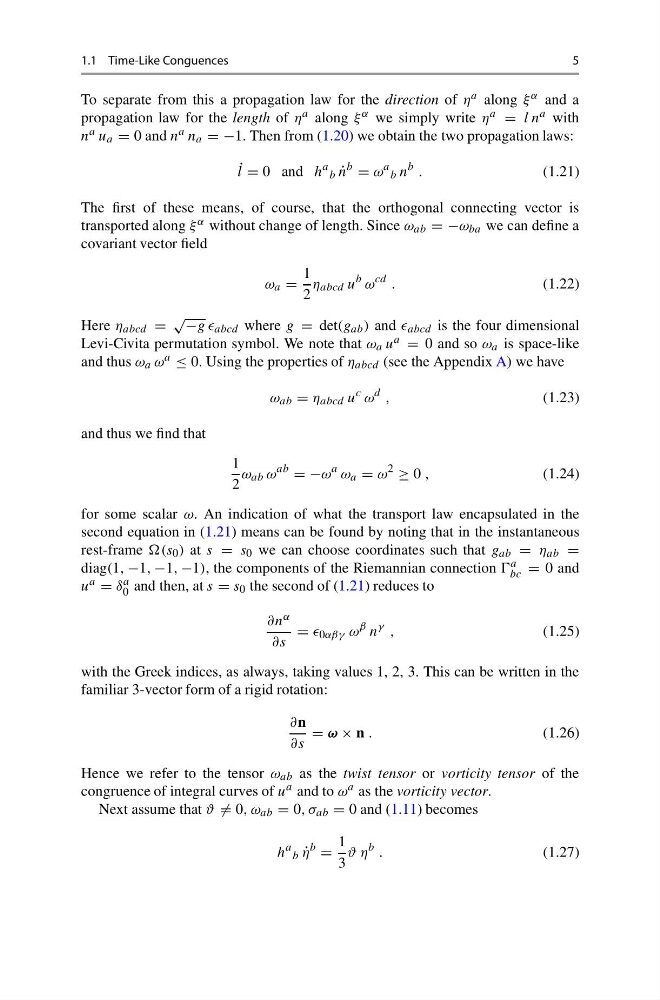
To separate from this a propagation law for the direction of η a along ξ α and a
propagation law for the length of η a along ξ α we simply write η a = l n a with
n a u a = 0 and n a n a = −1. Then from (1.20) we obtain the two propagation laws:
˙
l = 0 and h
a
b ˙
n
b
= ω
a
b n
b .
(1.21)
The first of these means, of course, that the orthogonal connecting vector is
transported along ξ α without change of length. Since ω ab = −ω ba we can define a
covariant vector field
ω a =
1
2
η abcd u
b ω
cd .
(1.22)
Here η abcd =
√ −g g abcd where g = det(g ab ) and abcd is the four dimensional
Levi-Civita permutation symbol. We note that ω a u a = 0 and so ω a is space-like
and thus ω a ω a ≤ 0. Using the properties of η abcd (see the Appendix A) we have
ω ab = η abcd u
c ω
d ,
(1.23)
and thus we find that
1
2
ω ab ω
ab
= −ω
a ω a = ω
2
≥ 0 ,
(1.24)
for some scalar ω. An indication of what the transport law encapsulated in the
second equation in (1.21) means can be found by noting that in the instantaneous
rest-frame (s 0 ) at s = s 0 we can choose coordinates such that g ab = η ab =
diag(1, −1, −1, −1), the components of the Riemannian connection
a
bc = 0 and
u a = δ
a
0 and then, at s = s 0 the second of (1.21) reduces to
∂n α
∂s
= 0αβγ ω
β n
γ ,
(1.25)
with the Greek indices, as always, taking values 1, 2, 3. This can be written in the
familiar 3-vector form of a rigid rotation:
∂n
∂s
= ω × n .
(1.26)
Hence we refer to the tensor ω ab as the twist tensor or vorticity tensor of the
congruence of integral curves of u a and to ω a as the vorticity vector.
Next assume that ϑ = 0, ω ab = 0, σ ab = 0 and (1.11) becomes
h
a
b ˙
η
b
=
1
3
ϑ η
b .
(1.27)
5
To separate from this a propagation law for the direction of η a along ξ α and a
propagation law for the length of η a along ξ α we simply write η a = l n a with
n a u a = 0 and n a n a = −1. Then from (1.20) we obtain the two propagation laws:
˙
l = 0 and h
a
b ˙
n
b
= ω
a
b n
b .
(1.21)
The first of these means, of course, that the orthogonal connecting vector is
transported along ξ α without change of length. Since ω ab = −ω ba we can define a
covariant vector field
ω a =
1
2
η abcd u
b ω
cd .
(1.22)
Here η abcd =
√ −g g abcd where g = det(g ab ) and abcd is the four dimensional
Levi-Civita permutation symbol. We note that ω a u a = 0 and so ω a is space-like
and thus ω a ω a ≤ 0. Using the properties of η abcd (see the Appendix A) we have
ω ab = η abcd u
c ω
d ,
(1.23)
and thus we find that
1
2
ω ab ω
ab
= −ω
a ω a = ω
2
≥ 0 ,
(1.24)
for some scalar ω. An indication of what the transport law encapsulated in the
second equation in (1.21) means can be found by noting that in the instantaneous
rest-frame (s 0 ) at s = s 0 we can choose coordinates such that g ab = η ab =
diag(1, −1, −1, −1), the components of the Riemannian connection
a
bc = 0 and
u a = δ
a
0 and then, at s = s 0 the second of (1.21) reduces to
∂n α
∂s
= 0αβγ ω
β n
γ ,
(1.25)
with the Greek indices, as always, taking values 1, 2, 3. This can be written in the
familiar 3-vector form of a rigid rotation:
∂n
∂s
= ω × n .
(1.26)
Hence we refer to the tensor ω ab as the twist tensor or vorticity tensor of the
congruence of integral curves of u a and to ω a as the vorticity vector.
Next assume that ϑ = 0, ω ab = 0, σ ab = 0 and (1.11) becomes
h
a
b ˙
η
b
=
1
3
ϑ η
b .
(1.27)