

6.4 de Sitter Space-Time Revisited
141
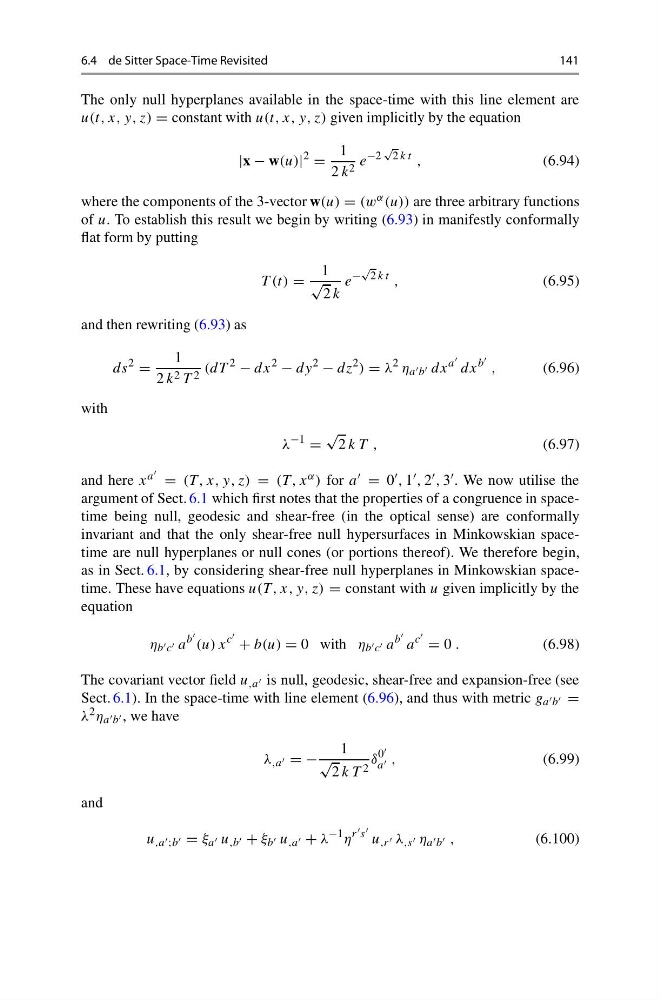
The only null hyperplanes available in the space-time with this line element are
u(t, x, y, z) = constant with u(t, x, y, z) given implicitly by the equation
|x − w(u)|
2
=
1
2 k 2 e
−2
√
2 k t ,
(6.94)
where the components of the 3-vector w(u) = (w α (u)) are three arbitrary functions
of u. To establish this result we begin by writing (6.93) in manifestly conformally
flat form by putting
T (t) =
1
√
2 k
e
−
√
2 k t ,
(6.95)
and then rewriting (6.93) as
ds
2
=
1
2 k 2 T 2 (dT
2
− dx
2
− dy
2
− dz
2 ) = λ
2 η a b dx
a
dx
b
,
(6.96)
with
λ
−1
=
√
2 k T ,
(6.97)
and here x a = (T , x, y, z) = (T , x α ) for a = 0 , 1 , 2 , 3 . We now utilise the
argument of Sect. 6.1 which first notes that the properties of a congruence in spacetime being null, geodesic and shear-free (in the optical sense) are conformally
invariant and that the only shear-free null hypersurfaces in Minkowskian spacetime are null hyperplanes or null cones (or portions thereof). We therefore begin,
as in Sect. 6.1, by considering shear-free null hyperplanes in Minkowskian spacetime. These have equations u(T , x, y, z) = constant with u given implicitly by the
equation
η b c a
b
(u) x
c + b(u) = 0 with η b c a
b
a
c = 0 .
(6.98)
The covariant vector field u ,a is null, geodesic, shear-free and expansion-free (see
Sect. 6.1). In the space-time with line element (6.96), and thus with metric g a b =
λ 2 η a b , we have
λ ,a = −
1
√
2 k T 2
δ
0
a ,
(6.99)
and
u ,a ;b = ξ a u ,b + ξ b u ,a + λ
−1 η
r s
u ,r λ ,s η a b ,
(6.100)
141
The only null hyperplanes available in the space-time with this line element are
u(t, x, y, z) = constant with u(t, x, y, z) given implicitly by the equation
|x − w(u)|
2
=
1
2 k 2 e
−2
√
2 k t ,
(6.94)
where the components of the 3-vector w(u) = (w α (u)) are three arbitrary functions
of u. To establish this result we begin by writing (6.93) in manifestly conformally
flat form by putting
T (t) =
1
√
2 k
e
−
√
2 k t ,
(6.95)
and then rewriting (6.93) as
ds
2
=
1
2 k 2 T 2 (dT
2
− dx
2
− dy
2
− dz
2 ) = λ
2 η a b dx
a
dx
b
,
(6.96)
with
λ
−1
=
√
2 k T ,
(6.97)
and here x a = (T , x, y, z) = (T , x α ) for a = 0 , 1 , 2 , 3 . We now utilise the
argument of Sect. 6.1 which first notes that the properties of a congruence in spacetime being null, geodesic and shear-free (in the optical sense) are conformally
invariant and that the only shear-free null hypersurfaces in Minkowskian spacetime are null hyperplanes or null cones (or portions thereof). We therefore begin,
as in Sect. 6.1, by considering shear-free null hyperplanes in Minkowskian spacetime. These have equations u(T , x, y, z) = constant with u given implicitly by the
equation
η b c a
b
(u) x
c + b(u) = 0 with η b c a
b
a
c = 0 .
(6.98)
The covariant vector field u ,a is null, geodesic, shear-free and expansion-free (see
Sect. 6.1). In the space-time with line element (6.96), and thus with metric g a b =
λ 2 η a b , we have
λ ,a = −
1
√
2 k T 2
δ
0
a ,
(6.99)
and
u ,a ;b = ξ a u ,b + ξ b u ,a + λ
−1 η
r s
u ,r λ ,s η a b ,
(6.100)