

138
6 de Sitter Cosmology
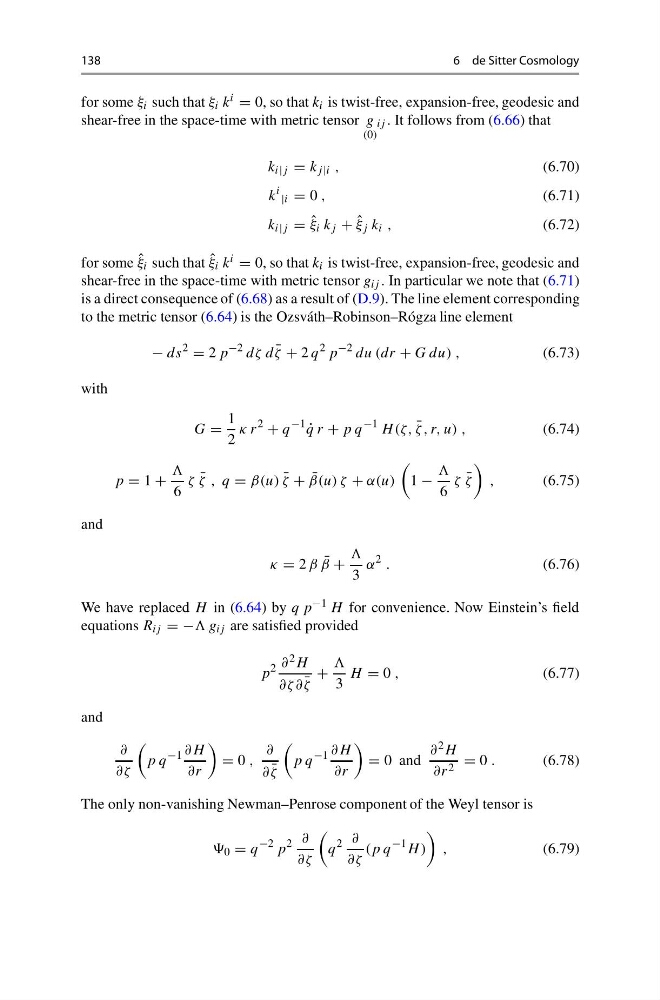
for some ξ i such that ξ i k i = 0, so that k i is twist-free, expansion-free, geodesic and
shear-free in the space-time with metric tensor g
(0)
ij . It follows from (6.66) that
k i|j = k j |i ,
(6.70)
k
i |i = 0 ,
(6.71)
k i|j = ˆ
ξ i k j + ˆ
ξ j k i ,
(6.72)
for some ˆ
ξ i such that ˆ
ξ i k i = 0, so that k i is twist-free, expansion-free, geodesic and
shear-free in the space-time with metric tensor g ij . In particular we note that (6.71)
is a direct consequence of (6.68) as a result of (D.9). The line element corresponding
to the metric tensor (6.64) is the Ozsváth–Robinson–Rógza line element
− ds
2
= 2 p
−2 dζ d ¯
ζ + 2 q
2 p
−2 du (dr + G du) ,
(6.73)
with
G =
1
2
κ r
2
+ q
−1
˙
q r + p q
−1 H (ζ, ¯
ζ , r, u) ,
(6.74)
p = 1 +
6
ζ ¯
ζ , q = β(u) ¯
ζ + ¯
β(u) ζ + α(u)
1 −
6
ζ ¯
ζ
,
(6.75)
and
κ = 2 β ¯
β +
3
α
2 .
(6.76)
We have replaced H in (6.64) by q p −1 H for convenience. Now Einstein’s field
equations R ij = − g ij are satisfied provided
p
2 ∂ 2 H
∂ζ ∂ ¯
ζ
+
3
H = 0 ,
(6.77)
and
∂
∂ζ
p q
−1 ∂H
∂r
= 0 ,
∂
∂ ¯
ζ
p q
−1 ∂H
∂r
= 0 and
∂ 2 H
∂r 2 = 0 .
(6.78)
The only non-vanishing Newman–Penrose component of the Weyl tensor is
0 = q
−2 p
2 ∂
∂ζ
q
2 ∂
∂ζ
(p q
−1 H )
,
(6.79)
6 de Sitter Cosmology
for some ξ i such that ξ i k i = 0, so that k i is twist-free, expansion-free, geodesic and
shear-free in the space-time with metric tensor g
(0)
ij . It follows from (6.66) that
k i|j = k j |i ,
(6.70)
k
i |i = 0 ,
(6.71)
k i|j = ˆ
ξ i k j + ˆ
ξ j k i ,
(6.72)
for some ˆ
ξ i such that ˆ
ξ i k i = 0, so that k i is twist-free, expansion-free, geodesic and
shear-free in the space-time with metric tensor g ij . In particular we note that (6.71)
is a direct consequence of (6.68) as a result of (D.9). The line element corresponding
to the metric tensor (6.64) is the Ozsváth–Robinson–Rógza line element
− ds
2
= 2 p
−2 dζ d ¯
ζ + 2 q
2 p
−2 du (dr + G du) ,
(6.73)
with
G =
1
2
κ r
2
+ q
−1
˙
q r + p q
−1 H (ζ, ¯
ζ , r, u) ,
(6.74)
p = 1 +
6
ζ ¯
ζ , q = β(u) ¯
ζ + ¯
β(u) ζ + α(u)
1 −
6
ζ ¯
ζ
,
(6.75)
and
κ = 2 β ¯
β +
3
α
2 .
(6.76)
We have replaced H in (6.64) by q p −1 H for convenience. Now Einstein’s field
equations R ij = − g ij are satisfied provided
p
2 ∂ 2 H
∂ζ ∂ ¯
ζ
+
3
H = 0 ,
(6.77)
and
∂
∂ζ
p q
−1 ∂H
∂r
= 0 ,
∂
∂ ¯
ζ
p q
−1 ∂H
∂r
= 0 and
∂ 2 H
∂r 2 = 0 .
(6.78)
The only non-vanishing Newman–Penrose component of the Weyl tensor is
0 = q
−2 p
2 ∂
∂ζ
q
2 ∂
∂ζ
(p q
−1 H )
,
(6.79)