

62
3 Physical Theory of RFID System Physical Anti-Collision
S =
P tx G tx
4πR 2 =
P EIR
4πR 2
(3.5)
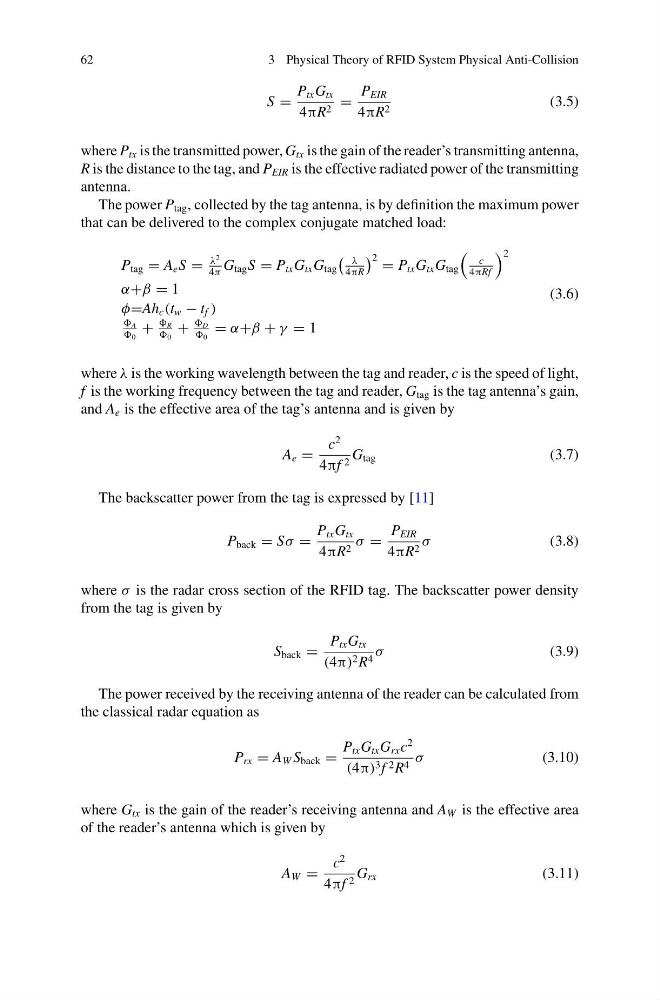
where P tx is the transmitted power, G tx is the gain of the reader’s transmitting antenna,
R is the distance to the tag, and P EIR is the effective radiated power of the transmitting
antenna.
The power P tag , collected by the tag antenna, is by definition the maximum power
that can be delivered to the complex conjugate matched load:
P tag = A e S =
λ
2
4π
G tag S = P tx G tx G tag
λ
4πR
2 = P tx G tx G tag
c
4πRf
2
α+β = 1
φ=Ah c (t w − t f )
A
0
+
R
0
+
D
0
= α+β + γ = 1
(3.6)
where λ is the working wavelength between the tag and reader, c is the speed of light,
f is the working frequency between the tag and reader, G tag is the tag antenna’s gain,
and A e is the effective area of the tag’s antenna and is given by
A e =
c
2
4πf 2 G tag
(3.7)
The backscatter power from the tag is expressed by [11]
P back = Sσ =
P tx G tx
4πR 2 σ =
P EIR
4πR 2 σ
(3.8)
where σ is the radar cross section of the RFID tag. The backscatter power density
from the tag is given by
S back =
P tx G tx
(4π) 2 R 4 σ
(3.9)
The power received by the receiving antenna of the reader can be calculated from
the classical radar equation as
P rx = A W S back =
P tx G tx G rx c
2
(4π) 3 f 2 R 4 σ
(3.10)
where G tx is the gain of the reader’s receiving antenna and A W is the effective area
of the reader’s antenna which is given by
A W =
c
2
4πf 2 G rx
(3.11)
3 Physical Theory of RFID System Physical Anti-Collision
S =
P tx G tx
4πR 2 =
P EIR
4πR 2
(3.5)
where P tx is the transmitted power, G tx is the gain of the reader’s transmitting antenna,
R is the distance to the tag, and P EIR is the effective radiated power of the transmitting
antenna.
The power P tag , collected by the tag antenna, is by definition the maximum power
that can be delivered to the complex conjugate matched load:
P tag = A e S =
λ
2
4π
G tag S = P tx G tx G tag
λ
4πR
2 = P tx G tx G tag
c
4πRf
2
α+β = 1
φ=Ah c (t w − t f )
A
0
+
R
0
+
D
0
= α+β + γ = 1
(3.6)
where λ is the working wavelength between the tag and reader, c is the speed of light,
f is the working frequency between the tag and reader, G tag is the tag antenna’s gain,
and A e is the effective area of the tag’s antenna and is given by
A e =
c
2
4πf 2 G tag
(3.7)
The backscatter power from the tag is expressed by [11]
P back = Sσ =
P tx G tx
4πR 2 σ =
P EIR
4πR 2 σ
(3.8)
where σ is the radar cross section of the RFID tag. The backscatter power density
from the tag is given by
S back =
P tx G tx
(4π) 2 R 4 σ
(3.9)
The power received by the receiving antenna of the reader can be calculated from
the classical radar equation as
P rx = A W S back =
P tx G tx G rx c
2
(4π) 3 f 2 R 4 σ
(3.10)
where G tx is the gain of the reader’s receiving antenna and A W is the effective area
of the reader’s antenna which is given by
A W =
c
2
4πf 2 G rx
(3.11)