

1.2 RFID System Anti-Collision Technology
23
(3) The method of constructing RFID multi-input multi-output (RFID-MIMO)
system
With the in-depth research on RFID and the rapid development of multi-input multioutput (MIMO) communication, the RFID-MIMO system established by the integration of RFID and MIMO communication presents a broad space for development.
MIMO technology improves the reliability of the RFID system by eliminating interference through near-field spatial multiplexing and far-field spatial diversity. MIMO
channel has multiple links working at the same frequency, which can lengthen the
read–write distance of RFID, reduce the system error rate of RFID and improve the
read–write rate of tags without increasing the signal bandwidth.
(4) Methods to reduce the electromagnetic interference in ambient space
It can be seen from Eq. (1.4) that noise in space will have an impact on the communication channel of the RFID system. Therefore, when designing and applying RFID
systems, if engineers can accurately grasp the impact of the environment on the electromagnetic field, and correctly use these parameters to optimize the system, then it
will be very helpful to improve the whole RFID system’s reading performance and
reduce the error rate of reading.
For the parameters of the environmental electromagnetic field, the following three
points are mainly considered:
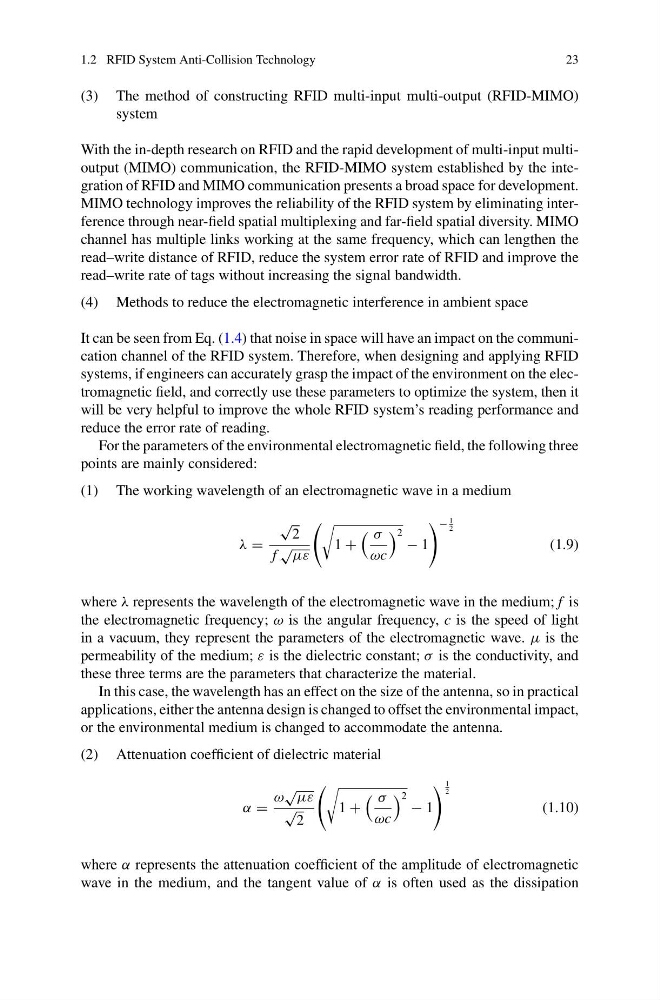
(1) The working wavelength of an electromagnetic wave in a medium
λ =
√
2
f
√ με
1 +
σ
ωc
2 − 1
−
1
2
(1.9)
where λ represents the wavelength of the electromagnetic wave in the medium; f is
the electromagnetic frequency; ω is the angular frequency, c is the speed of light
in a vacuum, they represent the parameters of the electromagnetic wave. μ is the
permeability of the medium; ε is the dielectric constant; σ is the conductivity, and
these three terms are the parameters that characterize the material.
In this case, the wavelength has an effect on the size of the antenna, so in practical
applications, either the antenna design is changed to offset the environmental impact,
or the environmental medium is changed to accommodate the antenna.
(2) Attenuation coefficient of dielectric material
α =
ω
√
με
√
2
1 +
σ
ωc
2 − 1
1
2
(1.10)
where α represents the attenuation coefficient of the amplitude of electromagnetic
wave in the medium, and the tangent value of α is often used as the dissipation
23
(3) The method of constructing RFID multi-input multi-output (RFID-MIMO)
system
With the in-depth research on RFID and the rapid development of multi-input multioutput (MIMO) communication, the RFID-MIMO system established by the integration of RFID and MIMO communication presents a broad space for development.
MIMO technology improves the reliability of the RFID system by eliminating interference through near-field spatial multiplexing and far-field spatial diversity. MIMO
channel has multiple links working at the same frequency, which can lengthen the
read–write distance of RFID, reduce the system error rate of RFID and improve the
read–write rate of tags without increasing the signal bandwidth.
(4) Methods to reduce the electromagnetic interference in ambient space
It can be seen from Eq. (1.4) that noise in space will have an impact on the communication channel of the RFID system. Therefore, when designing and applying RFID
systems, if engineers can accurately grasp the impact of the environment on the electromagnetic field, and correctly use these parameters to optimize the system, then it
will be very helpful to improve the whole RFID system’s reading performance and
reduce the error rate of reading.
For the parameters of the environmental electromagnetic field, the following three
points are mainly considered:
(1) The working wavelength of an electromagnetic wave in a medium
λ =
√
2
f
√ με
1 +
σ
ωc
2 − 1
−
1
2
(1.9)
where λ represents the wavelength of the electromagnetic wave in the medium; f is
the electromagnetic frequency; ω is the angular frequency, c is the speed of light
in a vacuum, they represent the parameters of the electromagnetic wave. μ is the
permeability of the medium; ε is the dielectric constant; σ is the conductivity, and
these three terms are the parameters that characterize the material.
In this case, the wavelength has an effect on the size of the antenna, so in practical
applications, either the antenna design is changed to offset the environmental impact,
or the environmental medium is changed to accommodate the antenna.
(2) Attenuation coefficient of dielectric material
α =
ω
√
με
√
2
1 +
σ
ωc
2 − 1
1
2
(1.10)
where α represents the attenuation coefficient of the amplitude of electromagnetic
wave in the medium, and the tangent value of α is often used as the dissipation