

1.2 RFID System Anti-Collision Technology
19
The disadvantage of the fixed slot ALOHA method is that the system efficiency
is very low when the number of slots in the frame is different from the number of
tags.
(4) Dynamic framed slotted ALOHA(DFSA) algorithm
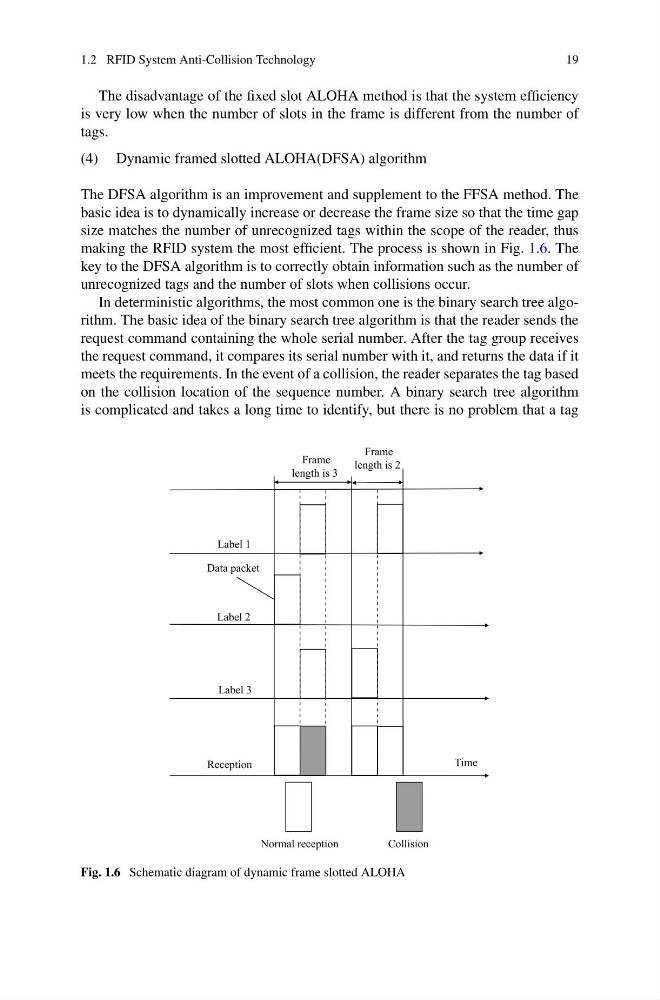
The DFSA algorithm is an improvement and supplement to the FFSA method. The
basic idea is to dynamically increase or decrease the frame size so that the time gap
size matches the number of unrecognized tags within the scope of the reader, thus
making the RFID system the most efficient. The process is shown in Fig. 1.6. The
key to the DFSA algorithm is to correctly obtain information such as the number of
unrecognized tags and the number of slots when collisions occur.
In deterministic algorithms, the most common one is the binary search tree algorithm. The basic idea of the binary search tree algorithm is that the reader sends the
request command containing the whole serial number. After the tag group receives
the request command, it compares its serial number with it, and returns the data if it
meets the requirements. In the event of a collision, the reader separates the tag based
on the collision location of the sequence number. A binary search tree algorithm
is complicated and takes a long time to identify, but there is no problem that a tag
Fig. 1.6 Schematic diagram of dynamic frame slotted ALOHA
19
The disadvantage of the fixed slot ALOHA method is that the system efficiency
is very low when the number of slots in the frame is different from the number of
tags.
(4) Dynamic framed slotted ALOHA(DFSA) algorithm
The DFSA algorithm is an improvement and supplement to the FFSA method. The
basic idea is to dynamically increase or decrease the frame size so that the time gap
size matches the number of unrecognized tags within the scope of the reader, thus
making the RFID system the most efficient. The process is shown in Fig. 1.6. The
key to the DFSA algorithm is to correctly obtain information such as the number of
unrecognized tags and the number of slots when collisions occur.
In deterministic algorithms, the most common one is the binary search tree algorithm. The basic idea of the binary search tree algorithm is that the reader sends the
request command containing the whole serial number. After the tag group receives
the request command, it compares its serial number with it, and returns the data if it
meets the requirements. In the event of a collision, the reader separates the tag based
on the collision location of the sequence number. A binary search tree algorithm
is complicated and takes a long time to identify, but there is no problem that a tag
Fig. 1.6 Schematic diagram of dynamic frame slotted ALOHA