

120
4 Image Theory of RFID System Physical Anti-Collision
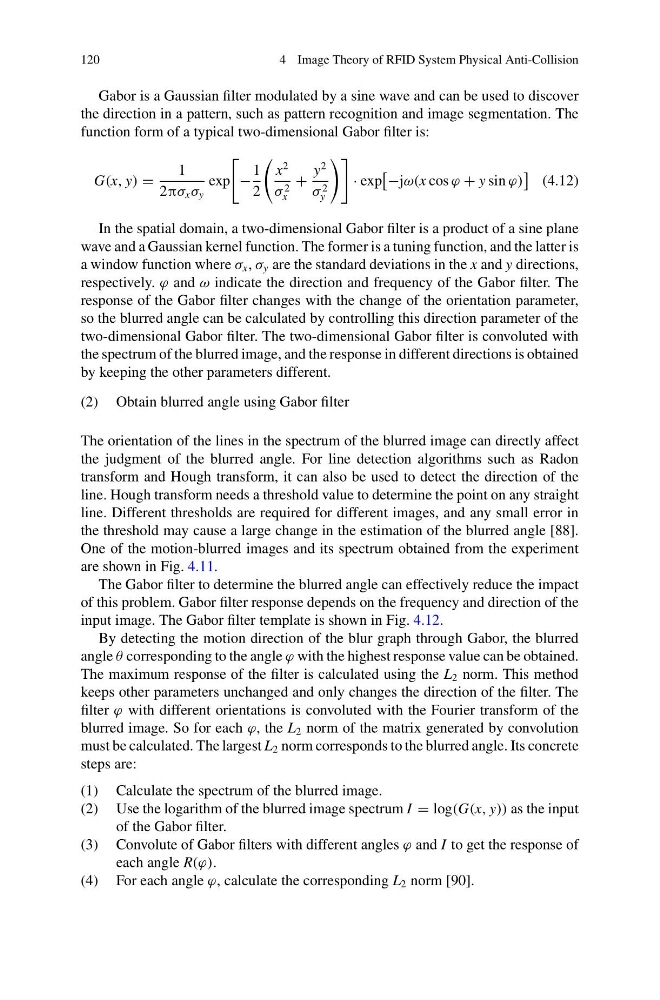
Gabor is a Gaussian filter modulated by a sine wave and can be used to discover
the direction in a pattern, such as pattern recognition and image segmentation. The
function form of a typical two-dimensional Gabor filter is:
G(x, y) =
1
2πσ x σ y
exp
−
1
2
x
2
σ 2
x
+
y
2
σ 2
y
· exp
−jω(x cos ϕ + y sin ϕ)
(4.12)
In the spatial domain, a two-dimensional Gabor filter is a product of a sine plane
wave and a Gaussian kernel function. The former is a tuning function, and the latter is
a window function where σ x , σ y are the standard deviations in the x and y directions,
respectively. ϕ and ω indicate the direction and frequency of the Gabor filter. The
response of the Gabor filter changes with the change of the orientation parameter,
so the blurred angle can be calculated by controlling this direction parameter of the
two-dimensional Gabor filter. The two-dimensional Gabor filter is convoluted with
the spectrum of the blurred image, and the response in different directions is obtained
by keeping the other parameters different.
(2) Obtain blurred angle using Gabor filter
The orientation of the lines in the spectrum of the blurred image can directly affect
the judgment of the blurred angle. For line detection algorithms such as Radon
transform and Hough transform, it can also be used to detect the direction of the
line. Hough transform needs a threshold value to determine the point on any straight
line. Different thresholds are required for different images, and any small error in
the threshold may cause a large change in the estimation of the blurred angle [88].
One of the motion-blurred images and its spectrum obtained from the experiment
are shown in Fig. 4.11.
The Gabor filter to determine the blurred angle can effectively reduce the impact
of this problem. Gabor filter response depends on the frequency and direction of the
input image. The Gabor filter template is shown in Fig. 4.12.
By detecting the motion direction of the blur graph through Gabor, the blurred
angle θ corresponding to the angle ϕ with the highest response value can be obtained.
The maximum response of the filter is calculated using the L 2 norm. This method
keeps other parameters unchanged and only changes the direction of the filter. The
filter ϕ with different orientations is convoluted with the Fourier transform of the
blurred image. So for each ϕ, the L 2 norm of the matrix generated by convolution
must be calculated. The largest L 2 norm corresponds to the blurred angle. Its concrete
steps are:
(1) Calculate the spectrum of the blurred image.
(2) Use the logarithm of the blurred image spectrum I = log(G(x, y)) as the input
of the Gabor filter.
(3) Convolute of Gabor filters with different angles ϕ and I to get the response of
each angle R(ϕ).
(4) For each angle ϕ, calculate the corresponding L 2 norm [90].
4 Image Theory of RFID System Physical Anti-Collision
Gabor is a Gaussian filter modulated by a sine wave and can be used to discover
the direction in a pattern, such as pattern recognition and image segmentation. The
function form of a typical two-dimensional Gabor filter is:
G(x, y) =
1
2πσ x σ y
exp
−
1
2
x
2
σ 2
x
+
y
2
σ 2
y
· exp
−jω(x cos ϕ + y sin ϕ)
(4.12)
In the spatial domain, a two-dimensional Gabor filter is a product of a sine plane
wave and a Gaussian kernel function. The former is a tuning function, and the latter is
a window function where σ x , σ y are the standard deviations in the x and y directions,
respectively. ϕ and ω indicate the direction and frequency of the Gabor filter. The
response of the Gabor filter changes with the change of the orientation parameter,
so the blurred angle can be calculated by controlling this direction parameter of the
two-dimensional Gabor filter. The two-dimensional Gabor filter is convoluted with
the spectrum of the blurred image, and the response in different directions is obtained
by keeping the other parameters different.
(2) Obtain blurred angle using Gabor filter
The orientation of the lines in the spectrum of the blurred image can directly affect
the judgment of the blurred angle. For line detection algorithms such as Radon
transform and Hough transform, it can also be used to detect the direction of the
line. Hough transform needs a threshold value to determine the point on any straight
line. Different thresholds are required for different images, and any small error in
the threshold may cause a large change in the estimation of the blurred angle [88].
One of the motion-blurred images and its spectrum obtained from the experiment
are shown in Fig. 4.11.
The Gabor filter to determine the blurred angle can effectively reduce the impact
of this problem. Gabor filter response depends on the frequency and direction of the
input image. The Gabor filter template is shown in Fig. 4.12.
By detecting the motion direction of the blur graph through Gabor, the blurred
angle θ corresponding to the angle ϕ with the highest response value can be obtained.
The maximum response of the filter is calculated using the L 2 norm. This method
keeps other parameters unchanged and only changes the direction of the filter. The
filter ϕ with different orientations is convoluted with the Fourier transform of the
blurred image. So for each ϕ, the L 2 norm of the matrix generated by convolution
must be calculated. The largest L 2 norm corresponds to the blurred angle. Its concrete
steps are:
(1) Calculate the spectrum of the blurred image.
(2) Use the logarithm of the blurred image spectrum I = log(G(x, y)) as the input
of the Gabor filter.
(3) Convolute of Gabor filters with different angles ϕ and I to get the response of
each angle R(ϕ).
(4) For each angle ϕ, calculate the corresponding L 2 norm [90].