

118
4 Image Theory of RFID System Physical Anti-Collision
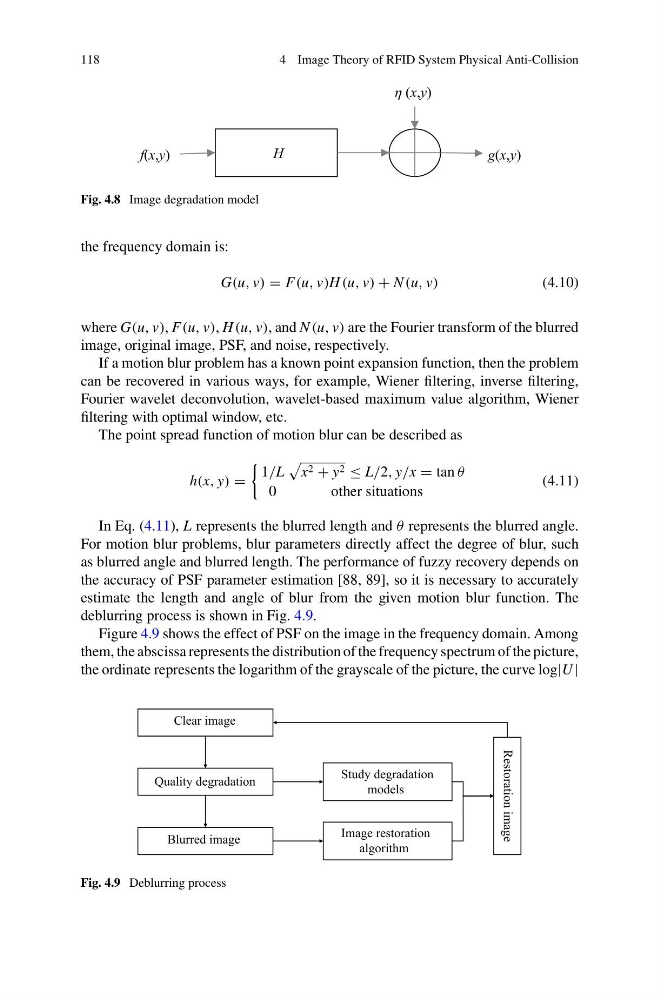
Fig. 4.8 Image degradation model
the frequency domain is:
G(u, v) = F(u, v)H (u, v) + N (u, v)
(4.10)
where G(u, v), F(u, v), H (u, v), and N (u, v) are the Fourier transform of the blurred
image, original image, PSF, and noise, respectively.
If a motion blur problem has a known point expansion function, then the problem
can be recovered in various ways, for example, Wiener filtering, inverse filtering,
Fourier wavelet deconvolution, wavelet-based maximum value algorithm, Wiener
filtering with optimal window, etc.
The point spread function of motion blur can be described as
h(x, y) =
1/L
x 2 + y 2 ≤ L/2, y/x = tan θ
0
other situations
(4.11)
In Eq. (4.11), L represents the blurred length and θ represents the blurred angle.
For motion blur problems, blur parameters directly affect the degree of blur, such
as blurred angle and blurred length. The performance of fuzzy recovery depends on
the accuracy of PSF parameter estimation [88, 89], so it is necessary to accurately
estimate the length and angle of blur from the given motion blur function. The
deblurring process is shown in Fig. 4.9.
Figure 4.9 shows the effect of PSF on the image in the frequency domain. Among
them, the abscissa represents the distribution of the frequency spectrum of the picture,
the ordinate represents the logarithm of the grayscale of the picture, the curve log|U |
Fig. 4.9 Deblurring process
4 Image Theory of RFID System Physical Anti-Collision
Fig. 4.8 Image degradation model
the frequency domain is:
G(u, v) = F(u, v)H (u, v) + N (u, v)
(4.10)
where G(u, v), F(u, v), H (u, v), and N (u, v) are the Fourier transform of the blurred
image, original image, PSF, and noise, respectively.
If a motion blur problem has a known point expansion function, then the problem
can be recovered in various ways, for example, Wiener filtering, inverse filtering,
Fourier wavelet deconvolution, wavelet-based maximum value algorithm, Wiener
filtering with optimal window, etc.
The point spread function of motion blur can be described as
h(x, y) =
1/L
x 2 + y 2 ≤ L/2, y/x = tan θ
0
other situations
(4.11)
In Eq. (4.11), L represents the blurred length and θ represents the blurred angle.
For motion blur problems, blur parameters directly affect the degree of blur, such
as blurred angle and blurred length. The performance of fuzzy recovery depends on
the accuracy of PSF parameter estimation [88, 89], so it is necessary to accurately
estimate the length and angle of blur from the given motion blur function. The
deblurring process is shown in Fig. 4.9.
Figure 4.9 shows the effect of PSF on the image in the frequency domain. Among
them, the abscissa represents the distribution of the frequency spectrum of the picture,
the ordinate represents the logarithm of the grayscale of the picture, the curve log|U |
Fig. 4.9 Deblurring process