

106
3 Physical Theory of RFID System Physical Anti-Collision
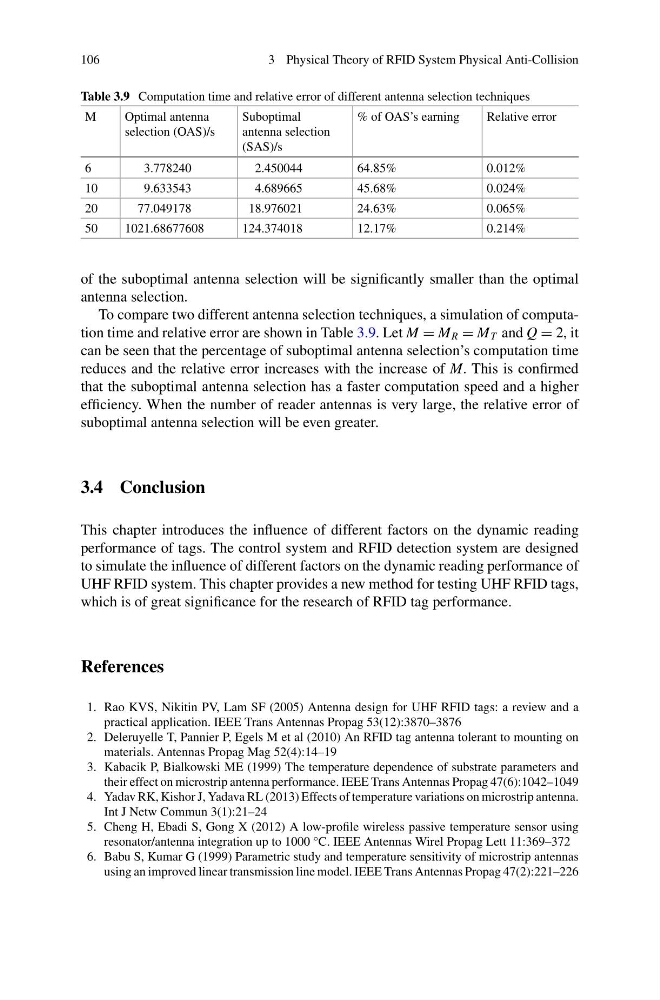
Table 3.9 Computation time and relative error of different antenna selection techniques
M
Optimal antenna
selection (OAS)/s
Suboptimal
antenna selection
(SAS)/s
% of OAS’s earning
Relative error
6
3.778240
2.450044
64.85%
0.012%
10
9.633543
4.689665
45.68%
0.024%
20
77.049178
18.976021
24.63%
0.065%
50
1021.68677608
124.374018
12.17%
0.214%
of the suboptimal antenna selection will be significantly smaller than the optimal
antenna selection.
To compare two different antenna selection techniques, a simulation of computation time and relative error are shown in Table 3.9. Let M = M R = M T and Q = 2, it
can be seen that the percentage of suboptimal antenna selection’s computation time
reduces and the relative error increases with the increase of M. This is confirmed
that the suboptimal antenna selection has a faster computation speed and a higher
efficiency. When the number of reader antennas is very large, the relative error of
suboptimal antenna selection will be even greater.
3.4 Conclusion
This chapter introduces the influence of different factors on the dynamic reading
performance of tags. The control system and RFID detection system are designed
to simulate the influence of different factors on the dynamic reading performance of
UHF RFID system. This chapter provides a new method for testing UHF RFID tags,
which is of great significance for the research of RFID tag performance.
References
1. Rao KVS, Nikitin PV, Lam SF (2005) Antenna design for UHF RFID tags: a review and a
practical application. IEEE Trans Antennas Propag 53(12):3870–3876
2. Deleruyelle T, Pannier P, Egels M et al (2010) An RFID tag antenna tolerant to mounting on
materials. Antennas Propag Mag 52(4):14–19
3. Kabacik P, Bialkowski ME (1999) The temperature dependence of substrate parameters and
their effect on microstrip antenna performance. IEEE Trans Antennas Propag 47(6):1042–1049
4. Yadav RK, Kishor J, Yadava RL (2013) Effects of temperature variations on microstrip antenna.
Int J Netw Commun 3(1):21–24
5. Cheng H, Ebadi S, Gong X (2012) A low-profile wireless passive temperature sensor using
resonator/antenna integration up to 1000 °C. IEEE Antennas Wirel Propag Lett 11:369–372
6. Babu S, Kumar G (1999) Parametric study and temperature sensitivity of microstrip antennas
using an improved linear transmission line model. IEEE Trans Antennas Propag 47(2):221–226
3 Physical Theory of RFID System Physical Anti-Collision
Table 3.9 Computation time and relative error of different antenna selection techniques
M
Optimal antenna
selection (OAS)/s
Suboptimal
antenna selection
(SAS)/s
% of OAS’s earning
Relative error
6
3.778240
2.450044
64.85%
0.012%
10
9.633543
4.689665
45.68%
0.024%
20
77.049178
18.976021
24.63%
0.065%
50
1021.68677608
124.374018
12.17%
0.214%
of the suboptimal antenna selection will be significantly smaller than the optimal
antenna selection.
To compare two different antenna selection techniques, a simulation of computation time and relative error are shown in Table 3.9. Let M = M R = M T and Q = 2, it
can be seen that the percentage of suboptimal antenna selection’s computation time
reduces and the relative error increases with the increase of M. This is confirmed
that the suboptimal antenna selection has a faster computation speed and a higher
efficiency. When the number of reader antennas is very large, the relative error of
suboptimal antenna selection will be even greater.
3.4 Conclusion
This chapter introduces the influence of different factors on the dynamic reading
performance of tags. The control system and RFID detection system are designed
to simulate the influence of different factors on the dynamic reading performance of
UHF RFID system. This chapter provides a new method for testing UHF RFID tags,
which is of great significance for the research of RFID tag performance.
References
1. Rao KVS, Nikitin PV, Lam SF (2005) Antenna design for UHF RFID tags: a review and a
practical application. IEEE Trans Antennas Propag 53(12):3870–3876
2. Deleruyelle T, Pannier P, Egels M et al (2010) An RFID tag antenna tolerant to mounting on
materials. Antennas Propag Mag 52(4):14–19
3. Kabacik P, Bialkowski ME (1999) The temperature dependence of substrate parameters and
their effect on microstrip antenna performance. IEEE Trans Antennas Propag 47(6):1042–1049
4. Yadav RK, Kishor J, Yadava RL (2013) Effects of temperature variations on microstrip antenna.
Int J Netw Commun 3(1):21–24
5. Cheng H, Ebadi S, Gong X (2012) A low-profile wireless passive temperature sensor using
resonator/antenna integration up to 1000 °C. IEEE Antennas Wirel Propag Lett 11:369–372
6. Babu S, Kumar G (1999) Parametric study and temperature sensitivity of microstrip antennas
using an improved linear transmission line model. IEEE Trans Antennas Propag 47(2):221–226