

3.3 Kinetic Analysis of Physical Anti-Collision …
95
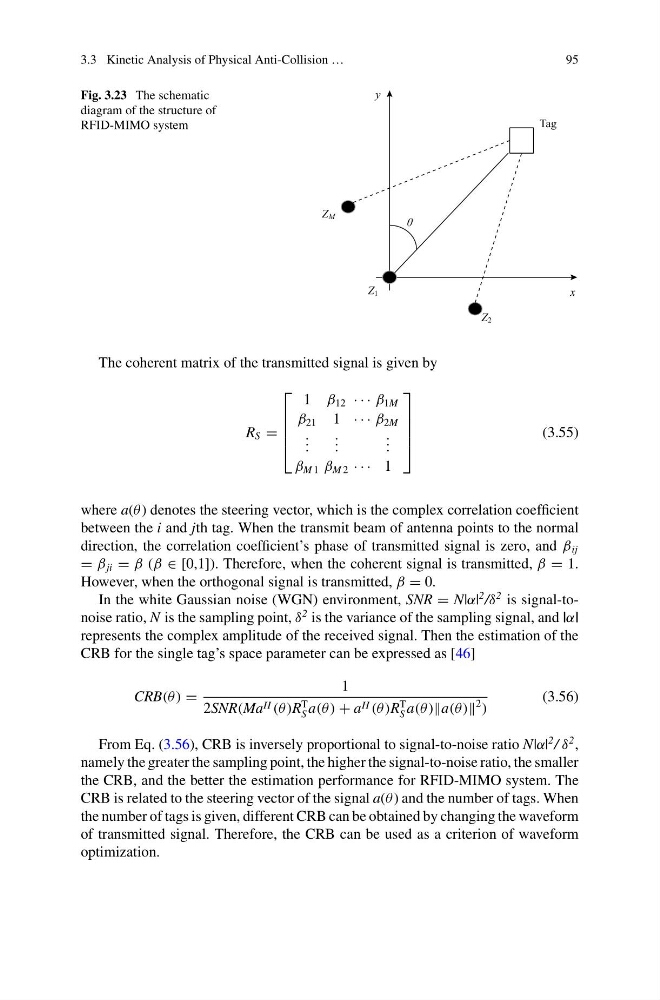
Fig. 3.23 The schematic
diagram of the structure of
RFID-MIMO system
The coherent matrix of the transmitted signal is given by
R S =
⎡
⎢
⎢
⎢
⎣
1 β 12 · · · β 1M
β 21 1 · · · β 2M
. . .
. . .
. . .
β M 1 β M 2 · · · 1
⎤
⎥
⎥
⎥
⎦
(3.55)
where a(θ ) denotes the steering vector, which is the complex correlation coefficient
between the i and jth tag. When the transmit beam of antenna points to the normal
direction, the correlation coefficient’s phase of transmitted signal is zero, and β ij
= β ji = β (β ∈ [0,1]). Therefore, when the coherent signal is transmitted, β = 1.
However, when the orthogonal signal is transmitted, β = 0.
In the white Gaussian noise (WGN) environment, SNR = N|α|
2 /δ
2 is signal-tonoise ratio, N is the sampling point, δ
2 is the variance of the sampling signal, and |α|
represents the complex amplitude of the received signal. Then the estimation of the
CRB for the single tag’s space parameter can be expressed as [46]
CRB(θ ) =
1
2SNR(Ma H (θ )R
T
S a(θ ) + a H (θ )R
T
S a(θ )a(θ )
2
)
(3.56)
From Eq. (3.56), CRB is inversely proportional to signal-to-noise ratio N|α|
2 / δ
2 ,
namely the greater the sampling point, the higher the signal-to-noise ratio, the smaller
the CRB, and the better the estimation performance for RFID-MIMO system. The
CRB is related to the steering vector of the signal a(θ ) and the number of tags. When
the number of tags is given, different CRB can be obtained by changing the waveform
of transmitted signal. Therefore, the CRB can be used as a criterion of waveform
optimization.
95
Fig. 3.23 The schematic
diagram of the structure of
RFID-MIMO system
The coherent matrix of the transmitted signal is given by
R S =
⎡
⎢
⎢
⎢
⎣
1 β 12 · · · β 1M
β 21 1 · · · β 2M
. . .
. . .
. . .
β M 1 β M 2 · · · 1
⎤
⎥
⎥
⎥
⎦
(3.55)
where a(θ ) denotes the steering vector, which is the complex correlation coefficient
between the i and jth tag. When the transmit beam of antenna points to the normal
direction, the correlation coefficient’s phase of transmitted signal is zero, and β ij
= β ji = β (β ∈ [0,1]). Therefore, when the coherent signal is transmitted, β = 1.
However, when the orthogonal signal is transmitted, β = 0.
In the white Gaussian noise (WGN) environment, SNR = N|α|
2 /δ
2 is signal-tonoise ratio, N is the sampling point, δ
2 is the variance of the sampling signal, and |α|
represents the complex amplitude of the received signal. Then the estimation of the
CRB for the single tag’s space parameter can be expressed as [46]
CRB(θ ) =
1
2SNR(Ma H (θ )R
T
S a(θ ) + a H (θ )R
T
S a(θ )a(θ )
2
)
(3.56)
From Eq. (3.56), CRB is inversely proportional to signal-to-noise ratio N|α|
2 / δ
2 ,
namely the greater the sampling point, the higher the signal-to-noise ratio, the smaller
the CRB, and the better the estimation performance for RFID-MIMO system. The
CRB is related to the steering vector of the signal a(θ ) and the number of tags. When
the number of tags is given, different CRB can be obtained by changing the waveform
of transmitted signal. Therefore, the CRB can be used as a criterion of waveform
optimization.