

2.13 Behaviour of Metals During Anodic Polarization
51
2.13 Behaviour of Metals During Anodic Polarization
When a non-noble metallic element is positively polarized, it can actively dissolve
if the surface is not covered by a protecting passive layer. This can be observed for
a number of metals if the solution does not contain anions with which the metal
of interest forms a weakly soluble compound (Ag, Cu, Pb, Bi, Cd, Co, Zn etc.).
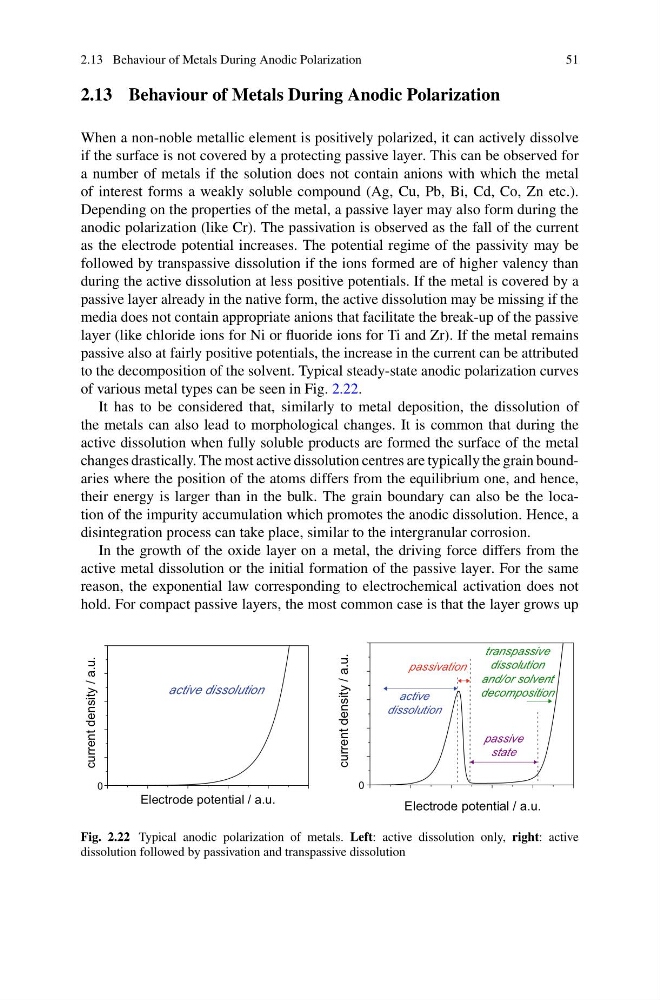
Depending on the properties of the metal, a passive layer may also form during the
anodic polarization (like Cr). The passivation is observed as the fall of the current
as the electrode potential increases. The potential regime of the passivity may be
followed by transpassive dissolution if the ions formed are of higher valency than
during the active dissolution at less positive potentials. If the metal is covered by a
passive layer already in the native form, the active dissolution may be missing if the
media does not contain appropriate anions that facilitate the break-up of the passive
layer (like chloride ions for Ni or fluoride ions for Ti and Zr). If the metal remains
passive also at fairly positive potentials, the increase in the current can be attributed
to the decomposition of the solvent. Typical steady-state anodic polarization curves
of various metal types can be seen in Fig. 2.22.
It has to be considered that, similarly to metal deposition, the dissolution of
the metals can also lead to morphological changes. It is common that during the
active dissolution when fully soluble products are formed the surface of the metal
changes drastically. The most active dissolution centres are typically the grain boundaries where the position of the atoms differs from the equilibrium one, and hence,
their energy is larger than in the bulk. The grain boundary can also be the location of the impurity accumulation which promotes the anodic dissolution. Hence, a
disintegration process can take place, similar to the intergranular corrosion.
In the growth of the oxide layer on a metal, the driving force differs from the
active metal dissolution or the initial formation of the passive layer. For the same
reason, the exponential law corresponding to electrochemical activation does not
hold. For compact passive layers, the most common case is that the layer grows up
0
active dissolution
current density / a.u.
Electrode potential / a.u.
0
transpassive
dissolution
and/or solvent
decomposition
passive
state
passivation
active
dissolution
current density / a.u.
Electrode potential / a.u.
Fig. 2.22 Typical anodic polarization of metals. Left: active dissolution only, right: active
dissolution followed by passivation and transpassive dissolution
51
2.13 Behaviour of Metals During Anodic Polarization
When a non-noble metallic element is positively polarized, it can actively dissolve
if the surface is not covered by a protecting passive layer. This can be observed for
a number of metals if the solution does not contain anions with which the metal
of interest forms a weakly soluble compound (Ag, Cu, Pb, Bi, Cd, Co, Zn etc.).
Depending on the properties of the metal, a passive layer may also form during the
anodic polarization (like Cr). The passivation is observed as the fall of the current
as the electrode potential increases. The potential regime of the passivity may be
followed by transpassive dissolution if the ions formed are of higher valency than
during the active dissolution at less positive potentials. If the metal is covered by a
passive layer already in the native form, the active dissolution may be missing if the
media does not contain appropriate anions that facilitate the break-up of the passive
layer (like chloride ions for Ni or fluoride ions for Ti and Zr). If the metal remains
passive also at fairly positive potentials, the increase in the current can be attributed
to the decomposition of the solvent. Typical steady-state anodic polarization curves
of various metal types can be seen in Fig. 2.22.
It has to be considered that, similarly to metal deposition, the dissolution of
the metals can also lead to morphological changes. It is common that during the
active dissolution when fully soluble products are formed the surface of the metal
changes drastically. The most active dissolution centres are typically the grain boundaries where the position of the atoms differs from the equilibrium one, and hence,
their energy is larger than in the bulk. The grain boundary can also be the location of the impurity accumulation which promotes the anodic dissolution. Hence, a
disintegration process can take place, similar to the intergranular corrosion.
In the growth of the oxide layer on a metal, the driving force differs from the
active metal dissolution or the initial formation of the passive layer. For the same
reason, the exponential law corresponding to electrochemical activation does not
hold. For compact passive layers, the most common case is that the layer grows up
0
active dissolution
current density / a.u.
Electrode potential / a.u.
0
transpassive
dissolution
and/or solvent
decomposition
passive
state
passivation
active
dissolution
current density / a.u.
Electrode potential / a.u.
Fig. 2.22 Typical anodic polarization of metals. Left: active dissolution only, right: active
dissolution followed by passivation and transpassive dissolution