

2.12 Composition Aspects of Alloy Electrodeposition
47
2.12.2 Basic Codeposition Modes
The most commonly used classification of the codeposition modes of the metals with
respect to the comparison of the composition of the bath used and the resulting alloy
stems from Brenner who first summarized this topic [1]. Brenner’s classification is
still the basic approach nowadays. The codeposition modes have been established for
metal pairs. For alloys with more than two components, the retention of the mutual
codeposition preferences is a principle that often helps to design alloy composition.
The basic codeposition modes in accord with Brenner’s definition are as follows:
• Equilibrium codeposition
• Regular codeposition
• Irregular codeposition
• Anomalous codeposition
• Induced codeposition.
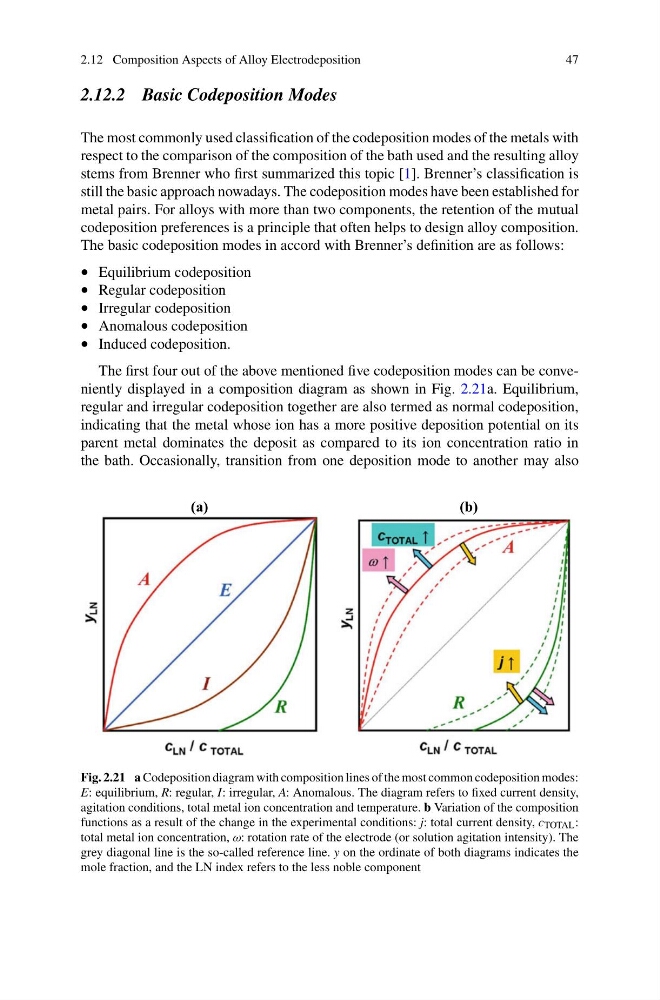
The first four out of the above mentioned five codeposition modes can be conveniently displayed in a composition diagram as shown in Fig. 2.21a. Equilibrium,
regular and irregular codeposition together are also termed as normal codeposition,
indicating that the metal whose ion has a more positive deposition potential on its
parent metal dominates the deposit as compared to its ion concentration ratio in
the bath. Occasionally, transition from one deposition mode to another may also
(a)
(b)
Fig. 2.21 a Codeposition diagram with composition lines of the most common codeposition modes:
E: equilibrium, R: regular, I: irregular, A: Anomalous. The diagram refers to fixed current density,
agitation conditions, total metal ion concentration and temperature. b Variation of the composition
functions as a result of the change in the experimental conditions: j: total current density, c TOTAL :
total metal ion concentration, ω: rotation rate of the electrode (or solution agitation intensity). The
grey diagonal line is the so-called reference line. y on the ordinate of both diagrams indicates the
mole fraction, and the LN index refers to the less noble component
47
2.12.2 Basic Codeposition Modes
The most commonly used classification of the codeposition modes of the metals with
respect to the comparison of the composition of the bath used and the resulting alloy
stems from Brenner who first summarized this topic [1]. Brenner’s classification is
still the basic approach nowadays. The codeposition modes have been established for
metal pairs. For alloys with more than two components, the retention of the mutual
codeposition preferences is a principle that often helps to design alloy composition.
The basic codeposition modes in accord with Brenner’s definition are as follows:
• Equilibrium codeposition
• Regular codeposition
• Irregular codeposition
• Anomalous codeposition
• Induced codeposition.
The first four out of the above mentioned five codeposition modes can be conveniently displayed in a composition diagram as shown in Fig. 2.21a. Equilibrium,
regular and irregular codeposition together are also termed as normal codeposition,
indicating that the metal whose ion has a more positive deposition potential on its
parent metal dominates the deposit as compared to its ion concentration ratio in
the bath. Occasionally, transition from one deposition mode to another may also
(a)
(b)
Fig. 2.21 a Codeposition diagram with composition lines of the most common codeposition modes:
E: equilibrium, R: regular, I: irregular, A: Anomalous. The diagram refers to fixed current density,
agitation conditions, total metal ion concentration and temperature. b Variation of the composition
functions as a result of the change in the experimental conditions: j: total current density, c TOTAL :
total metal ion concentration, ω: rotation rate of the electrode (or solution agitation intensity). The
grey diagonal line is the so-called reference line. y on the ordinate of both diagrams indicates the
mole fraction, and the LN index refers to the less noble component