

2.11 Major Factors of the Grain Structure of Electrodeposited Metals
45
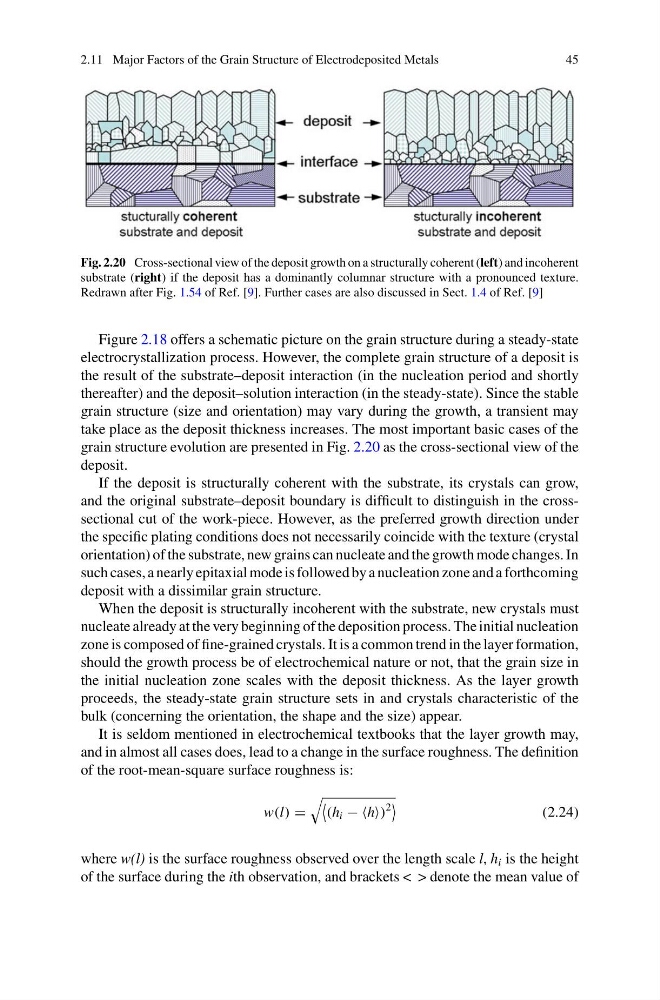
Fig. 2.20 Cross-sectional view of the deposit growth on a structurally coherent (left) and incoherent
substrate (right) if the deposit has a dominantly columnar structure with a pronounced texture.
Redrawn after Fig. 1.54 of Ref. [9]. Further cases are also discussed in Sect. 1.4 of Ref. [9]
Figure 2.18 offers a schematic picture on the grain structure during a steady-state
electrocrystallization process. However, the complete grain structure of a deposit is
the result of the substrate–deposit interaction (in the nucleation period and shortly
thereafter) and the deposit–solution interaction (in the steady-state). Since the stable
grain structure (size and orientation) may vary during the growth, a transient may
take place as the deposit thickness increases. The most important basic cases of the
grain structure evolution are presented in Fig. 2.20 as the cross-sectional view of the
deposit.
If the deposit is structurally coherent with the substrate, its crystals can grow,
and the original substrate–deposit boundary is difficult to distinguish in the crosssectional cut of the work-piece. However, as the preferred growth direction under
the specific plating conditions does not necessarily coincide with the texture (crystal
orientation) of the substrate, new grains can nucleate and the growth mode changes. In
such cases, a nearly epitaxial mode is followed by a nucleation zone and a forthcoming
deposit with a dissimilar grain structure.
When the deposit is structurally incoherent with the substrate, new crystals must
nucleate already at the very beginning of the deposition process. The initial nucleation
zone is composed of fine-grained crystals. It is a common trend in the layer formation,
should the growth process be of electrochemical nature or not, that the grain size in
the initial nucleation zone scales with the deposit thickness. As the layer growth
proceeds, the steady-state grain structure sets in and crystals characteristic of the
bulk (concerning the orientation, the shape and the size) appear.
It is seldom mentioned in electrochemical textbooks that the layer growth may,
and in almost all cases does, lead to a change in the surface roughness. The definition
of the root-mean-square surface roughness is:
w(l) =
(h i − h)
2
(2.24)
where w(l) is the surface roughness observed over the length scale l, h i is the height
of the surface during the ith observation, and brackets < > denote the mean value of
45
Fig. 2.20 Cross-sectional view of the deposit growth on a structurally coherent (left) and incoherent
substrate (right) if the deposit has a dominantly columnar structure with a pronounced texture.
Redrawn after Fig. 1.54 of Ref. [9]. Further cases are also discussed in Sect. 1.4 of Ref. [9]
Figure 2.18 offers a schematic picture on the grain structure during a steady-state
electrocrystallization process. However, the complete grain structure of a deposit is
the result of the substrate–deposit interaction (in the nucleation period and shortly
thereafter) and the deposit–solution interaction (in the steady-state). Since the stable
grain structure (size and orientation) may vary during the growth, a transient may
take place as the deposit thickness increases. The most important basic cases of the
grain structure evolution are presented in Fig. 2.20 as the cross-sectional view of the
deposit.
If the deposit is structurally coherent with the substrate, its crystals can grow,
and the original substrate–deposit boundary is difficult to distinguish in the crosssectional cut of the work-piece. However, as the preferred growth direction under
the specific plating conditions does not necessarily coincide with the texture (crystal
orientation) of the substrate, new grains can nucleate and the growth mode changes. In
such cases, a nearly epitaxial mode is followed by a nucleation zone and a forthcoming
deposit with a dissimilar grain structure.
When the deposit is structurally incoherent with the substrate, new crystals must
nucleate already at the very beginning of the deposition process. The initial nucleation
zone is composed of fine-grained crystals. It is a common trend in the layer formation,
should the growth process be of electrochemical nature or not, that the grain size in
the initial nucleation zone scales with the deposit thickness. As the layer growth
proceeds, the steady-state grain structure sets in and crystals characteristic of the
bulk (concerning the orientation, the shape and the size) appear.
It is seldom mentioned in electrochemical textbooks that the layer growth may,
and in almost all cases does, lead to a change in the surface roughness. The definition
of the root-mean-square surface roughness is:
w(l) =
(h i − h)
2
(2.24)
where w(l) is the surface roughness observed over the length scale l, h i is the height
of the surface during the ith observation, and brackets < > denote the mean value of