

2.11 Major Factors of the Grain Structure of Electrodeposited Metals
43
additives leads to a smaller current density and a more frequent nucleation of the
new crystals. Since the rate of the process decreases, the additives have an inhibitory
effect on the deposition. In galvanostatic mode, the additives act similarly, and the
driving force (overpotential) must increase to maintain the same process rate, and the
concomitant consequences on the grain refinement are the same as for potentiostatic
mode.
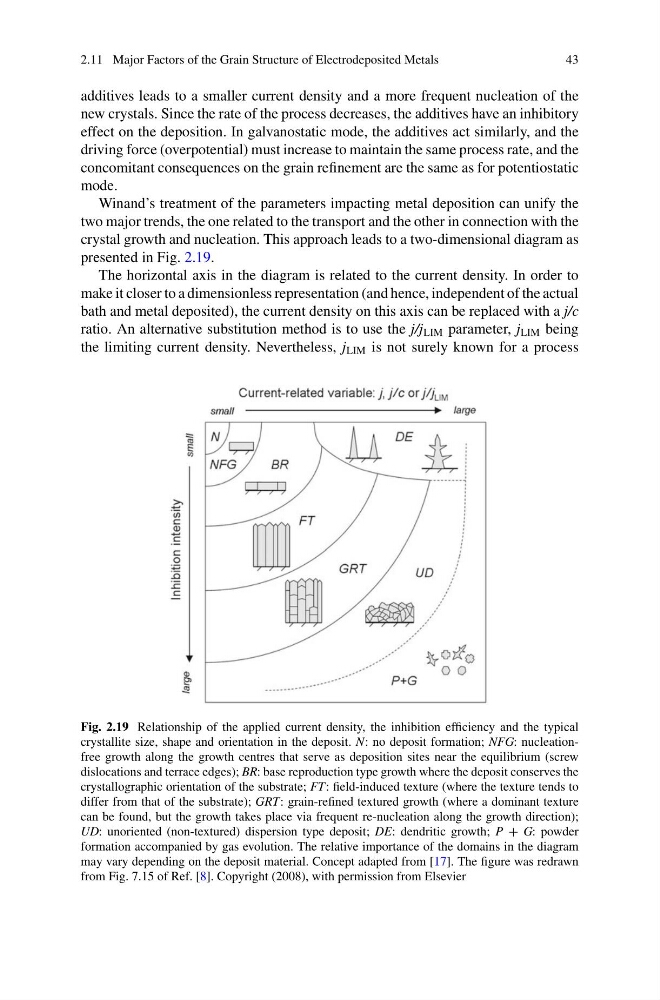
Winand’s treatment of the parameters impacting metal deposition can unify the
two major trends, the one related to the transport and the other in connection with the
crystal growth and nucleation. This approach leads to a two-dimensional diagram as
presented in Fig. 2.19.
The horizontal axis in the diagram is related to the current density. In order to
make it closer to a dimensionless representation (and hence, independent of the actual
bath and metal deposited), the current density on this axis can be replaced with a j/c
ratio. An alternative substitution method is to use the j/j LIM parameter, j LIM being
the limiting current density. Nevertheless, j LIM is not surely known for a process
Fig. 2.19 Relationship of the applied current density, the inhibition efficiency and the typical
crystallite size, shape and orientation in the deposit. N: no deposit formation; NFG: nucleationfree growth along the growth centres that serve as deposition sites near the equilibrium (screw
dislocations and terrace edges); BR: base reproduction type growth where the deposit conserves the
crystallographic orientation of the substrate; FT: field-induced texture (where the texture tends to
differ from that of the substrate); GRT: grain-refined textured growth (where a dominant texture
can be found, but the growth takes place via frequent re-nucleation along the growth direction);
UD: unoriented (non-textured) dispersion type deposit; DE: dendritic growth; P + G: powder
formation accompanied by gas evolution. The relative importance of the domains in the diagram
may vary depending on the deposit material. Concept adapted from [17]. The figure was redrawn
from Fig. 7.15 of Ref. [8]. Copyright (2008), with permission from Elsevier
43
additives leads to a smaller current density and a more frequent nucleation of the
new crystals. Since the rate of the process decreases, the additives have an inhibitory
effect on the deposition. In galvanostatic mode, the additives act similarly, and the
driving force (overpotential) must increase to maintain the same process rate, and the
concomitant consequences on the grain refinement are the same as for potentiostatic
mode.
Winand’s treatment of the parameters impacting metal deposition can unify the
two major trends, the one related to the transport and the other in connection with the
crystal growth and nucleation. This approach leads to a two-dimensional diagram as
presented in Fig. 2.19.
The horizontal axis in the diagram is related to the current density. In order to
make it closer to a dimensionless representation (and hence, independent of the actual
bath and metal deposited), the current density on this axis can be replaced with a j/c
ratio. An alternative substitution method is to use the j/j LIM parameter, j LIM being
the limiting current density. Nevertheless, j LIM is not surely known for a process
Fig. 2.19 Relationship of the applied current density, the inhibition efficiency and the typical
crystallite size, shape and orientation in the deposit. N: no deposit formation; NFG: nucleationfree growth along the growth centres that serve as deposition sites near the equilibrium (screw
dislocations and terrace edges); BR: base reproduction type growth where the deposit conserves the
crystallographic orientation of the substrate; FT: field-induced texture (where the texture tends to
differ from that of the substrate); GRT: grain-refined textured growth (where a dominant texture
can be found, but the growth takes place via frequent re-nucleation along the growth direction);
UD: unoriented (non-textured) dispersion type deposit; DE: dendritic growth; P + G: powder
formation accompanied by gas evolution. The relative importance of the domains in the diagram
may vary depending on the deposit material. Concept adapted from [17]. The figure was redrawn
from Fig. 7.15 of Ref. [8]. Copyright (2008), with permission from Elsevier