

2.10 Nucleation During Electrochemical Phase Formation
39
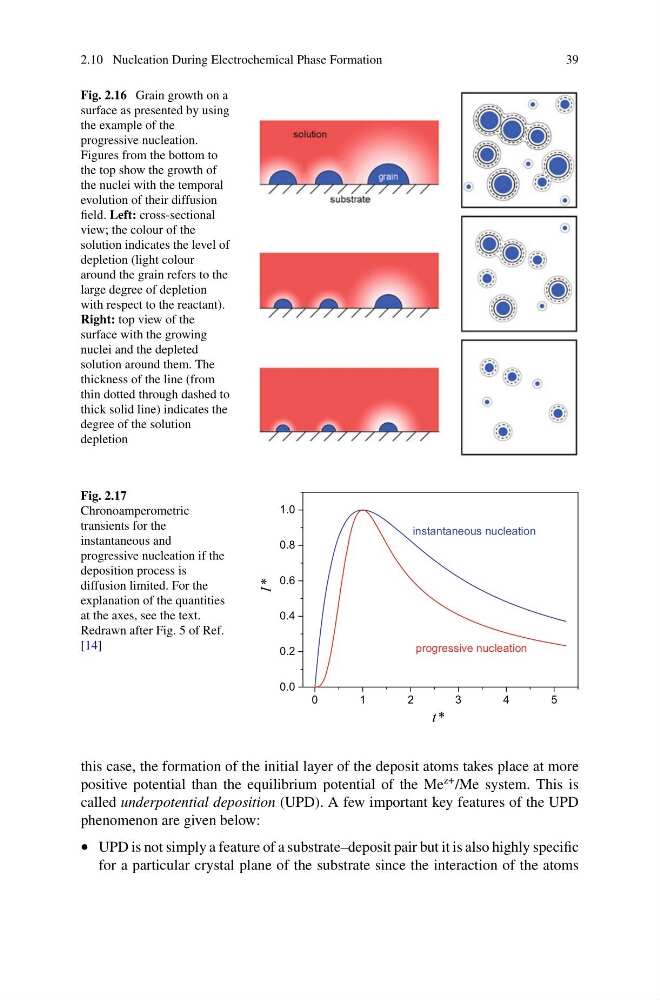
Fig. 2.16 Grain growth on a
surface as presented by using
the example of the
progressive nucleation.
Figures from the bottom to
the top show the growth of
the nuclei with the temporal
evolution of their diffusion
field. Left: cross-sectional
view; the colour of the
solution indicates the level of
depletion (light colour
around the grain refers to the
large degree of depletion
with respect to the reactant).
Right: top view of the
surface with the growing
nuclei and the depleted
solution around them. The
thickness of the line (from
thin dotted through dashed to
thick solid line) indicates the
degree of the solution
depletion
Fig. 2.17
Chronoamperometric
transients for the
instantaneous and
progressive nucleation if the
deposition process is
diffusion limited. For the
explanation of the quantities
at the axes, see the text.
Redrawn after Fig. 5 of Ref.
[14]
0
1
2
3
4
5
0.0
0.2
0.4
0.6
0.8
1.0
progressive nucleation
instantaneous nucleation
I *
t *
this case, the formation of the initial layer of the deposit atoms takes place at more
positive potential than the equilibrium potential of the Me
z+ /Me system. This is
called underpotential deposition (UPD). A few important key features of the UPD
phenomenon are given below:
• UPD is not simply a feature of a substrate–deposit pair but it is also highly specific
for a particular crystal plane of the substrate since the interaction of the atoms
39
Fig. 2.16 Grain growth on a
surface as presented by using
the example of the
progressive nucleation.
Figures from the bottom to
the top show the growth of
the nuclei with the temporal
evolution of their diffusion
field. Left: cross-sectional
view; the colour of the
solution indicates the level of
depletion (light colour
around the grain refers to the
large degree of depletion
with respect to the reactant).
Right: top view of the
surface with the growing
nuclei and the depleted
solution around them. The
thickness of the line (from
thin dotted through dashed to
thick solid line) indicates the
degree of the solution
depletion
Fig. 2.17
Chronoamperometric
transients for the
instantaneous and
progressive nucleation if the
deposition process is
diffusion limited. For the
explanation of the quantities
at the axes, see the text.
Redrawn after Fig. 5 of Ref.
[14]
0
1
2
3
4
5
0.0
0.2
0.4
0.6
0.8
1.0
progressive nucleation
instantaneous nucleation
I *
t *
this case, the formation of the initial layer of the deposit atoms takes place at more
positive potential than the equilibrium potential of the Me
z+ /Me system. This is
called underpotential deposition (UPD). A few important key features of the UPD
phenomenon are given below:
• UPD is not simply a feature of a substrate–deposit pair but it is also highly specific
for a particular crystal plane of the substrate since the interaction of the atoms