

14.7 Non-Carbonaceous Nanostructures Obtained by Plasma Synthesis
521
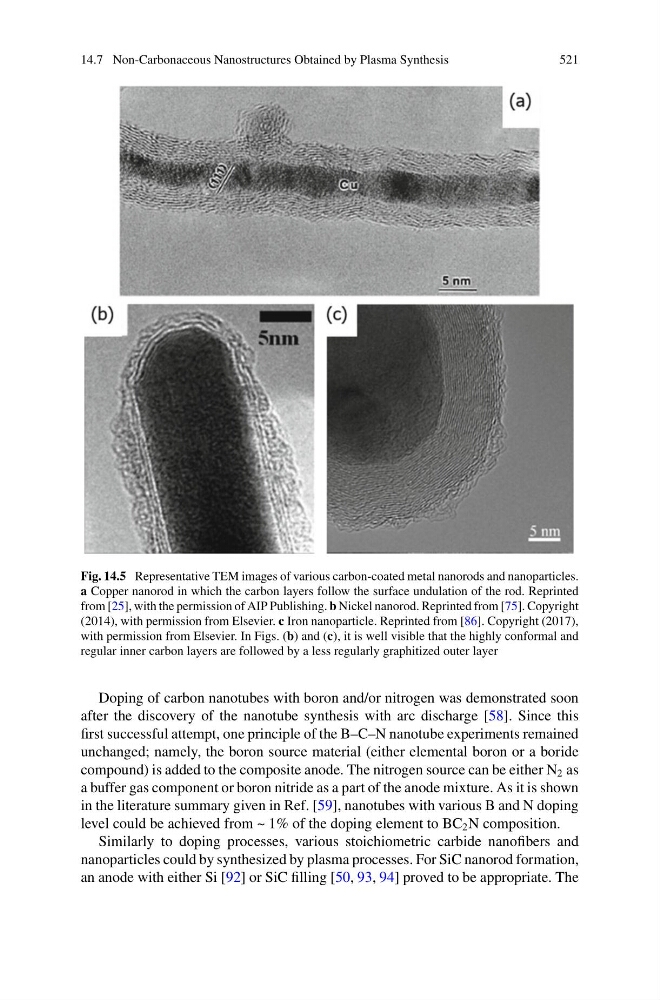
Fig. 14.5 Representative TEM images of various carbon-coated metal nanorods and nanoparticles.
a Copper nanorod in which the carbon layers follow the surface undulation of the rod. Reprinted
from [25], with the permission of AIP Publishing. b Nickel nanorod. Reprinted from [75]. Copyright
(2014), with permission from Elsevier. c Iron nanoparticle. Reprinted from [86]. Copyright (2017),
with permission from Elsevier. In Figs. (b) and (c), it is well visible that the highly conformal and
regular inner carbon layers are followed by a less regularly graphitized outer layer
Doping of carbon nanotubes with boron and/or nitrogen was demonstrated soon
after the discovery of the nanotube synthesis with arc discharge [58]. Since this
first successful attempt, one principle of the B–C–N nanotube experiments remained
unchanged; namely, the boron source material (either elemental boron or a boride
compound) is added to the composite anode. The nitrogen source can be either N 2 as
a buffer gas component or boron nitride as a part of the anode mixture. As it is shown
in the literature summary given in Ref. [59], nanotubes with various B and N doping
level could be achieved from ~ 1% of the doping element to BC 2 N composition.
Similarly to doping processes, various stoichiometric carbide nanofibers and
nanoparticles could by synthesized by plasma processes. For SiC nanorod formation,
an anode with either Si [92] or SiC filling [50, 93, 94] proved to be appropriate. The
521
Fig. 14.5 Representative TEM images of various carbon-coated metal nanorods and nanoparticles.
a Copper nanorod in which the carbon layers follow the surface undulation of the rod. Reprinted
from [25], with the permission of AIP Publishing. b Nickel nanorod. Reprinted from [75]. Copyright
(2014), with permission from Elsevier. c Iron nanoparticle. Reprinted from [86]. Copyright (2017),
with permission from Elsevier. In Figs. (b) and (c), it is well visible that the highly conformal and
regular inner carbon layers are followed by a less regularly graphitized outer layer
Doping of carbon nanotubes with boron and/or nitrogen was demonstrated soon
after the discovery of the nanotube synthesis with arc discharge [58]. Since this
first successful attempt, one principle of the B–C–N nanotube experiments remained
unchanged; namely, the boron source material (either elemental boron or a boride
compound) is added to the composite anode. The nitrogen source can be either N 2 as
a buffer gas component or boron nitride as a part of the anode mixture. As it is shown
in the literature summary given in Ref. [59], nanotubes with various B and N doping
level could be achieved from ~ 1% of the doping element to BC 2 N composition.
Similarly to doping processes, various stoichiometric carbide nanofibers and
nanoparticles could by synthesized by plasma processes. For SiC nanorod formation,
an anode with either Si [92] or SiC filling [50, 93, 94] proved to be appropriate. The