

13.6 Pursuits Related to the Extension of the Anodizing Conditions
495
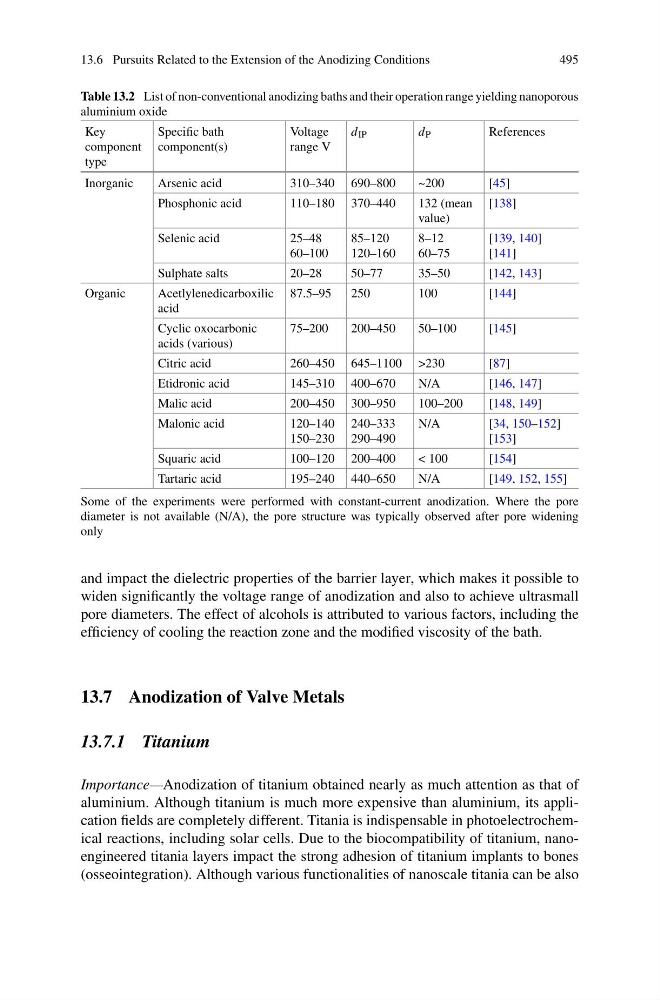
Table 13.2 List of non-conventional anodizing baths and their operation range yielding nanoporous
aluminium oxide
Key
component
type
Specific bath
component(s)
Voltage
range V
d IP
d P
References
Inorganic
Arsenic acid
310–340 690–800
~200
[45]
Phosphonic acid
110–180 370–440
132 (mean
value)
[138]
Selenic acid
25–48
60–100
85–120
120–160
8–12
60–75
[139, 140]
[141]
Sulphate salts
20–28
50–77
35–50
[142, 143]
Organic
Acetlylenedicarboxilic
acid
87.5–95
250
100
[144]
Cyclic oxocarbonic
acids (various)
75–200
200–450
50–100
[145]
Citric acid
260–450 645–1100 >230
[87]
Etidronic acid
145–310 400–670
N/A
[146, 147]
Malic acid
200–450 300–950
100–200
[148, 149]
Malonic acid
120–140
150–230
240–333
290–490
N/A
[34, 150–152]
[153]
Squaric acid
100–120 200–400
< 100
[154]
Tartaric acid
195–240 440–650
N/A
[149, 152, 155]
Some of the experiments were performed with constant-current anodization. Where the pore
diameter is not available (N/A), the pore structure was typically observed after pore widening
only
and impact the dielectric properties of the barrier layer, which makes it possible to
widen significantly the voltage range of anodization and also to achieve ultrasmall
pore diameters. The effect of alcohols is attributed to various factors, including the
efficiency of cooling the reaction zone and the modified viscosity of the bath.
13.7 Anodization of Valve Metals
13.7.1 Titanium
Importance—Anodization of titanium obtained nearly as much attention as that of
aluminium. Although titanium is much more expensive than aluminium, its application fields are completely different. Titania is indispensable in photoelectrochemical reactions, including solar cells. Due to the biocompatibility of titanium, nanoengineered titania layers impact the strong adhesion of titanium implants to bones
(osseointegration). Although various functionalities of nanoscale titania can be also
495
Table 13.2 List of non-conventional anodizing baths and their operation range yielding nanoporous
aluminium oxide
Key
component
type
Specific bath
component(s)
Voltage
range V
d IP
d P
References
Inorganic
Arsenic acid
310–340 690–800
~200
[45]
Phosphonic acid
110–180 370–440
132 (mean
value)
[138]
Selenic acid
25–48
60–100
85–120
120–160
8–12
60–75
[139, 140]
[141]
Sulphate salts
20–28
50–77
35–50
[142, 143]
Organic
Acetlylenedicarboxilic
acid
87.5–95
250
100
[144]
Cyclic oxocarbonic
acids (various)
75–200
200–450
50–100
[145]
Citric acid
260–450 645–1100 >230
[87]
Etidronic acid
145–310 400–670
N/A
[146, 147]
Malic acid
200–450 300–950
100–200
[148, 149]
Malonic acid
120–140
150–230
240–333
290–490
N/A
[34, 150–152]
[153]
Squaric acid
100–120 200–400
< 100
[154]
Tartaric acid
195–240 440–650
N/A
[149, 152, 155]
Some of the experiments were performed with constant-current anodization. Where the pore
diameter is not available (N/A), the pore structure was typically observed after pore widening
only
and impact the dielectric properties of the barrier layer, which makes it possible to
widen significantly the voltage range of anodization and also to achieve ultrasmall
pore diameters. The effect of alcohols is attributed to various factors, including the
efficiency of cooling the reaction zone and the modified viscosity of the bath.
13.7 Anodization of Valve Metals
13.7.1 Titanium
Importance—Anodization of titanium obtained nearly as much attention as that of
aluminium. Although titanium is much more expensive than aluminium, its application fields are completely different. Titania is indispensable in photoelectrochemical reactions, including solar cells. Due to the biocompatibility of titanium, nanoengineered titania layers impact the strong adhesion of titanium implants to bones
(osseointegration). Although various functionalities of nanoscale titania can be also