

13.3 Traditional Laboratory Technique of PAA Preparation
487
dissociation equilibrium of the second hydrogen atoms of divalent acids and oxygen
evolution. It is usually shown by using linear stability analysis that short-wave instability occurs in certain parameter ranges, which then can lead to the formation of
hexagonally ordered pores.
13.4 Patterning Methods in the PAA Preparation Process
The patterning methods involving anodized aluminium have two major goals, either
initiating a regular large-scale pattern formation on aluminium or to transfer the
pattern formed on anodized aluminium to another material. Several methods have
been developed for both goals, and these methods can be combined in some cases.
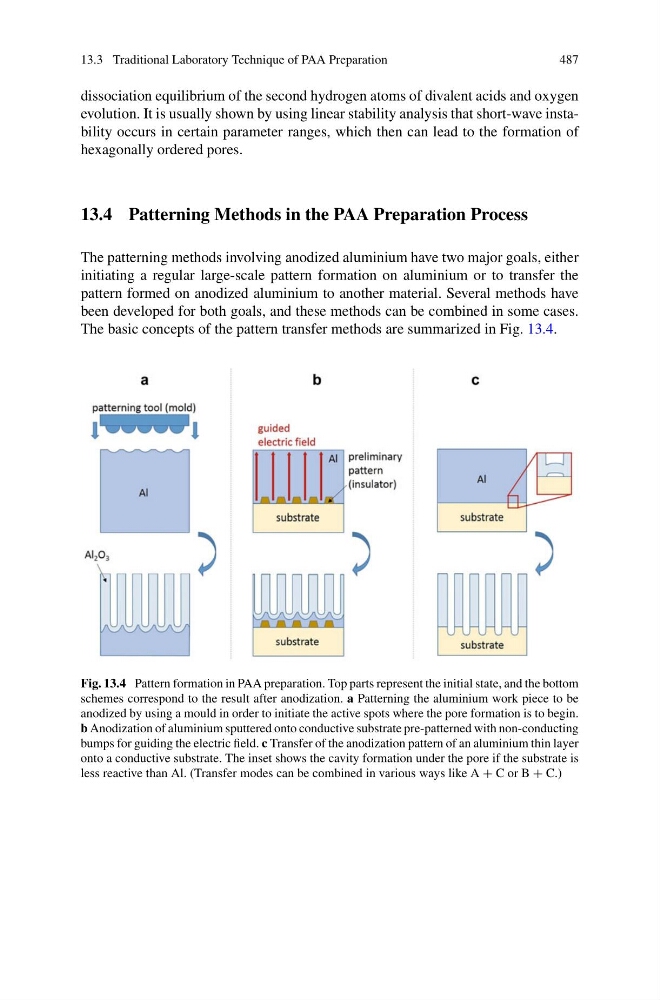
The basic concepts of the pattern transfer methods are summarized in Fig. 13.4.
Fig. 13.4 Pattern formation in PAA preparation. Top parts represent the initial state, and the bottom
schemes correspond to the result after anodization. a Patterning the aluminium work piece to be
anodized by using a mould in order to initiate the active spots where the pore formation is to begin.
b Anodization of aluminium sputtered onto conductive substrate pre-patterned with non-conducting
bumps for guiding the electric field. c Transfer of the anodization pattern of an aluminium thin layer
onto a conductive substrate. The inset shows the cavity formation under the pore if the substrate is
less reactive than Al. (Transfer modes can be combined in various ways like A + C or B + C.)
487
dissociation equilibrium of the second hydrogen atoms of divalent acids and oxygen
evolution. It is usually shown by using linear stability analysis that short-wave instability occurs in certain parameter ranges, which then can lead to the formation of
hexagonally ordered pores.
13.4 Patterning Methods in the PAA Preparation Process
The patterning methods involving anodized aluminium have two major goals, either
initiating a regular large-scale pattern formation on aluminium or to transfer the
pattern formed on anodized aluminium to another material. Several methods have
been developed for both goals, and these methods can be combined in some cases.
The basic concepts of the pattern transfer methods are summarized in Fig. 13.4.
Fig. 13.4 Pattern formation in PAA preparation. Top parts represent the initial state, and the bottom
schemes correspond to the result after anodization. a Patterning the aluminium work piece to be
anodized by using a mould in order to initiate the active spots where the pore formation is to begin.
b Anodization of aluminium sputtered onto conductive substrate pre-patterned with non-conducting
bumps for guiding the electric field. c Transfer of the anodization pattern of an aluminium thin layer
onto a conductive substrate. The inset shows the cavity formation under the pore if the substrate is
less reactive than Al. (Transfer modes can be combined in various ways like A + C or B + C.)