

464
12 Localized or Spatially Selective Electrodeposition Methods
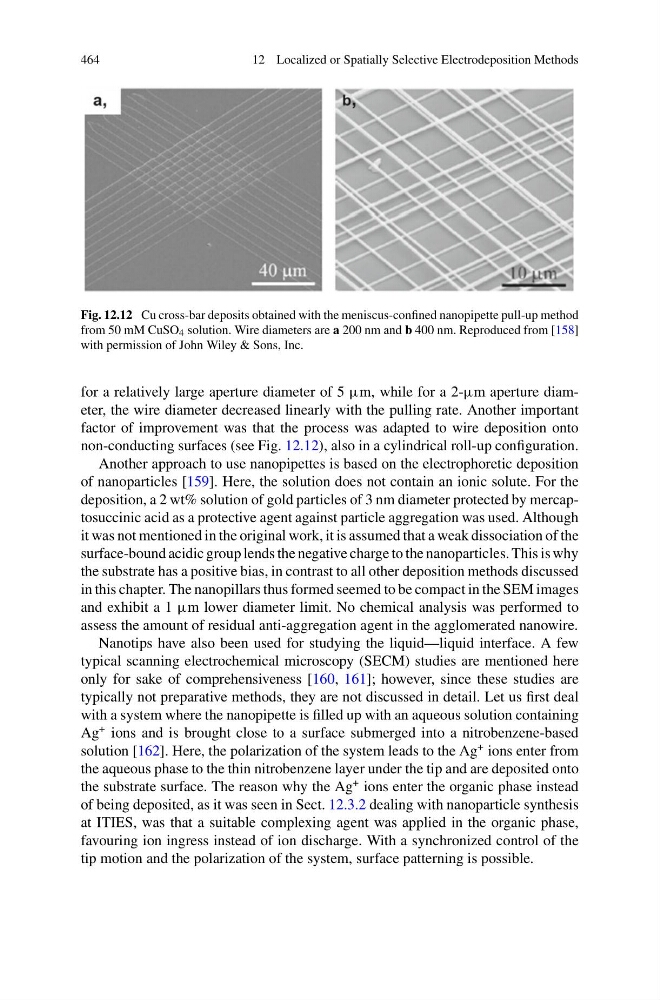
Fig. 12.12 Cu cross-bar deposits obtained with the meniscus-confined nanopipette pull-up method
from 50 mM CuSO 4 solution. Wire diameters are a 200 nm and b 400 nm. Reproduced from [158]
with permission of John Wiley & Sons, Inc.
for a relatively large aperture diameter of 5 µm, while for a 2-µm aperture diameter, the wire diameter decreased linearly with the pulling rate. Another important
factor of improvement was that the process was adapted to wire deposition onto
non-conducting surfaces (see Fig. 12.12), also in a cylindrical roll-up configuration.
Another approach to use nanopipettes is based on the electrophoretic deposition
of nanoparticles [159]. Here, the solution does not contain an ionic solute. For the
deposition, a 2 wt% solution of gold particles of 3 nm diameter protected by mercaptosuccinic acid as a protective agent against particle aggregation was used. Although
it was not mentioned in the original work, it is assumed that a weak dissociation of the
surface-bound acidic group lends the negative charge to the nanoparticles. This is why
the substrate has a positive bias, in contrast to all other deposition methods discussed
in this chapter. The nanopillars thus formed seemed to be compact in the SEM images
and exhibit a 1 µm lower diameter limit. No chemical analysis was performed to
assess the amount of residual anti-aggregation agent in the agglomerated nanowire.
Nanotips have also been used for studying the liquid—liquid interface. A few
typical scanning electrochemical microscopy (SECM) studies are mentioned here
only for sake of comprehensiveness [160, 161]; however, since these studies are
typically not preparative methods, they are not discussed in detail. Let us first deal
with a system where the nanopipette is filled up with an aqueous solution containing
Ag
+ ions and is brought close to a surface submerged into a nitrobenzene-based
solution [162]. Here, the polarization of the system leads to the Ag
+ ions enter from
the aqueous phase to the thin nitrobenzene layer under the tip and are deposited onto
the substrate surface. The reason why the Ag
+ ions enter the organic phase instead
of being deposited, as it was seen in Sect. 12.3.2 dealing with nanoparticle synthesis
at ITIES, was that a suitable complexing agent was applied in the organic phase,
favouring ion ingress instead of ion discharge. With a synchronized control of the
tip motion and the polarization of the system, surface patterning is possible.
12 Localized or Spatially Selective Electrodeposition Methods
Fig. 12.12 Cu cross-bar deposits obtained with the meniscus-confined nanopipette pull-up method
from 50 mM CuSO 4 solution. Wire diameters are a 200 nm and b 400 nm. Reproduced from [158]
with permission of John Wiley & Sons, Inc.
for a relatively large aperture diameter of 5 µm, while for a 2-µm aperture diameter, the wire diameter decreased linearly with the pulling rate. Another important
factor of improvement was that the process was adapted to wire deposition onto
non-conducting surfaces (see Fig. 12.12), also in a cylindrical roll-up configuration.
Another approach to use nanopipettes is based on the electrophoretic deposition
of nanoparticles [159]. Here, the solution does not contain an ionic solute. For the
deposition, a 2 wt% solution of gold particles of 3 nm diameter protected by mercaptosuccinic acid as a protective agent against particle aggregation was used. Although
it was not mentioned in the original work, it is assumed that a weak dissociation of the
surface-bound acidic group lends the negative charge to the nanoparticles. This is why
the substrate has a positive bias, in contrast to all other deposition methods discussed
in this chapter. The nanopillars thus formed seemed to be compact in the SEM images
and exhibit a 1 µm lower diameter limit. No chemical analysis was performed to
assess the amount of residual anti-aggregation agent in the agglomerated nanowire.
Nanotips have also been used for studying the liquid—liquid interface. A few
typical scanning electrochemical microscopy (SECM) studies are mentioned here
only for sake of comprehensiveness [160, 161]; however, since these studies are
typically not preparative methods, they are not discussed in detail. Let us first deal
with a system where the nanopipette is filled up with an aqueous solution containing
Ag
+ ions and is brought close to a surface submerged into a nitrobenzene-based
solution [162]. Here, the polarization of the system leads to the Ag
+ ions enter from
the aqueous phase to the thin nitrobenzene layer under the tip and are deposited onto
the substrate surface. The reason why the Ag
+ ions enter the organic phase instead
of being deposited, as it was seen in Sect. 12.3.2 dealing with nanoparticle synthesis
at ITIES, was that a suitable complexing agent was applied in the organic phase,
favouring ion ingress instead of ion discharge. With a synchronized control of the
tip motion and the polarization of the system, surface patterning is possible.