

448
12 Localized or Spatially Selective Electrodeposition Methods
as compared to the earlier ionic liquid study. The supporting electrolyte was KPF 6
in both cases, although it was mentioned that the experiment would work with either
KClO 4 or KCl, too; the important factor is the non-reacting nature of the supporting
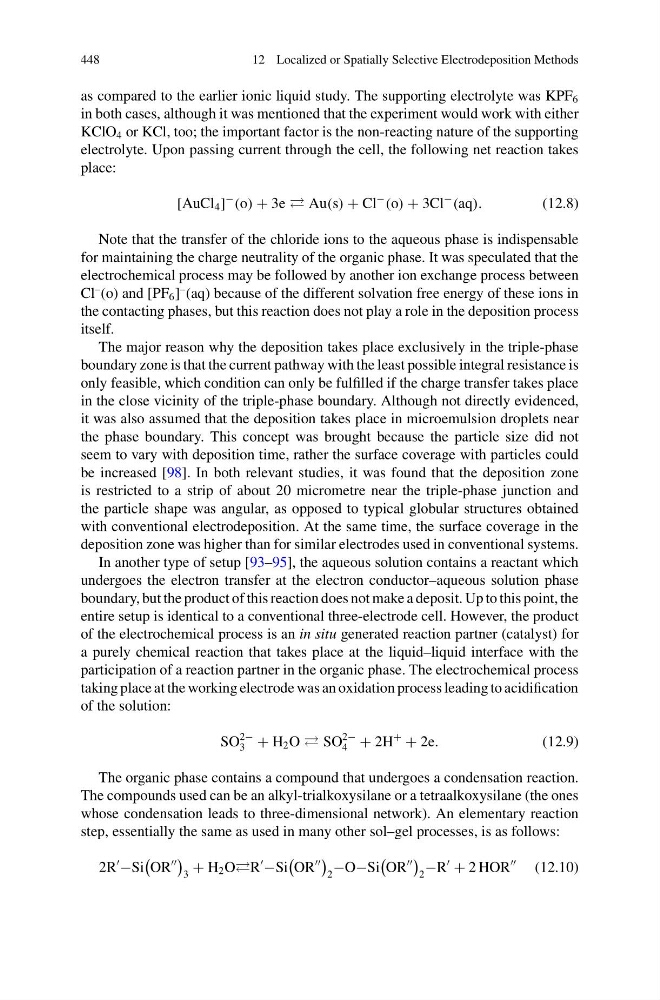
electrolyte. Upon passing current through the cell, the following net reaction takes
place:
[AuCl 4 ]
−
(o) + 3e Au(s) + Cl
−
(o) + 3Cl
−
(aq).
(12.8)
Note that the transfer of the chloride ions to the aqueous phase is indispensable
for maintaining the charge neutrality of the organic phase. It was speculated that the
electrochemical process may be followed by another ion exchange process between
Cl
– (o) and [PF 6 ]
– (aq) because of the different solvation free energy of these ions in
the contacting phases, but this reaction does not play a role in the deposition process
itself.
The major reason why the deposition takes place exclusively in the triple-phase
boundary zone is that the current pathway with the least possible integral resistance is
only feasible, which condition can only be fulfilled if the charge transfer takes place
in the close vicinity of the triple-phase boundary. Although not directly evidenced,
it was also assumed that the deposition takes place in microemulsion droplets near
the phase boundary. This concept was brought because the particle size did not
seem to vary with deposition time, rather the surface coverage with particles could
be increased [98]. In both relevant studies, it was found that the deposition zone
is restricted to a strip of about 20 micrometre near the triple-phase junction and
the particle shape was angular, as opposed to typical globular structures obtained
with conventional electrodeposition. At the same time, the surface coverage in the
deposition zone was higher than for similar electrodes used in conventional systems.
In another type of setup [93–95], the aqueous solution contains a reactant which
undergoes the electron transfer at the electron conductor–aqueous solution phase
boundary, but the product of this reaction does not make a deposit. Up to this point, the
entire setup is identical to a conventional three-electrode cell. However, the product
of the electrochemical process is an in situ generated reaction partner (catalyst) for
a purely chemical reaction that takes place at the liquid–liquid interface with the
participation of a reaction partner in the organic phase. The electrochemical process
taking place at the working electrode was an oxidation process leading to acidification
of the solution:
SO
2−
3 + H 2 O SO
2−
4 + 2H
+
+ 2e.
(12.9)
The organic phase contains a compound that undergoes a condensation reaction.
The compounds used can be an alkyl-trialkoxysilane or a tetraalkoxysilane (the ones
whose condensation leads to three-dimensional network). An elementary reaction
step, essentially the same as used in many other sol–gel processes, is as follows:
2R
−Si
OR
3
+ H 2 OR
−Si
OR
2
−O−Si
OR
2
−R
+ 2 HOR
(12.10)
12 Localized or Spatially Selective Electrodeposition Methods
as compared to the earlier ionic liquid study. The supporting electrolyte was KPF 6
in both cases, although it was mentioned that the experiment would work with either
KClO 4 or KCl, too; the important factor is the non-reacting nature of the supporting
electrolyte. Upon passing current through the cell, the following net reaction takes
place:
[AuCl 4 ]
−
(o) + 3e Au(s) + Cl
−
(o) + 3Cl
−
(aq).
(12.8)
Note that the transfer of the chloride ions to the aqueous phase is indispensable
for maintaining the charge neutrality of the organic phase. It was speculated that the
electrochemical process may be followed by another ion exchange process between
Cl
– (o) and [PF 6 ]
– (aq) because of the different solvation free energy of these ions in
the contacting phases, but this reaction does not play a role in the deposition process
itself.
The major reason why the deposition takes place exclusively in the triple-phase
boundary zone is that the current pathway with the least possible integral resistance is
only feasible, which condition can only be fulfilled if the charge transfer takes place
in the close vicinity of the triple-phase boundary. Although not directly evidenced,
it was also assumed that the deposition takes place in microemulsion droplets near
the phase boundary. This concept was brought because the particle size did not
seem to vary with deposition time, rather the surface coverage with particles could
be increased [98]. In both relevant studies, it was found that the deposition zone
is restricted to a strip of about 20 micrometre near the triple-phase junction and
the particle shape was angular, as opposed to typical globular structures obtained
with conventional electrodeposition. At the same time, the surface coverage in the
deposition zone was higher than for similar electrodes used in conventional systems.
In another type of setup [93–95], the aqueous solution contains a reactant which
undergoes the electron transfer at the electron conductor–aqueous solution phase
boundary, but the product of this reaction does not make a deposit. Up to this point, the
entire setup is identical to a conventional three-electrode cell. However, the product
of the electrochemical process is an in situ generated reaction partner (catalyst) for
a purely chemical reaction that takes place at the liquid–liquid interface with the
participation of a reaction partner in the organic phase. The electrochemical process
taking place at the working electrode was an oxidation process leading to acidification
of the solution:
SO
2−
3 + H 2 O SO
2−
4 + 2H
+
+ 2e.
(12.9)
The organic phase contains a compound that undergoes a condensation reaction.
The compounds used can be an alkyl-trialkoxysilane or a tetraalkoxysilane (the ones
whose condensation leads to three-dimensional network). An elementary reaction
step, essentially the same as used in many other sol–gel processes, is as follows:
2R
−Si
OR
3
+ H 2 OR
−Si
OR
2
−O−Si
OR
2
−R
+ 2 HOR
(12.10)