

12.3 Deposition at the Liquid–Liquid Interface
441
Table 12.1 Properties of the
solvents used in
electrodeposition studies at
the liquid–liquid interface
listed in the order of the
density ρ. ε r : relative
dielectric constant
Solvent
ρ/g cm −3 ε r
Reference(s)
Chloroform
1.49
4.81 [63]
Dichloromethane
1.33
9.1
[64, 65]
1,2-dichlorobenzene
1.30
9.9
[66–68]
1,2-dichloroethane (DCE) 1.25
10.6
[66, 69–91]
Nitrobenzene
1.20
34.8
[92–95]
n-buthylacetate
0.88
5.0
[96, 97]
Toluene
0.87
2.4
[98]
4-methyl-2-pentanon
0.80
13.1
[99]
n-heptane
0.68
1.9
[100]
that nanostructure deposition is possible at a solid–solid interface, too, a prominent example being the silver whisker growth at silver/silver halogenide interface.
Therefore, deposition at the liquid–liquid interface will be discussed below only.
Electrodeposited nanomaterials produced at the liquid–liquid interface just make a
minor part of the larger material family, whose properties and synthesis opportunities
in a wider scope have been summarized elsewhere [61].
The principle of the formation of a new phase at the boundary of two liquids
with the assistance of the electric current is as follows. The two-phase system has
to be created by using two liquids with negligible miscibility. For the reaction site
in such systems, the common terminology that can be found in the literature is the
“Interface between two immiscible electrolyte solutions” (ITIES). One of the phases
is aqueous in all studies published so far, and the other solvent can be either a polar
or apolar organic molecular liquid. A summary of the key physical properties of the
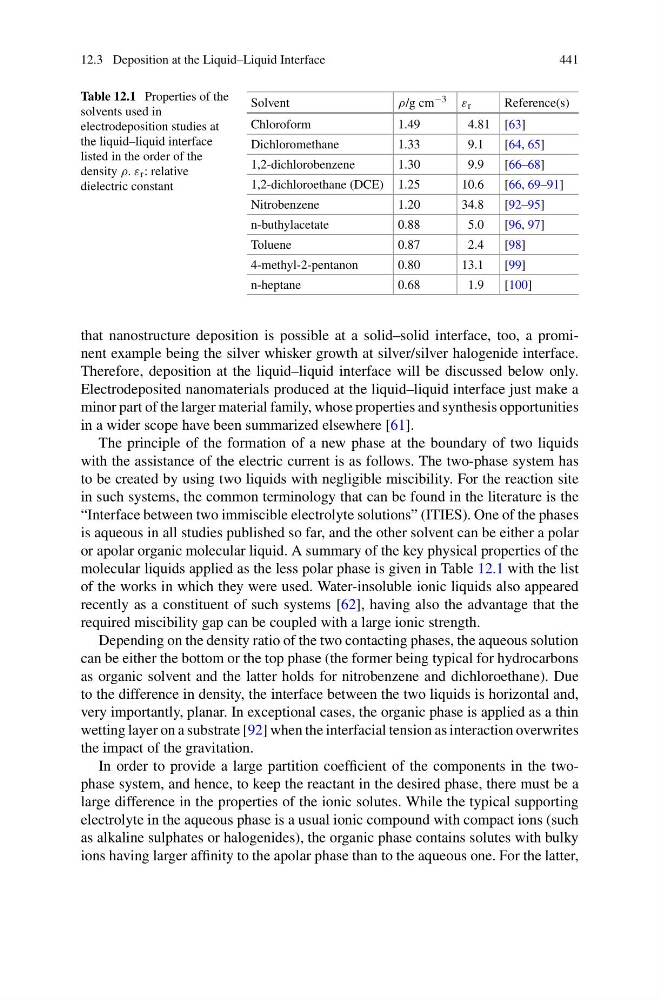
molecular liquids applied as the less polar phase is given in Table 12.1 with the list
of the works in which they were used. Water-insoluble ionic liquids also appeared
recently as a constituent of such systems [62], having also the advantage that the
required miscibility gap can be coupled with a large ionic strength.
Depending on the density ratio of the two contacting phases, the aqueous solution
can be either the bottom or the top phase (the former being typical for hydrocarbons
as organic solvent and the latter holds for nitrobenzene and dichloroethane). Due
to the difference in density, the interface between the two liquids is horizontal and,
very importantly, planar. In exceptional cases, the organic phase is applied as a thin
wetting layer on a substrate [92] when the interfacial tension as interaction overwrites
the impact of the gravitation.
In order to provide a large partition coefficient of the components in the twophase system, and hence, to keep the reactant in the desired phase, there must be a
large difference in the properties of the ionic solutes. While the typical supporting
electrolyte in the aqueous phase is a usual ionic compound with compact ions (such
as alkaline sulphates or halogenides), the organic phase contains solutes with bulky
ions having larger affinity to the apolar phase than to the aqueous one. For the latter,
441
Table 12.1 Properties of the
solvents used in
electrodeposition studies at
the liquid–liquid interface
listed in the order of the
density ρ. ε r : relative
dielectric constant
Solvent
ρ/g cm −3 ε r
Reference(s)
Chloroform
1.49
4.81 [63]
Dichloromethane
1.33
9.1
[64, 65]
1,2-dichlorobenzene
1.30
9.9
[66–68]
1,2-dichloroethane (DCE) 1.25
10.6
[66, 69–91]
Nitrobenzene
1.20
34.8
[92–95]
n-buthylacetate
0.88
5.0
[96, 97]
Toluene
0.87
2.4
[98]
4-methyl-2-pentanon
0.80
13.1
[99]
n-heptane
0.68
1.9
[100]
that nanostructure deposition is possible at a solid–solid interface, too, a prominent example being the silver whisker growth at silver/silver halogenide interface.
Therefore, deposition at the liquid–liquid interface will be discussed below only.
Electrodeposited nanomaterials produced at the liquid–liquid interface just make a
minor part of the larger material family, whose properties and synthesis opportunities
in a wider scope have been summarized elsewhere [61].
The principle of the formation of a new phase at the boundary of two liquids
with the assistance of the electric current is as follows. The two-phase system has
to be created by using two liquids with negligible miscibility. For the reaction site
in such systems, the common terminology that can be found in the literature is the
“Interface between two immiscible electrolyte solutions” (ITIES). One of the phases
is aqueous in all studies published so far, and the other solvent can be either a polar
or apolar organic molecular liquid. A summary of the key physical properties of the
molecular liquids applied as the less polar phase is given in Table 12.1 with the list
of the works in which they were used. Water-insoluble ionic liquids also appeared
recently as a constituent of such systems [62], having also the advantage that the
required miscibility gap can be coupled with a large ionic strength.
Depending on the density ratio of the two contacting phases, the aqueous solution
can be either the bottom or the top phase (the former being typical for hydrocarbons
as organic solvent and the latter holds for nitrobenzene and dichloroethane). Due
to the difference in density, the interface between the two liquids is horizontal and,
very importantly, planar. In exceptional cases, the organic phase is applied as a thin
wetting layer on a substrate [92] when the interfacial tension as interaction overwrites
the impact of the gravitation.
In order to provide a large partition coefficient of the components in the twophase system, and hence, to keep the reactant in the desired phase, there must be a
large difference in the properties of the ionic solutes. While the typical supporting
electrolyte in the aqueous phase is a usual ionic compound with compact ions (such
as alkaline sulphates or halogenides), the organic phase contains solutes with bulky
ions having larger affinity to the apolar phase than to the aqueous one. For the latter,