

11.4 Soft Templates Formed by Molecular Self-assembly Processes
409
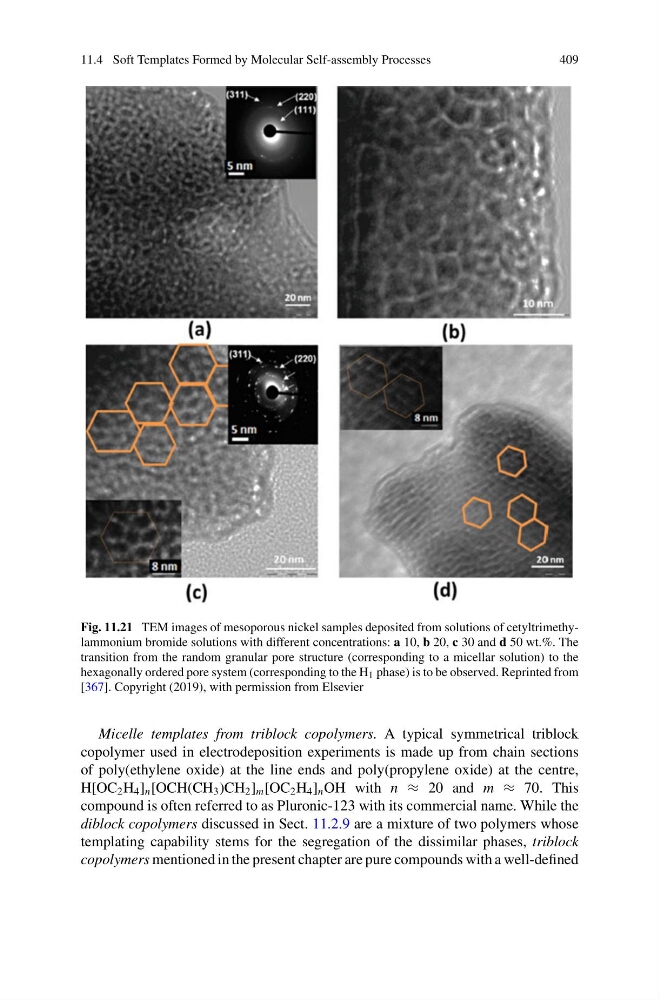
Fig. 11.21 TEM images of mesoporous nickel samples deposited from solutions of cetyltrimethylammonium bromide solutions with different concentrations: a 10, b 20, c 30 and d 50 wt.%. The
transition from the random granular pore structure (corresponding to a micellar solution) to the
hexagonally ordered pore system (corresponding to the H 1 phase) is to be observed. Reprinted from
[367]. Copyright (2019), with permission from Elsevier
Micelle templates from triblock copolymers. A typical symmetrical triblock
copolymer used in electrodeposition experiments is made up from chain sections
of poly(ethylene oxide) at the line ends and poly(propylene oxide) at the centre,
H[OC 2 H 4 ] n [OCH(CH 3 )CH 2 ] m [OC 2 H 4 ] n OH with n ≈ 20 and m ≈ 70. This
compound is often referred to as Pluronic-123 with its commercial name. While the
diblock copolymers discussed in Sect. 11.2.9 are a mixture of two polymers whose
templating capability stems for the segregation of the dissimilar phases, triblock
copolymers mentioned in the present chapter are pure compounds with a well-defined
409
Fig. 11.21 TEM images of mesoporous nickel samples deposited from solutions of cetyltrimethylammonium bromide solutions with different concentrations: a 10, b 20, c 30 and d 50 wt.%. The
transition from the random granular pore structure (corresponding to a micellar solution) to the
hexagonally ordered pore system (corresponding to the H 1 phase) is to be observed. Reprinted from
[367]. Copyright (2019), with permission from Elsevier
Micelle templates from triblock copolymers. A typical symmetrical triblock
copolymer used in electrodeposition experiments is made up from chain sections
of poly(ethylene oxide) at the line ends and poly(propylene oxide) at the centre,
H[OC 2 H 4 ] n [OCH(CH 3 )CH 2 ] m [OC 2 H 4 ] n OH with n ≈ 20 and m ≈ 70. This
compound is often referred to as Pluronic-123 with its commercial name. While the
diblock copolymers discussed in Sect. 11.2.9 are a mixture of two polymers whose
templating capability stems for the segregation of the dissimilar phases, triblock
copolymers mentioned in the present chapter are pure compounds with a well-defined