

11.4 Soft Templates Formed by Molecular Self-assembly Processes
407
system with the H 1 phase is used as the fluid medium in a solid template of larger pore
size, i.e., either an AAO template [356–361] or a colloidal solid particle template
[362, 363]. The preparation of self-supporting porous materials requires two steps,
corresponding to the dissolution conditions of both templates. The resulting deposit
exhibits a hierarchical porous structure in which the macropores are determined by
the solid template and the diameter of the mesopores is in accord with the column
diameter of the H 1 lyotropic phase. While the macropores directly reflect the pore
structure orientation of the larger template, the orientation of the mesopores seems to
be rather diverse. While the data in several works indicate a random orientation of the
mesopores with respect to the growth direction of the porous deposits, a few examples
can be found for nanowires grown in AAO template that the cylindrical pores related
to the lyotropic secondary template are ordered in parallel to the nanowire axis
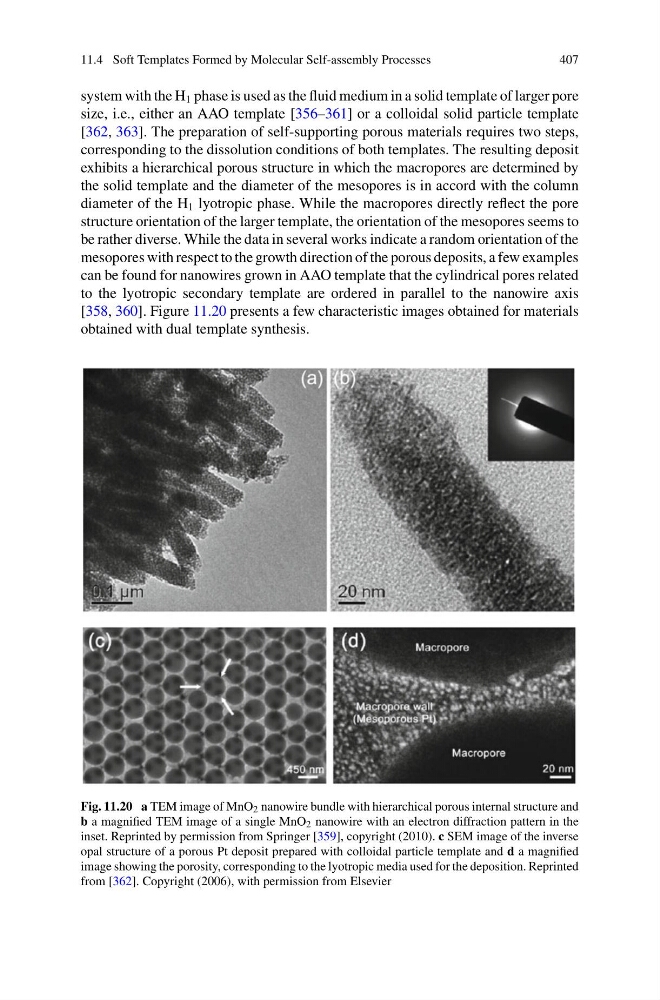
[358, 360]. Figure 11.20 presents a few characteristic images obtained for materials
obtained with dual template synthesis.
Fig. 11.20 a TEM image of MnO 2 nanowire bundle with hierarchical porous internal structure and
b a magnified TEM image of a single MnO 2 nanowire with an electron diffraction pattern in the
inset. Reprinted by permission from Springer [359], copyright (2010). c SEM image of the inverse
opal structure of a porous Pt deposit prepared with colloidal particle template and d a magnified
image showing the porosity, corresponding to the lyotropic media used for the deposition. Reprinted
from [362]. Copyright (2006), with permission from Elsevier
407
system with the H 1 phase is used as the fluid medium in a solid template of larger pore
size, i.e., either an AAO template [356–361] or a colloidal solid particle template
[362, 363]. The preparation of self-supporting porous materials requires two steps,
corresponding to the dissolution conditions of both templates. The resulting deposit
exhibits a hierarchical porous structure in which the macropores are determined by
the solid template and the diameter of the mesopores is in accord with the column
diameter of the H 1 lyotropic phase. While the macropores directly reflect the pore
structure orientation of the larger template, the orientation of the mesopores seems to
be rather diverse. While the data in several works indicate a random orientation of the
mesopores with respect to the growth direction of the porous deposits, a few examples
can be found for nanowires grown in AAO template that the cylindrical pores related
to the lyotropic secondary template are ordered in parallel to the nanowire axis
[358, 360]. Figure 11.20 presents a few characteristic images obtained for materials
obtained with dual template synthesis.
Fig. 11.20 a TEM image of MnO 2 nanowire bundle with hierarchical porous internal structure and
b a magnified TEM image of a single MnO 2 nanowire with an electron diffraction pattern in the
inset. Reprinted by permission from Springer [359], copyright (2010). c SEM image of the inverse
opal structure of a porous Pt deposit prepared with colloidal particle template and d a magnified
image showing the porosity, corresponding to the lyotropic media used for the deposition. Reprinted
from [362]. Copyright (2006), with permission from Elsevier