

11.4 Soft Templates Formed by Molecular Self-assembly Processes
401
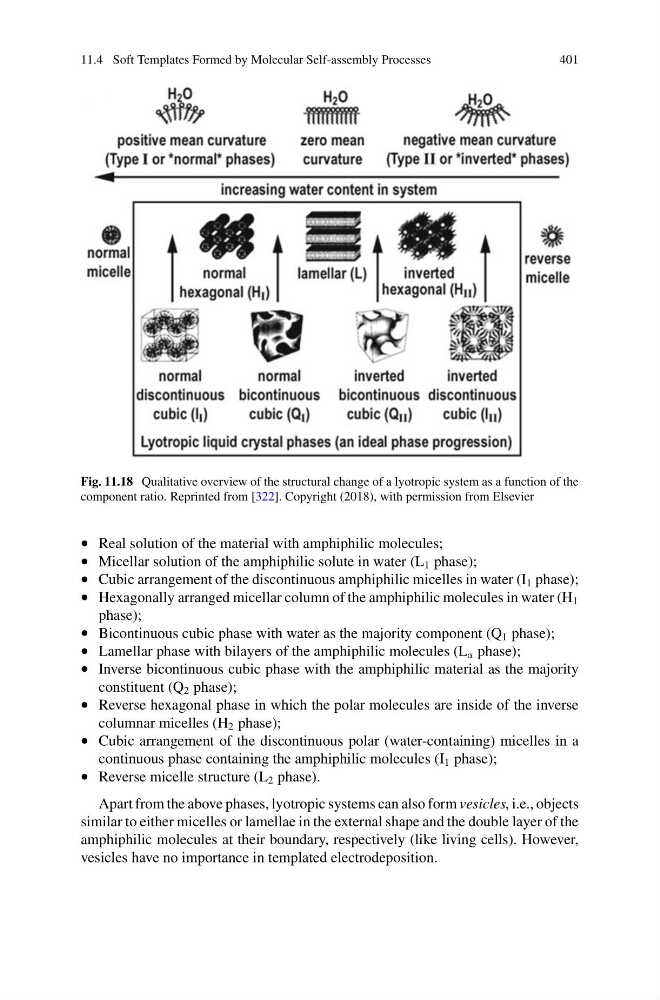
Fig. 11.18 Qualitative overview of the structural change of a lyotropic system as a function of the
component ratio. Reprinted from [322]. Copyright (2018), with permission from Elsevier
• Real solution of the material with amphiphilic molecules;
• Micellar solution of the amphiphilic solute in water (L 1 phase);
• Cubic arrangement of the discontinuous amphiphilic micelles in water (I 1 phase);
• Hexagonally arranged micellar column of the amphiphilic molecules in water (H 1
phase);
• Bicontinuous cubic phase with water as the majority component (Q 1 phase);
• Lamellar phase with bilayers of the amphiphilic molecules (L α phase);
• Inverse bicontinuous cubic phase with the amphiphilic material as the majority
constituent (Q 2 phase);
• Reverse hexagonal phase in which the polar molecules are inside of the inverse
columnar micelles (H 2 phase);
• Cubic arrangement of the discontinuous polar (water-containing) micelles in a
continuous phase containing the amphiphilic molecules (I 1 phase);
• Reverse micelle structure (L 2 phase).
Apart from the above phases, lyotropic systems can also form vesicles, i.e., objects
similar to either micelles or lamellae in the external shape and the double layer of the
amphiphilic molecules at their boundary, respectively (like living cells). However,
vesicles have no importance in templated electrodeposition.
401
Fig. 11.18 Qualitative overview of the structural change of a lyotropic system as a function of the
component ratio. Reprinted from [322]. Copyright (2018), with permission from Elsevier
• Real solution of the material with amphiphilic molecules;
• Micellar solution of the amphiphilic solute in water (L 1 phase);
• Cubic arrangement of the discontinuous amphiphilic micelles in water (I 1 phase);
• Hexagonally arranged micellar column of the amphiphilic molecules in water (H 1
phase);
• Bicontinuous cubic phase with water as the majority component (Q 1 phase);
• Lamellar phase with bilayers of the amphiphilic molecules (L α phase);
• Inverse bicontinuous cubic phase with the amphiphilic material as the majority
constituent (Q 2 phase);
• Reverse hexagonal phase in which the polar molecules are inside of the inverse
columnar micelles (H 2 phase);
• Cubic arrangement of the discontinuous polar (water-containing) micelles in a
continuous phase containing the amphiphilic molecules (I 1 phase);
• Reverse micelle structure (L 2 phase).
Apart from the above phases, lyotropic systems can also form vesicles, i.e., objects
similar to either micelles or lamellae in the external shape and the double layer of the
amphiphilic molecules at their boundary, respectively (like living cells). However,
vesicles have no importance in templated electrodeposition.