

11.3 Templates Obtained Through the Self-assembly of Particles
399
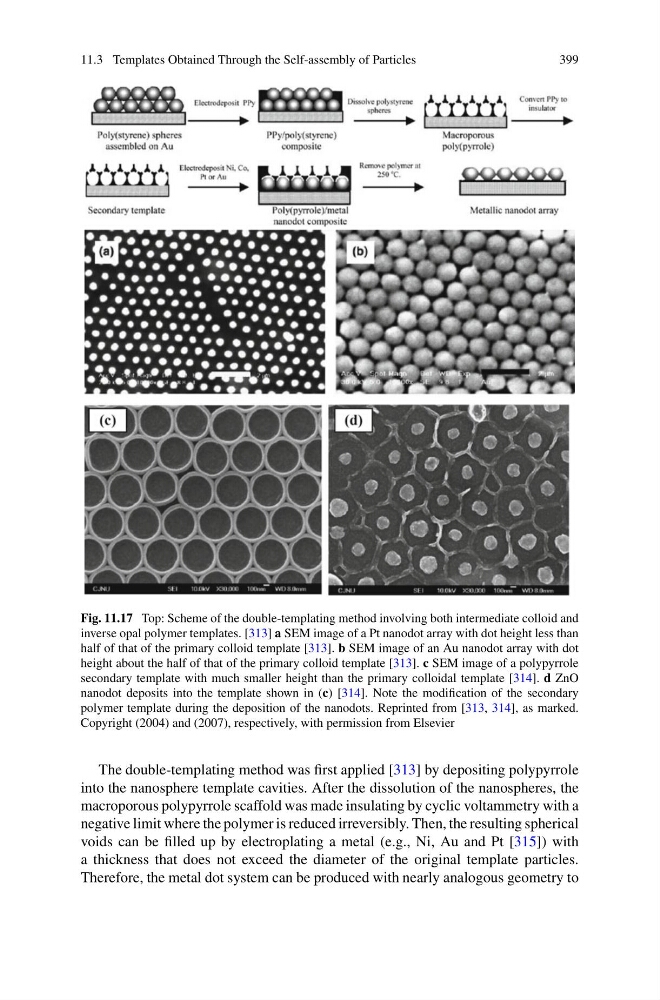
Fig. 11.17 Top: Scheme of the double-templating method involving both intermediate colloid and
inverse opal polymer templates. [313] a SEM image of a Pt nanodot array with dot height less than
half of that of the primary colloid template [313]. b SEM image of an Au nanodot array with dot
height about the half of that of the primary colloid template [313]. c SEM image of a polypyrrole
secondary template with much smaller height than the primary colloidal template [314]. d ZnO
nanodot deposits into the template shown in (c) [314]. Note the modification of the secondary
polymer template during the deposition of the nanodots. Reprinted from [313, 314], as marked.
Copyright (2004) and (2007), respectively, with permission from Elsevier
The double-templating method was first applied [313] by depositing polypyrrole
into the nanosphere template cavities. After the dissolution of the nanospheres, the
macroporous polypyrrole scaffold was made insulating by cyclic voltammetry with a
negative limit where the polymer is reduced irreversibly. Then, the resulting spherical
voids can be filled up by electroplating a metal (e.g., Ni, Au and Pt [315]) with
a thickness that does not exceed the diameter of the original template particles.
Therefore, the metal dot system can be produced with nearly analogous geometry to
399
Fig. 11.17 Top: Scheme of the double-templating method involving both intermediate colloid and
inverse opal polymer templates. [313] a SEM image of a Pt nanodot array with dot height less than
half of that of the primary colloid template [313]. b SEM image of an Au nanodot array with dot
height about the half of that of the primary colloid template [313]. c SEM image of a polypyrrole
secondary template with much smaller height than the primary colloidal template [314]. d ZnO
nanodot deposits into the template shown in (c) [314]. Note the modification of the secondary
polymer template during the deposition of the nanodots. Reprinted from [313, 314], as marked.
Copyright (2004) and (2007), respectively, with permission from Elsevier
The double-templating method was first applied [313] by depositing polypyrrole
into the nanosphere template cavities. After the dissolution of the nanospheres, the
macroporous polypyrrole scaffold was made insulating by cyclic voltammetry with a
negative limit where the polymer is reduced irreversibly. Then, the resulting spherical
voids can be filled up by electroplating a metal (e.g., Ni, Au and Pt [315]) with
a thickness that does not exceed the diameter of the original template particles.
Therefore, the metal dot system can be produced with nearly analogous geometry to